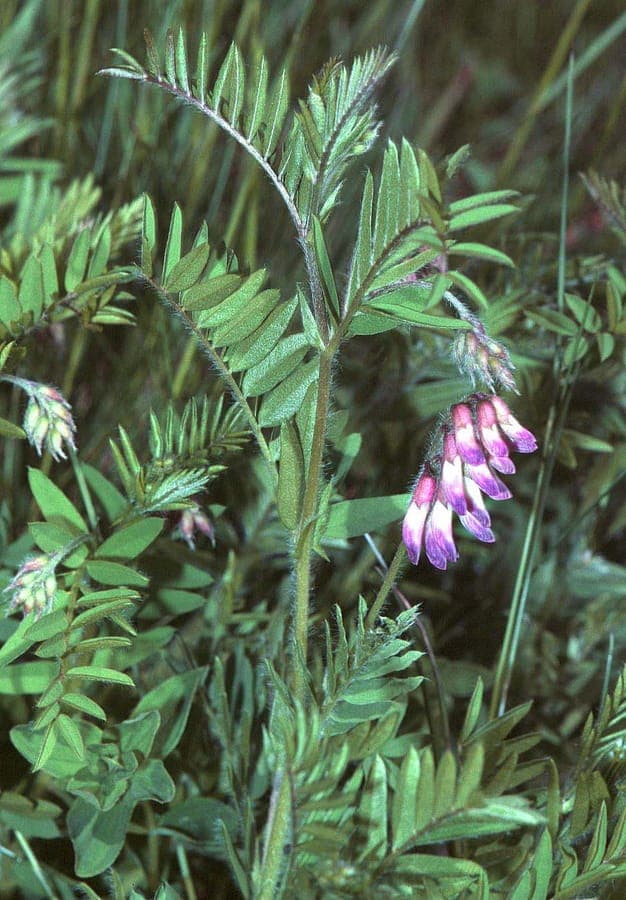
Wikimedia Commons / CC BY-SA 3.0, via Wikimedia Commons
Wood Bitter Vetch: complete guide
Vicia orobus
Want to see Wood Bitter Vetch: complete guide in your garden?
Full design in HD: €7.99
Look after your Wood Bitter Vetch with the GardenWorld app
Identify plants with your camera and get a care calendar with reminders for this plant.


Overview
Wood Bitter Vetch (Vicia orobus) is an elegant plant from the Fabaceae family (legumes), native to Northwestern and Western Europe. This climbing or semi-upright plant is known for its delicate, small white flowers and finely textured foliage. Wood Bitter Vetch is particularly suitable for rock gardens, borders, and wildflower meadows in temperate climates.
Appearance and Bloom
Wood Bitter Vetch reaches approximately 30-50 centimeters in height and forms a lightly spreading, climbing plant form. The leaves are compound, with many small, elliptic leaflets giving fine detail to the plant. The flowers are small, approximately 0.8-1 centimeter, white to pinkish-tinted, appearing in loose clusters. The flowering period extends from May through July, making this plant ideal for summer flora.
Ideal Location
Wood Bitter Vetch grows best in full sun to partial shade. The plant needs at least four to six hours of direct sunlight for optimal growth and blooming. Partial shade can benefit the plant in very warm climates. The plant thrives also in lighter shaded environments but will produce fewer flowers.
Soil
Wood Bitter Vetch prefers well-draining, neutral to slightly acidic soil. The plant grows best on moderately fertile soil with pH 5.0-5.5. Heavier, acidic soils work well for this plant. Add well-rotted compost at planting time. As a legume, this plant is self-nitrogen fixing.
Free preview
Want to see Wood Bitter Vetch: complete guide in your garden? Make a free preview of your design.
Watering
After planting, water the plant regularly until well established. Adult plants are fairly drought-tolerant and need water mainly during sustained dry periods. Excessive watering must be avoided, especially in winter. Water at the base of the plant.
Pruning
Wood Bitter Vetch requires minimal pruning. After blooming, spent flower clusters can be removed. In spring, thin or damaged twigs can be removed. Heavy pruning is not needed.
Maintenance Calendar
Spring: Check for winter damage. Summer: Water during dry periods. Autumn: Remove spent flower parts. Winter: Minimal maintenance in mild climates.
Winter Hardiness
Wood Bitter Vetch is hardy to about -15 degrees Celsius. In warmer climates, the plant may die back partially in winter and regrow in spring. In very cold regions, protection with mulch may be beneficial.
Companion Plants
Wood Bitter Vetch grows beautifully with other heath-like plants and alpine flora. Combinations with Erica, Calluna, and ornamental grasses work well. In wildflower borders, the plant fits nicely in schemes with other legumes.
Closing Remarks
Wood Bitter Vetch is an elegant plant for gardeners who appreciate natural character. The fine foliage and delicate flowers make it a special addition to any garden. Available at garden centers online at gardenworld.app/en and gardenworld.app/nl.
Frequently asked questions about Wood Bitter Vetch
Is Wood Bitter Vetch winter hardy?
Wood Bitter Vetch is hardy to about -15 degrees Celsius. In warmer climates, the plant may die back partially in winter and regrow in spring.
When and how do you prune Wood Bitter Vetch?
Wood Bitter Vetch requires minimal pruning. After blooming, spent flower clusters can be removed.
How much water does Wood Bitter Vetch need?
After planting, water the plant regularly until well established. Adult plants are fairly drought-tolerant and need water mainly during sustained dry periods.
Where does Wood Bitter Vetch grow best?
Wood Bitter Vetch grows best in full sun to partial shade. The plant needs at least four to six hours of direct sunlight for optimal growth and blooming.
What soil does Wood Bitter Vetch need?
Wood Bitter Vetch prefers well-draining, neutral to slightly acidic soil. The plant grows best on moderately fertile soil with pH 5.0-5.5.

See it in your garden
See Wood Bitter Vetch in your garden
One photo of your garden and a few questions. You see the result in about a minute.
Try it with a photoIdentify this plant in your own garden. Identify a plant
Similar plants
Pineapple broom (Argyrocytisus battandieri): complete guide
Argyrocytisus battandieri
Everything about pineapple broom (Argyrocytisus battandieri), the Moroccan wall shrub with silver leaves and pineapple-scented flowers: site, pruning and hardiness.
Blue false indigo: complete guide
Baptisia australis
Everything about blue false indigo (Baptisia australis): position, soil, watering, cutting back, hardiness and toxicity. A long-lived prairie perennial with indigo flowers.
Warminster broom (Cytisus × praecox): complete guide
Cytisus × praecox
Everything about Warminster broom (Cytisus × praecox): position, poor soil, pruning after flowering, hardiness and what you need to know about its toxicity.
