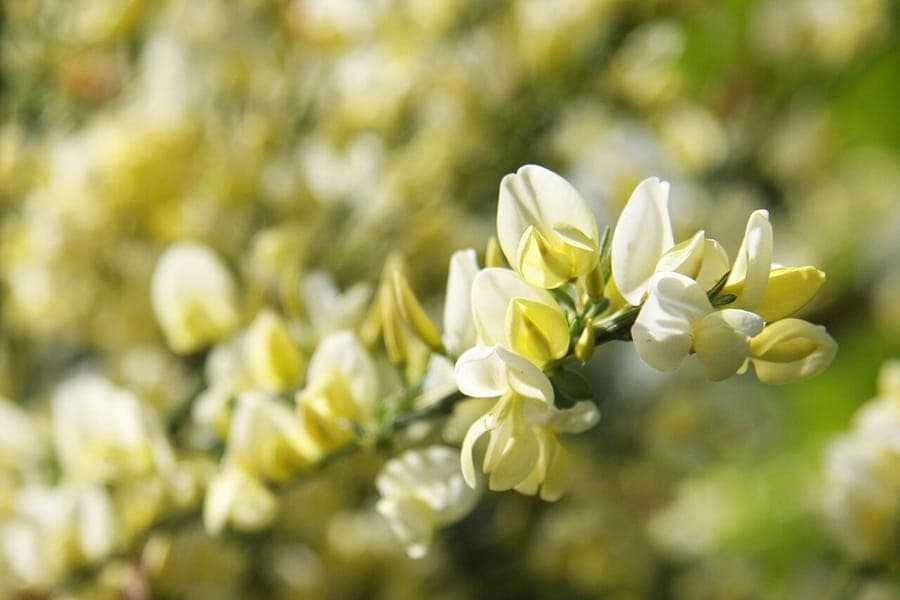
Maja Dumat from Deutschland (Germany) / CC BY 2.0, via Wikimedia Commons
Warminster broom (Cytisus × praecox): complete guide
Cytisus × praecox
Want to see Warminster broom (Cytisus × praecox): complete guide in your garden?
Full design in HD: €7.99
Look after your Warminster broom with the GardenWorld app
Identify plants with your camera and get a care calendar with reminders for this plant.


Overview
Warminster broom, Cytisus × praecox, is one of the most widely planted brooms in European gardens, and for good reason. For a few weeks in spring it turns into a dome of creamy yellow pea flowers so dense that the green stems almost disappear. The hybrid arose around 1867 at the nursery of the Wheeler family in Warminster, Wiltshire, from a cross between two southern European species: the white Spanish broom Cytisus multiflorus and Cytisus purgans (now often called Cytisus oromediterraneus), a yellow mountain broom from Spain and southern France.
The result is a compact, generously flowering shrub that reaches 1 to 1.5 m in height and spread. It grows quickly, asks for very little and suits sunny, dry gardens perfectly. The trade-off is a short life: after ten to fifteen years most plants become woody and bare at the base, and replacing them is usually the best option. The most popular cultivars are 'Allgold', with rich golden flowers, and 'Albus', with pure white ones. If you are wondering where a broom would look best in your own plot, gardenworld.app can draw up a garden design that takes sun, soil and your existing plants into account.
One point to keep in mind from the start: like all brooms, Cytisus × praecox is poisonous. There is a dedicated section on this further down.
Appearance and bloom cycle
Outside the flowering season this broom is mostly a plant of slender green stems. The thin, ridged shoots grow densely and arch outwards, giving the bush a loose, rounded outline. Leaves are sparse: small, narrow, simple or three-parted, barely 1 to 2 cm long, and many drop by early summer.
Flowering starts in late April and continues into mid May, sometimes earlier after a mild spring. The individual pea flowers are only about 1 cm long and sit singly or in pairs along the shoots, but there are so many of them that the whole plant is smothered. In the species they are cream to sulphur yellow, in 'Allgold' a warm gold and in 'Albus' white. The flowers give off a heavy, sweetish scent that some people find rather cloying, so avoid planting it right beside a seating area or bedroom window.
After flowering, small hairy pods develop. They ripen brown in summer and split open to release the seeds.
Ideal location
Broom is a true sun lover. Give Cytisus × praecox at least six hours of direct sunlight a day, and ideally more. In partial shade it becomes thin and lanky and flowers far less. It copes extremely well with wind, including salt-laden coastal wind, which makes it a good choice for exposed gardens and seaside plots.
Thanks to its rounded habit and modest size it fits into a mixed border, onto a sunny bank, into a gravel garden or as a loose group along a drive. Planting 80 to 100 cm apart gives a closed group within two or three years. Brooms resent being moved, so choose the final position from the outset.
Soil requirements
The secret of a healthy broom is poor, well-drained soil. Sandy, gravelly or stony ground is ideal. Rich, fertile soil produces long, soft shoots that flop open and carry fewer flowers. Waterlogged roots in winter are fatal, so on heavy clay either build a raised bed or work plenty of coarse sand and fine gravel into the top layer.
Slightly acidic to neutral soil suits it best. It tolerates a little lime better than some other brooms, but on very chalky ground it tends to struggle and the stems turn yellowish. There is no need to feed: like all members of the pea family, broom lives in partnership with bacteria in root nodules that fix nitrogen from the air. A spadeful of compost in the planting hole is plenty; after that, leave the soil alone.
Always plant young, pot-grown specimens, ideally in spring or early autumn. Large, older plants establish poorly because broom forms a deep and sensitive taproot.
Watering
Once established, this broom almost never needs extra water. It is built for dry summers, and its green stems lose very little moisture. In the first year after planting, however, water regularly: during dry spells give a generous can of 8 to 10 litres once a week so the roots grow down deeply.
From the second year onwards, water only during long droughts of three weeks or more, and then mainly young plants and those in containers. Overwatering, especially on heavy soil, leads to root rot. Container plants need closer attention: in summer check every few days whether the top few centimetres are dry, and never leave water standing in a saucer.
Free preview
Want to see Warminster broom (Cytisus × praecox): complete guide in your garden? Make a free preview of your design.
Pruning
Pruning decides how long this broom stays attractive. Left alone, it soon becomes an open shrub with bare, woody legs and flowers only at the tips. The rule is simple: prune straight after flowering, in late May or early June, cutting the flowered shoots back by up to two thirds, always just above a green side shoot.
Never cut into old, brown wood. Broom rarely reshoots from it, and hard pruning can kill the plant. If a shrub is already leggy and bare, replacing it is usually wiser than trying to rejuvenate it. Avoid pruning in autumn or early spring as well, because the flower buds for next year are formed during summer. Wear gloves and clear up the clippings, particularly if children or animals use the garden.
Toxicity
All parts of Cytisus × praecox contain quinolizidine alkaloids such as cytisine and sparteine, with the highest levels in the seeds and pods. Eating them can cause nausea, vomiting, abdominal pain, sweating and a racing heartbeat, and larger amounts are more serious. Broom is also poisonous to dogs, cats, rabbits, guinea pigs and horses.
Poisoning is uncommon in practice because the plant tastes bitter, but the risk is real for young children who open the pods and for pets that chew on twigs. Pruning after flowering keeps pod formation to a minimum, and clippings should never go into a rabbit run or paddock. If you suspect a child or animal has eaten part of the plant, contact your doctor, NHS 111 or your vet straight away.
Maintenance calendar
March: Plant new brooms from containers. Check that the soil around existing plants drains well.
April–May: Full bloom. Water young plants during prolonged dry spells.
Late May–June: Prune immediately after flowering, cutting the flowered shoots back by up to two thirds and never into old wood.
July–August: Water only young plants and containers during long droughts. Remove any pods that have formed.
September–October: Another good window for planting, so the roots can settle before winter.
November–February: Rest period. Make sure water does not collect around the base, and protect containers from hard frost.
For a month-by-month overview of jobs in your whole garden, the planting calendar on gardenworld.app reminds you when your broom is due for its trim.
Winter hardiness
Cytisus × praecox is fully hardy in most of the UK and north-western Europe, coping with frosts down to about -15 to -20 °C as long as the soil stays reasonably dry. What kills broom is rarely cold alone; it is the combination of wet ground and frost. In a well-drained spot it needs no winter protection in a normal year.
Container plants are more vulnerable because the root ball freezes more quickly. In severe winters move the pot against a sheltered wall, raise it on pot feet and wrap it in hessian or bubble wrap. Any frost-damaged shoot tips can simply be cut away when you prune after flowering.
Companion plants
Broom pairs naturally with other plants that enjoy sun and dry soil. Lavender (Lavandula angustifolia) takes over once the broom has finished and keeps a border in flower into August. Rock roses (Helianthemum nummularium) make a low, colourful edging at its feet, and Euphorbia characias, with its blue-grey foliage and lime-green flower heads, provides a bold contrast to the fine broom stems.
For a yellow spring scheme, combine it with the low-growing Genista lydia. Underneath, grape hyacinths (Muscari armeniacum) flower at the same time and look striking against the yellow. Keep moisture-loving plants such as hydrangeas well away, since their needs are the opposite of broom's.
Final thoughts
Warminster broom is a rewarding shrub for a sunny, dry garden: fast-growing, rarely troubled by pests and lavishly in flower every spring. Give it poor soil, full sun and a trim straight after flowering and it will stay compact for years. Bear its toxicity in mind if young children or pets share the garden, and expect a lifespan of around ten to fifteen years. Accept those limits and you gain one of the most cheerful spring shrubs there is.
Frequently asked questions about Warminster broom
Is Warminster broom winter hardy?
Cytisus × praecox is fully hardy in most of the UK and north-western Europe, coping with frosts down to about -15 to -20 °C as long as the soil stays reasonably dry. What kills broom is rarely cold alone; it is the combination of wet ground and frost.
When and how do you prune Warminster broom?
Pruning decides how long this broom stays attractive. Left alone, it soon becomes an open shrub with bare, woody legs and flowers only at the tips.
How much water does Warminster broom need?
Once established, this broom almost never needs extra water. It is built for dry summers, and its green stems lose very little moisture.
Where does Warminster broom grow best?
Broom is a true sun lover. Give Cytisus × praecox at least six hours of direct sunlight a day, and ideally more.
What soil does Warminster broom need?
The secret of a healthy broom is poor, well-drained soil. Sandy, gravelly or stony ground is ideal.

See it in your garden
See Warminster broom in your garden
One photo of your garden and a few questions. You see the result in about a minute.
Try it with a photoIdentify this plant in your own garden. Identify a plant
Similar plants
English Lavender: complete guide
Lavandula angustifolia
Everything about English Lavender (Lavandula angustifolia): planting, pruning, care and overwintering. Practical tips for lush purple blooms.
Lydia broom: complete guide
Genista lydia Boiss.
Discover this compact shrub with cascading yellow flowers in May-June. Ideal for alpine gardens, rock walls, and dry soils. Outstanding drought tolerance and easy care.
Mediterranean spurge: complete guide
Euphorbia characias
Everything you need to know about Euphorbia characias: care, blooming cycle, ideal placement, and companion plants for dry gardens.
