
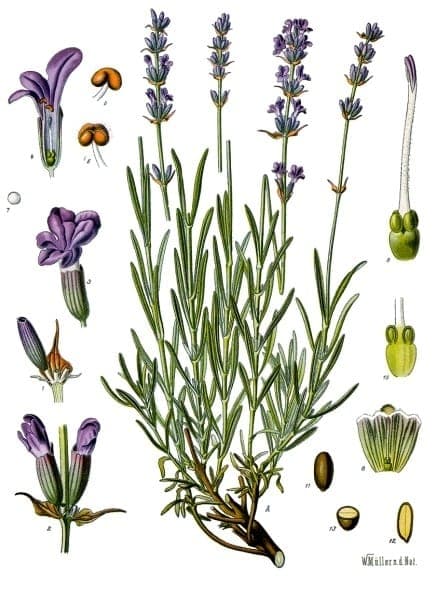
Franz Eugen Köhler, Köhler's Medizinal-Pflanzen / Public domain, via Wikimedia Commons
English Lavender: complete guide
Lavandula angustifolia
Want to see English Lavender: complete guide in your garden?
1 minute, no credit card
Overview
English Lavender (Lavandula angustifolia) is, without question, one of the most beloved garden plants across Europe and beyond. This aromatic sub-shrub from the Mediterranean basin has won the hearts of gardeners from Portugal to Scandinavia over the course of centuries. With its signature purple flower spikes, silvery-grey foliage, and enchanting fragrance, lavender brings a touch of Provence to any garden, whether it sits in the south of France or the north of England.
True English Lavender (Lavandula angustifolia) distinguishes itself from other lavender species through its compact growth habit, superior winter hardiness, and the most refined fragrance. On gardenworld.app you can create a garden design where lavender takes centre stage - along a path, as a low hedge, or combined with roses and ornamental grasses. The plant reaches 30–60 cm in height and 40–50 cm in width, depending on the cultivar. Popular varieties include 'Hidcote' (deep purple, compact), 'Munstead' (early-flowering, lavender-blue), and 'Alba' (white).
Appearance and bloom cycle
Lavender flowers from June to August, producing slender, densely packed flower spikes that rise 5–10 cm above the foliage. Individual florets are only 5–8 mm across, but together they form impressive clusters that blanket the entire plant. Flower colour ranges from pale lilac to deep purple, with white and pink variants available. The leaves are narrow, lance-shaped, 2–4 cm long, and silvery-grey to grey-green, covered in fine hairs that reduce moisture loss.
The plant has a compact, dome-shaped growth habit and forms a woody base from which fresh shoots emerge each year. After flowering, the stems turn brown and can be dried for potpourri, sachets, or culinary use. The fragrance of lavender is complex: herbal, sweet, with camphoraceous undertones. This scent attracts bees, bumblebees, and butterflies while repelling mosquitoes and moths - a double benefit that few garden plants can match.
Ideal location
Lavender is a confirmed sun-worshipper. Plant it in the warmest, sunniest spot in your garden - a minimum of six hours of direct sun per day is essential for good flowering and strong fragrance. A south-facing border, a heat-reflecting wall, or a raised bed are ideal locations. Lavender tolerates wind well and even appreciates an airy position, because good air circulation prevents fungal disease.
Avoid shady spots and locations where rainwater collects. Lavender originates from dry, rocky slopes around the Mediterranean and requires the same conditions in your garden. An overly sheltered, damp position is the fastest route to losing your lavender. For a lavender hedge along a garden path, a spacing of 30–40 cm is ideal; for a border planting, allow 40–50 cm between plants.
Soil requirements
Soil is perhaps the single most critical factor for success with lavender. The plant demands well-drained, lean soil. In heavy clay that stays wet through winter, lavender almost invariably dies. If your soil is heavy, work a generous quantity of coarse grit or sharp sand (20–30% by volume) into the top 30 cm. In sandy soil, lavender feels right at home.
The ideal soil pH ranges from 6.5 to 8.0 - lavender favours slightly alkaline conditions. If your soil is too acidic, add garden lime at 100–200 g per square metre. Do not add compost or manure: overly rich soil produces excessive foliage at the expense of flowers, and a softer plant that is more vulnerable to frost. Most garden centres stock Mediterranean-style compost that works well as a planting amendment for lavender.
Watering
Lavender is a champion of drought tolerance and needs virtually no supplementary water after its first growing season. During the first year after planting, water weekly - approximately 5 litres per plant - to help the root system establish. Water only when the top 5 cm of soil feels dry to the touch. Overwatering is by far the most common cause of death in lavender plants.
From the second year onward, additional watering is only necessary during extreme drought exceeding three weeks. In winter, lavender must remain dry - soggy roots combined with cold are lethal. Always water at the base, never over the foliage. Container-grown lavender requires more frequent attention: check every three to four days and allow the soil to dry out thoroughly between waterings. Ensure pots have generous drainage holes.
Free design
Want to see English Lavender: complete guide in your garden? Make a free design now.
Pruning
Correct pruning is the secret to a long-lived, compact lavender plant. Without pruning, stems become woody, the plant opens up in the centre, and the attractive dome shape is lost. Prune twice a year: the first time immediately after flowering in August–September, and the second time lightly in April.
The late-summer prune (the more important of the two) involves cutting away the spent flower stems plus one-third of the current season's green growth. Never cut into old, brown wood - no new shoots will emerge from it and the plant may die. In April, give a light shaping cut: remove any frost damage and restore the dome form. A useful rule of thumb: prune the plant into a firm green mound at roughly two-thirds of its final height. Quality hedge shears, ideal for lavender, are available at most garden centres.
Maintenance calendar
March–April: Remove frost damage and dead twigs. Give a light shaping cut. Optionally spread a thin layer of gravel or shell mulch around the plants to improve drainage and reflect warmth.
May: The plant begins to flush with new growth. Check that drainage is adequate - clear any accumulated organic debris from around the stem base.
June–July: Peak flowering. Harvest blooms for drying when roughly half the florets on each spike have opened - this is when essential oil content is highest.
August–September: Main prune immediately after flowering. Cut the plant back to a compact dome. Avoid feeding after July.
October–November: Plant new lavender so it can root before winter. Ensure good drainage around established plants.
December–February: Dormancy. In prolonged frost below -10°C, consider covering with horticultural fleece or a layer of pine branches.
Winter hardiness
Lavandula angustifolia is the hardiest lavender species, surviving temperatures down to approximately -15°C to -20°C (USDA zones 5–9). True English Lavender is considerably tougher than Lavandula stoechas (French lavender) or Lavandula x intermedia (lavandin), both of which are more susceptible to severe frost.
Yet it is not cold but wetness that poses the greatest winter threat to lavender. In well-drained soil, lavender plants overwinter without difficulty across most of the UK and temperate Europe. In heavy clay or in pots sitting in the rain, the risk of winter loss is far higher. Protect container plants by placing them under an overhang or insulating the pot with bubble wrap. In severe winters (below -15°C), cover plants with a layer of straw or horticultural fleece.
Companion plants
Lavender is the ultimate companion plant and pairs beautifully with countless other species. The classic combination is lavender with roses - Rugosa Roses (Rosa rugosa) or shrub roses together with lavender create the quintessential romantic garden scene. The purple lavender and pink roses enhance each other's colours magnificently.
Other excellent partners include ornamental grasses (Stipa tenuissima, Festuca glauca), catmint (Nepeta), sage (Salvia nemorosa), yarrow (Achillea), and box (Buxus sempervirens) for structure. For a Mediterranean garden, combine lavender with rosemary, thyme, and santolina. Butterfly Bush (Buddleja davidii) works well as a taller backdrop behind a lavender border. Avoid combining lavender with moisture-loving, heavy-feeding plants such as hydrangeas - their needs are diametrically opposed to those of lavender.
Final thoughts
Lavender is a plant that repays you many times over: it delivers fragrance, colour, pollinators, and culinary potential for a minimal investment of care. The secret to success is straightforward: full sun, dry feet, and an annual trim. Follow these three ground rules and you will enjoy a lush purple carpet for years to come.
Purchase your lavender from a reputable garden centre - check the label to confirm it is Lavandula angustifolia rather than one of the less hardy species. On gardenworld.app you can create a garden design that combines lavender with the right partners for your specific garden, taking into account your soil type and sun exposure. Plant a row of lavender along your garden path this spring and let its fragrance surprise you with every stroll.
Want to see English Lavender: complete guide in your garden? Make a free design now.
Upload a photo, pick a style, and get a photorealistic design with plant list in under a minute.
No credit card required


Similar plants
Rugosa Rose: complete guide
Rosa rugosa
Everything about the Rugosa Rose (Rosa rugosa): planting, pruning, care and winter hardiness. Practical tips for abundant blooms in your garden.
Bigleaf Hydrangea: complete guide
Hydrangea macrophylla
Everything about the Bigleaf Hydrangea (Hydrangea macrophylla): planting, pruning, flower colour control and winter protection. Practical tips for lush blooms.
Butterfly Bush: complete guide
Buddleja davidii
Everything about the Butterfly Bush (Buddleja davidii): planting, pruning, care and attracting butterflies. Practical tips for a blooming butterfly garden.