
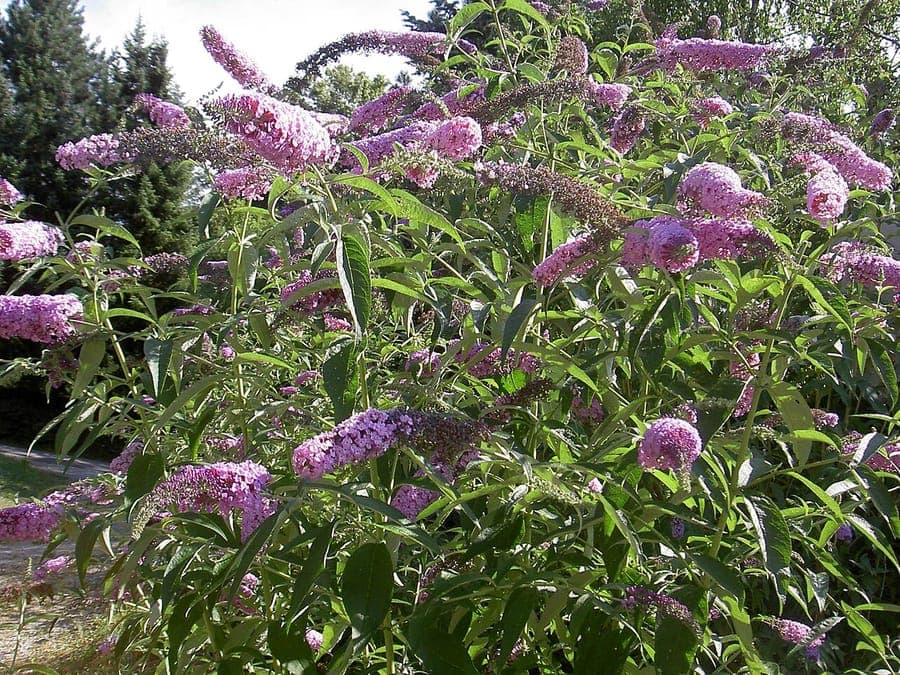
--IKAl 15:22, 23 July 2007 (UTC) / CC BY-SA 2.5, via Wikimedia Commons
Butterfly Bush: complete guide
Buddleja davidii
Want to see Butterfly Bush: complete guide in your garden?
1 minute, no credit card
Overview
The Butterfly Bush (Buddleja davidii) is the undisputed champion when it comes to attracting butterflies to the garden. No other garden plant can rival the magnetic pull this shrub exerts on butterflies, moths, bees, and bumblebees. Originally from the mountain regions of central China, the Butterfly Bush has naturalised across much of Europe during the twentieth century and established itself as a firm favourite in gardens from Lisbon to Stockholm.
The plant honours the French missionary and plant collector Pere Armand David, who gathered the type specimen in China in 1869. On gardenworld.app you can create a garden design that combines the Butterfly Bush with other nectar plants for an optimal butterfly garden. Buddleja davidii grows quickly - up to 2–3 metres per year - and reaches an ultimate height of 200–300 cm. With its long, elegant flower panicles in purple, white, pink, or blue and its unrivalled value for pollinators, this is a must-have for any wildlife-friendly garden.
Appearance and bloom cycle
The Butterfly Bush flowers from July to October, producing 20–40 cm long, cone-shaped flower panicles at the tips of the current season's growth. Each panicle consists of hundreds of small, tubular florets that are exceptionally rich in nectar. The most common colour is lilac-purple, but breeding has produced cultivars in virtually every shade: from pure white ('White Profusion') through pink ('Pink Delight') and deep purple ('Black Knight') to blue-violet ('Empire Blue') and even bicoloured forms.
The leaves are lance-shaped, 10–25 cm long, dark green on the upper surface and grey-white felted underneath. When touched, the foliage releases a faint, spicy fragrance. Stems are square in cross-section - a characteristic of the figwort family. The bark is grey-brown and peels attractively on older branches. In autumn the leaves turn yellow before dropping late in the season. Even in winter, the plant retains an open, elegant structure.
Ideal location
The Butterfly Bush is a true sun-lover that flowers most abundantly and attracts the most butterflies in a warm, sunny position. Choose a spot with at least six hours of direct sun per day. A south-west-facing border, a sunny wall, or a specimen position in an open part of the garden are ideal locations. The plant tolerates light partial shade but flowers less profusely.
Buddleja davidii is exceptionally wind-tolerant and thrives even in urban settings along busy roads, on waste ground, and in cracks in walls - proof of its extreme adaptability. Space the shrub 150–200 cm from neighbours or other large plants, as it can grow substantially. For an informal hedge, a spacing of 120 cm is sufficient.
Soil requirements
The Butterfly Bush is one of the least demanding garden plants when it comes to soil quality. It grows in virtually any ground: clay, sand, loam, chalky or slightly acidic. The only absolute requirement is good drainage - the plant does not tolerate prolonged waterlogging. The ideal soil pH ranges from 6.0 to 7.5, though the plant tolerates a broad range from 5.5 to 8.5.
When planting, dig a hole twice as wide as the root ball and equally deep. Mix the excavated soil with a spadeful of compost for a good start, but avoid excessive feeding - overly rich soil produces abundant foliage at the expense of flowers. On heavy clay, place a layer of gravel or broken rubble at the base of the planting hole for extra drainage. Firm the soil well and water immediately with 10 litres.
Watering
Once established, the Butterfly Bush is remarkably drought-tolerant - it survives extended rainless periods thanks to its deep root system. During the first year after planting, regular watering is important: provide 10 litres per plant weekly in dry weather. From the second year onward, supplementary watering is only needed during prolonged drought exceeding three weeks.
The plant gives clear signals of water stress: leaves droop limply, especially on hot afternoons. This is usually temporary and recovers by evening. If leaves are still limp in the morning, it is genuinely time to water. Water at the base of the plant. Container-grown Buddleja needs more frequent attention - check every two to three days and water thoroughly until it runs from the drainage holes.
Free design
Want to see Butterfly Bush: complete guide in your garden? Make a free design now.
Pruning
Pruning is the single most important maintenance task for a Butterfly Bush. Without annual pruning, the plant quickly becomes a bare, woody shrub with flowers only at the tips of tall branches. The Butterfly Bush flowers exclusively on the current season's new wood, which means you can prune hard without losing any blooms.
Prune each year in March - once the worst frost has passed but before new foliage emerges. Cut all branches back to 30–60 cm above ground level, just above a pair of healthy buds. This looks drastic, but the plant regrows to full height in a single season. After several years, you can optionally remove a few of the oldest, thickest stems entirely at the base to encourage renewal. Sturdy loppers suitable for the thick wood of a Butterfly Bush are available at most garden centres.
Maintenance calendar
March: Annual hard prune. Cut all branches back to 30–60 cm. Remove dead wood completely. Apply a light feed with a general-purpose garden fertiliser.
April–May: New shoots grow rapidly - up to 2 cm per day in warm weather. Check for aphids on the soft shoot tips. Apply a 5 cm mulch layer.
June: The first flower buds appear. Provide extra water during dry spells to support flower formation.
July–September: Peak flowering. Remove spent flower panicles regularly to encourage further blooming - cut the faded panicle back to the first leaf pair below. This significantly extends the flowering season.
October–November: The last flowers appear. Stop supplementary watering. The plant prepares for winter.
December–February: Dormancy. The Butterfly Bush is deciduous and has an open, twiggy appearance during this period. No action needed.
Winter hardiness
Buddleja davidii is reliably winter-hardy across most of temperate Europe, surviving temperatures down to approximately -15°C to -20°C (USDA zones 6–9). The above-ground parts may partially or fully die back in severe frost, but the plant re-sprouts from the base in spring - even after a harsh winter. This explains why the annual spring prune is so important: you prune close to the ground anyway, so any frost damage is automatically removed.
For extra protection during severe frost, apply a thick layer of mulch (10–15 cm of straw, leaves, or wood chips) around the base of the plant. This protects the root crown from which new shoots emerge. Young plants (first winter) are more vulnerable than established specimens - consider extra protection with horticultural fleece for them.
Companion plants
The Butterfly Bush combines beautifully with other sunny border plants. For a complete butterfly border, plant Buddleja alongside English Lavender (Lavandula angustifolia), which flowers in the same period and also attracts butterflies. The combination of purple Butterfly Bush with lilac lavender and pink Rugosa Roses (Rosa rugosa) in the foreground is a classic.
Other excellent partners include ornamental grasses (Miscanthus, Pennisetum), perennials such as Echinacea, Rudbeckia, Sedum, and Verbena bonariensis, and herbs like oregano and marjoram that attract bees. Box (Buxus sempervirens) can provide low structural hedging around a Butterfly Bush border. Avoid large shade-casting plants directly next to the Butterfly Bush - it needs every ray of sunshine it can get.
Final thoughts
The Butterfly Bush is a plant that brings magic to your garden. On a warm summer day, you can watch dozens of butterflies foraging simultaneously on a single shrub - red admirals, peacock butterflies, painted ladies, and brimstones all owe their nectar meals to this generous plant. With minimal maintenance and spectacular blooming from July to October, Buddleja davidii is the perfect choice for anyone who wants colour and life in the garden.
Purchase your Butterfly Bush from a reputable garden centre - choose a compact cultivar if space is limited, such as 'Buzz' (80–100 cm) or 'Nanho Blue' (150 cm). On gardenworld.app you can create a garden design that includes a complete butterfly border, with the right combination of nectar plants and host plants for a garden buzzing with life.
Want to see Butterfly Bush: complete guide in your garden? Make a free design now.
Upload a photo, pick a style, and get a photorealistic design with plant list in under a minute.
No credit card required


Similar plants
Rugosa Rose: complete guide
Rosa rugosa
Everything about the Rugosa Rose (Rosa rugosa): planting, pruning, care and winter hardiness. Practical tips for abundant blooms in your garden.
English Lavender: complete guide
Lavandula angustifolia
Everything about English Lavender (Lavandula angustifolia): planting, pruning, care and overwintering. Practical tips for lush purple blooms.
Common Boxwood: complete guide
Buxus sempervirens
Everything about Common Boxwood (Buxus sempervirens): planting, pruning, topiary and box moth control. Practical tips for healthy, green hedges and shapes.