
No machine-readable author provided. MPF assumed (based on copyright claims). / CC BY 2.5, via Wikimedia Commons
Common Boxwood: complete guide
Buxus sempervirens
Want to see Common Boxwood: complete guide in your garden?
1 minute, no credit card
Overview
Common Boxwood (Buxus sempervirens) has reigned as the undisputed king of formal garden architecture for centuries. From the geometric parterres of Versailles to the modest front gardens of English villages, boxwood forms the green skeleton of gardens worldwide. This evergreen shrub with its dense, fine-leaved growth lends itself to clipped hedges, balls, cones, pyramids, and even figurative topiary like no other plant.
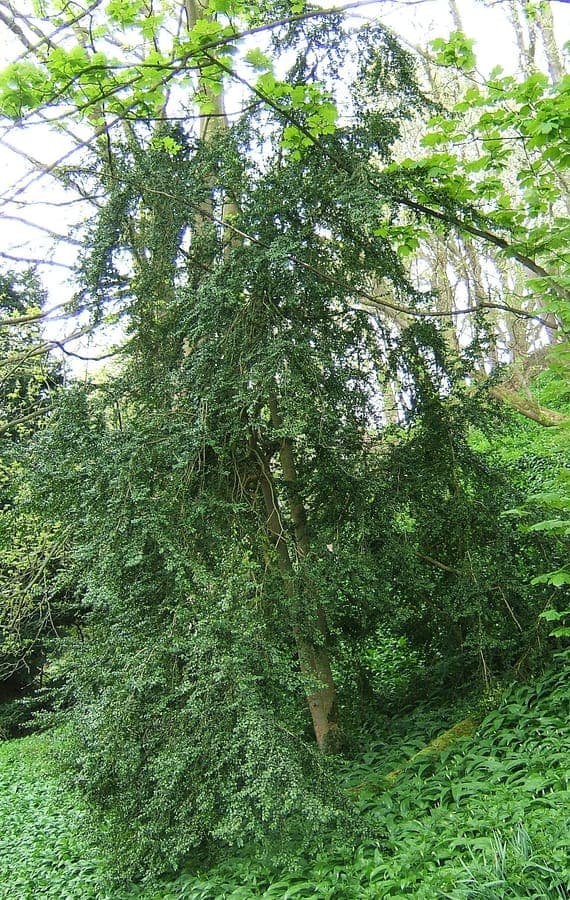
Buxus sempervirens is native to southern Europe, the Mediterranean basin, North Africa, and western Asia. In the wild it can grow into a small tree of 10–12 metres, but in the garden it is kept compact through pruning at 30–200 cm depending on its purpose. On gardenworld.app you can create a garden design where boxwood forms the structural backbone - as a low border edging, as a ball-shaped accent, or as a formal hedge that stays green year-round. After years of concern over box moth and box blight, there is good news: with proper prevention and care, boxwood remains an excellent garden plant.
Appearance and bloom cycle
Boxwood is an evergreen shrub with small, oval, leathery leaves measuring 1.5–3 cm in length. The foliage is glossy dark green on the upper surface and lighter green underneath. The leaves sit closely together along the branches, giving the plant its characteristic dense, compact appearance. New shoots are bright green and contrast attractively with the older, darker foliage.
In April–May, small, inconspicuous yellow-green flowers appear that emit a strong, sweet honey fragrance. The flowers are not particularly ornamental but serve as an important early nectar source for bees. After flowering, small three-lobed seed capsules develop. The bark is pale grey and develops attractive fissures on older specimens. Boxwood grows slowly - 5–15 cm per year - meaning a boxwood hedge needs little trimming to maintain its shape, but also requires patience to establish.
Ideal location
Boxwood is remarkably flexible regarding position and grows equally well in full sun and deep shade. This makes boxwood unique among hedging plants - most alternatives perform poorly in shade. The ideal location is partial shade or a spot with morning sun and afternoon shade, but the plant adapts to almost any light situation.
Boxwood is not fussy about wind, though extreme exposure to cold, dry winter winds can cause leaf scorch. A somewhat sheltered location is therefore ideal. For a low hedge, space plants 15–20 cm apart; for a medium hedge, 25–30 cm; and as a specimen ball or cone, allow at least 50 cm from other plants. Boxwood also performs excellently in pots and planters on patios and balconies.
Soil requirements
Boxwood grows in virtually any soil type, from heavy clay to light sand, provided drainage is reasonable. The plant tolerates chalky soil particularly well - in fact, boxwood performs best on slightly alkaline ground with a pH of 6.5–8.0. On very acidic soil (pH below 5.5), boxwood grows less vigorously; add garden lime in that case.
When planting, dig a trench (for a hedge) or individual hole (for a specimen) slightly larger than the root ball. Mix the excavated soil with a spadeful of compost. Set plants at the same depth they sat in their pots and firm well. Water immediately and apply a 3–5 cm mulch layer. For a hedge of small plants (10–15 cm), set 6–8 plants per linear metre. Most garden centres stock boxwood in various sizes from small plugs to mature specimens.
Watering
Boxwood is reasonably drought-tolerant once established but performs best with consistent moisture. During the first year after planting, weekly watering is essential - provide 5–10 litres per linear metre of hedge or per specimen plant. Pay particular attention in summer: boxwood has shallow roots that dry out quickly in heat.
From the second year onward, supplementary watering is needed during dry spells exceeding two weeks. An important point: container-grown boxwood dries out far faster than specimens in the ground. Check container boxwood daily in summer and weekly in winter - yes, even in winter, evergreen boxwood occasionally needs water because it transpires through its leaves year-round. Always water at the base, never over the foliage.
Free design
Want to see Common Boxwood: complete guide in your garden? Make a free design now.
Pruning
Pruning is what boxwood was made for. The plant tolerates repeated clipping superbly and responds with even denser growth. The best time for the main trim is June, after the first flush of growth. A second, lighter trim can take place in September for a crisp winter silhouette.
For formal hedges and shapes, use hand shears or a light electric hedge trimmer. Clip in overcast weather or in the evening to prevent leaf scorch - freshly cut leaves are sensitive to strong sun. Clip boxwood balls from top to bottom and use a template or string guide for a perfect shape. For a new hedge, trim only the sides in the first few years to encourage branching; once the desired height is reached, begin trimming the top as well. Quality shears designed specifically for boxwood are available at most garden centres.
Maintenance calendar
March–April: Check for box moth (Cydalima perspectalis) - look for webbing and green caterpillars. Feed with an organic fertiliser or specialist box feed. Apply fresh mulch.
May: Begin box moth prevention: hang pheromone traps and inspect plants weekly. Check for box blight (Cylindrocladium): brown leaf spots and defoliation.
June: Main trim. Clip hedges and shapes in overcast weather. Remove clippings thoroughly - do not leave them under the plant.
July–August: Second generation of box moth is active. Treat caterpillars with a biological control (Bacillus thuringiensis) or XenTari. Provide extra water in dry weather.
September: Second light trim for a crisp winter outline. Final check for box moth (third generation in warm years).
October–November: Apply a potassium-rich feed to promote winter hardiness. Remove fallen leaves from under the plants to reduce disease pressure.
December–February: Dormancy. Check container plants for moisture - water occasionally during dry frost periods.
Winter hardiness
Buxus sempervirens is fully winter-hardy, surviving temperatures down to -20°C to -25°C (USDA zones 5–8). The plant is evergreen and retains its foliage year-round, making it indispensable for winter structure in the garden. In extreme cold (below -15°C) combined with dry winter wind, leaf scorch can occur - the foliage takes on bronze or brown tones. This is cosmetic and usually recovers in spring when new leaves emerge.
Protection against winter damage is seldom necessary in the UK or most of temperate Europe. During prolonged severe frost, protect container plants by insulating the pot with bubble wrap or placing the plant against a sheltered wall. Provide evergreen boxwood with occasional water even in winter during dry spells - desiccation is a greater threat than frost itself.
Companion plants
Boxwood is the ultimate structural plant and pairs with virtually every other garden species. The classic combination is boxwood as a low hedge around rose beds - Rugosa Roses (Rosa rugosa) or shrub roses enclosed by a neatly clipped box border form the heart of the classic European garden. In a formal setting, boxwood combines with lavender (Lavandula angustifolia) along garden paths and yew as a taller background hedge.
In a modern garden, boxwood acts as a counterpoint to looser, wilder planting: ornamental grasses, hydrangeas (Hydrangea macrophylla), and perennials. Boxwood balls in a gravel garden with ornamental grasses create a contemporary contrast. Butterfly Bushes (Buddleja davidii) work well as taller background plants behind a boxwood hedge. Boxwood also excels in containers on a terrace, combined with seasonal bloomers in matching planters.
Final thoughts
Boxwood is timeless. Despite the challenges posed by box moth and box blight in recent years, Buxus sempervirens remains an irreplaceable garden plant. With regular inspection, preventive measures, and proper pruning, you can enjoy a plant that delivers structure, elegance, and evergreen character like no other for many years.
Purchase your boxwood from a reputable garden centre - look for healthy, green plants without brown spots or bare patches. On gardenworld.app you can create a garden design where boxwood forms the structural foundation, combined with flowering plants and ornamental grasses for a garden that looks attractive year-round. Invest in boxwood and you invest in a garden skeleton that lasts for generations.
Want to see Common Boxwood: complete guide in your garden? Make a free design now.
Upload a photo, pick a style, and get a photorealistic design with plant list in under a minute.
No credit card required


Similar plants
Rugosa Rose: complete guide
Rosa rugosa
Everything about the Rugosa Rose (Rosa rugosa): planting, pruning, care and winter hardiness. Practical tips for abundant blooms in your garden.
Bigleaf Hydrangea: complete guide
Hydrangea macrophylla
Everything about the Bigleaf Hydrangea (Hydrangea macrophylla): planting, pruning, flower colour control and winter protection. Practical tips for lush blooms.
English Lavender: complete guide
Lavandula angustifolia
Everything about English Lavender (Lavandula angustifolia): planting, pruning, care and overwintering. Practical tips for lush purple blooms.