
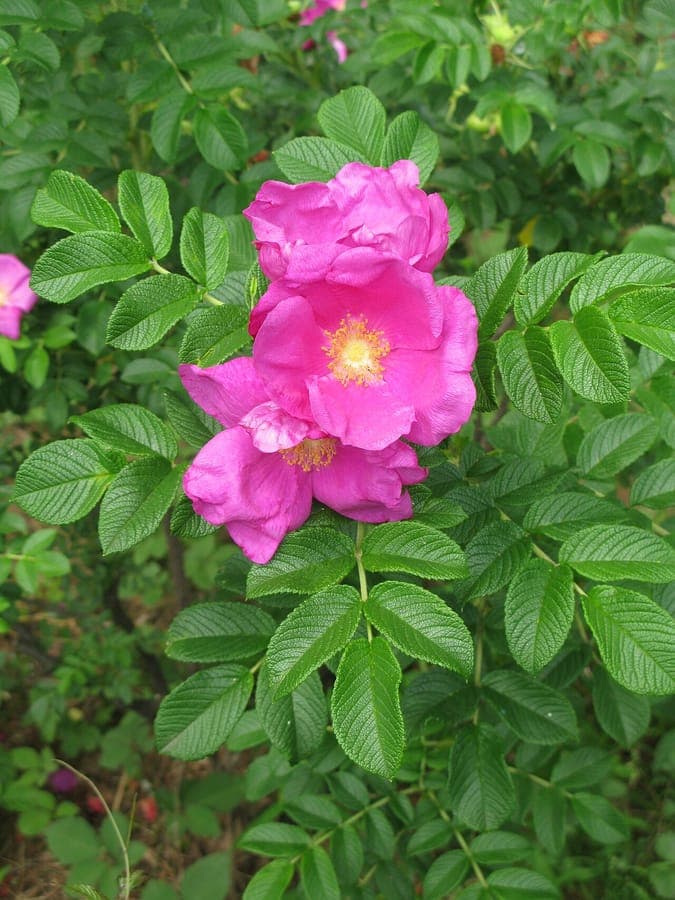
Qwert1234 / CC BY-SA 3.0, via Wikimedia Commons
Rugosa Rose: complete guide
Rosa rugosa
Want to see Rugosa Rose: complete guide in your garden?
1 minute, no credit card
Overview
The Rugosa Rose (Rosa rugosa) stands as one of the most resilient and rewarding rose species you can grow in a temperate garden. Originally native to East Asia - specifically Japan, Korea, and northeastern China - this shrub rose has naturalised across Europe and parts of North America over the centuries. The common name refers to its characteristically wrinkled (rugose) leaves, while the plant is also known as the Japanese rose, beach rose, or hedgehog rose.
Whether you are an experienced gardener or just starting to design your outdoor space, the Rugosa Rose deserves a prominent spot in your planting scheme. On gardenworld.app you can create a garden design that perfectly suits robust shrubs like Rosa rugosa. With fragrant flowers from June through September, ornamental hips in autumn, and near-zero maintenance requirements, this is a plant that delivers interest across all four seasons. Mature specimens reach 100–200 cm in height and spread, making them excellent as specimen shrubs, informal hedges, or coastal windbreaks.
Appearance and bloom cycle
Rosa rugosa flowers from June to September, producing single or semi-double blooms measuring 6–9 cm across. The most common flower colour is a vivid rose-pink, though white cultivars such as 'Alba' and deep magenta forms like 'Rubra' are widely available. The fragrance is intense and sweet - on a warm summer afternoon it can perfume an entire garden section.
The foliage is dark green, deeply veined, and leathery in texture. In autumn, the leaves turn shades of yellow and amber before dropping. Stems are densely covered with fine prickles and bristly hairs, making the plant a formidable security hedge. From September onwards, the large flattened hips appear - measuring 2–3 cm in diameter, they are significantly larger than those of most other rose species. These hips ripen to a deep orange-red and are exceptionally rich in vitamin C, making them prized for jams, syrups, and herbal teas.
Ideal location
The Rugosa Rose is remarkably adaptable when it comes to siting. It performs best in full sun to partial shade, though it tolerates considerable shade. In full sun it flowers most abundantly and sets the heaviest crop of hips. A standout feature of Rosa rugosa is its excellent salt tolerance, making it perfect for coastal gardens and roadside plantings where winter de-icing salt is used.
Give the Rugosa Rose room to develop. Allow 80–100 cm between plants for a hedge and 150 cm for a specimen shrub. The plant spreads by suckers, so if you want to contain it, install a root barrier or remove suckers annually. For hedging purposes, suckering is actually an advantage - the hedge thickens naturally over time. Plant in autumn or early spring for best establishment.
Soil requirements
One of the greatest strengths of the Rugosa Rose is its indifference to soil quality. It thrives in almost any ground: heavy clay, poor sand, chalky subsoil, or slightly acidic loam. The ideal soil pH ranges from 5.5 to 7.5. The plant even tolerates mildly saline conditions and extended dry spells, although it performs best in moisture-retentive, well-drained soil.
When planting, dig a hole approximately 40 x 40 x 40 cm. Mix the excavated soil with a spadeful of compost or well-rotted manure. Set the plant at the same depth it sat in its pot - the graft union (if present) should sit 3–5 cm below ground level. Firm the soil well and water generously. Apply a 5–8 cm layer of mulch around the base to retain moisture and suppress weeds. Most garden centres carry suitable organic mulch and rose compost.
Watering
Once established, the Rugosa Rose is notably drought-tolerant. During the first growing season after planting, regular watering is essential: provide 10 litres per plant two to three times a week during dry weather. From the second year onwards, supplementary watering is only necessary during prolonged dry spells lasting more than two weeks without rain.
Always water at the base of the plant, never over the foliage. Wet leaves promote fungal diseases such as blackspot and mildew. The best time to water is early morning, so any moisture on the foliage dries quickly in the rising sun. Container-grown Rugosa Roses need more frequent watering - check daily whether the top 3–4 cm of soil has dried out and water thoroughly until it runs from the drainage holes.
Free design
Want to see Rugosa Rose: complete guide in your garden? Make a free design now.
Pruning
The Rugosa Rose requires minimal pruning, which is a significant advantage over hybrid tea and floribunda roses. The best time to prune is late February to early March, before new shoots emerge. Remove dead, damaged, and crossing branches to improve air circulation through the centre of the plant.
For a compact shrub, reduce the overall height by one-third each year. For a natural, wild look, it is sufficient to cut out the oldest stems at the base every three to four years - this renewal pruning keeps the plant vigorous and productive. Never prune later than April, because Rosa rugosa flowers on both old and new wood, and late pruning reduces bloom. Good quality secateurs and loppers for rose pruning are available at most garden centres.
Maintenance calendar
March: Prune out dead wood and apply the first feed with an organic rose fertiliser (80–100 g per plant). Remove unwanted suckers.
April–May: Check for aphids. A strong jet of water from the hose usually dislodges light infestations. Top up mulch to a depth of 5–8 cm.
June–August: Enjoy the flowering season. Only deadhead spent blooms if you do not want hips - otherwise leave them for an outstanding autumn display. Water during extended dry periods.
September–October: The hips colour up to orange-red. Harvest hips for culinary use when they feel slightly soft but still firm. Apply a final feed with a potassium-rich fertiliser to boost winter hardiness.
November–February: Dormancy period. In areas with severe frost, add an extra layer of mulch around the base. The Rugosa Rose is hardy to -30°C, so additional winter protection is rarely needed in most of the UK and Ireland.
Winter hardiness
The Rugosa Rose ranks among the hardiest rose species in cultivation. It is fully hardy in USDA zones 2–8, meaning it survives temperatures down to -40°C without damage. In the UK (zones 7–9) frost damage is essentially unheard of.
Although deciduous, the plant retains its ornamental value in winter through the bright red hips clinging to thorny stems. These hips persist well into winter and provide a crucial food source for blackbirds, thrushes, and other berry-eating species. The dense, thorny structure also offers shelter for small birds during cold nights. Even in the bleakest midwinter, a Rugosa Rose hedge has structural interest and wildlife value.
Companion plants
The Rugosa Rose combines beautifully with a wide range of garden plants. For a romantic, cottage-garden look, pair it with English Lavender (Lavandula angustifolia), which shares the same preference for sun and well-drained soil. The purple lavender spikes create a striking colour contrast against the pink roses.
Other excellent companions include Butterfly Bush (Buddleja davidii) for a pollinator-friendly border, ornamental grasses such as Miscanthus or Stipa for textural contrast, and perennials like catmint (Nepeta), lady's mantle (Alchemilla mollis), and hardy geraniums. For a mixed hedge, combine Rosa rugosa with hawthorn, blackthorn, or wild privet to create a varied, natural screen that offers year-round interest. Hydrangeas (Hydrangea macrophylla) work well in a partially shaded spot alongside the Rugosa Rose.
Final thoughts
The Rugosa Rose is a plant that belongs in every garden. It asks little, gives generously, and withstands virtually anything the temperate climate throws at it. From fragrant summer blooms to sculptural winter hips, Rosa rugosa delivers visual delight and ecological value across all twelve months.
Seek out Rosa rugosa at your local garden centre - specialist nurseries often stock several named cultivars in both bare-root and container-grown forms. On gardenworld.app you can discover how the Rugosa Rose will look in your specific garden setting, with a personalised design that factors in your soil type, sun exposure, and style preferences. Plant one this autumn or spring and enjoy years of effortless beauty.
Want to see Rugosa Rose: complete guide in your garden? Make a free design now.
Upload a photo, pick a style, and get a photorealistic design with plant list in under a minute.
No credit card required


Similar plants
English Lavender: complete guide
Lavandula angustifolia
Everything about English Lavender (Lavandula angustifolia): planting, pruning, care and overwintering. Practical tips for lush purple blooms.
Bigleaf Hydrangea: complete guide
Hydrangea macrophylla
Everything about the Bigleaf Hydrangea (Hydrangea macrophylla): planting, pruning, flower colour control and winter protection. Practical tips for lush blooms.
Butterfly Bush: complete guide
Buddleja davidii
Everything about the Butterfly Bush (Buddleja davidii): planting, pruning, care and attracting butterflies. Practical tips for a blooming butterfly garden.