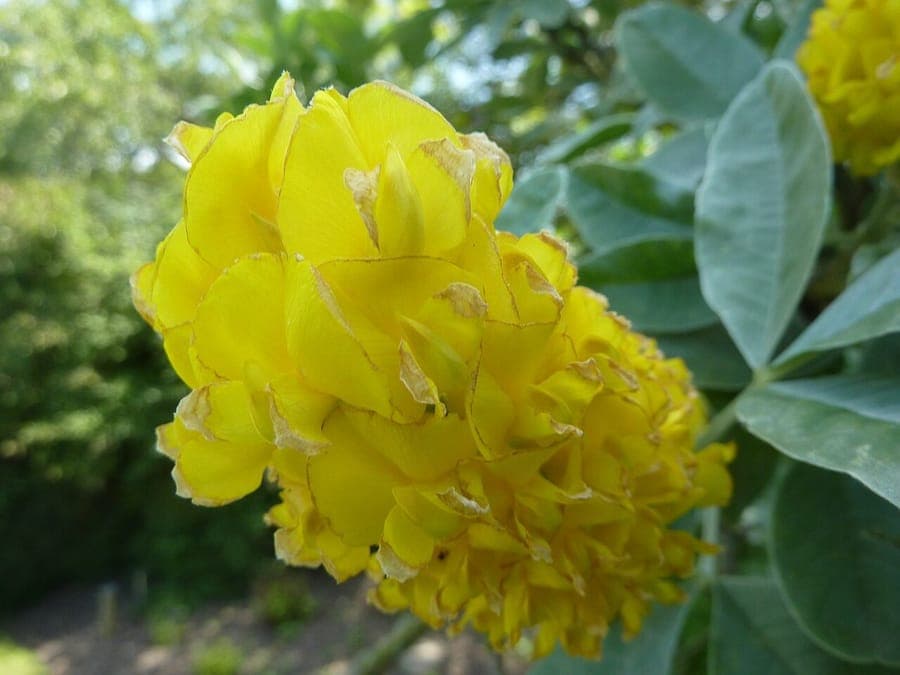
Magnus Manske / CC BY-SA 3.0, via Wikimedia Commons
Pineapple broom (Argyrocytisus battandieri): complete guide
Argyrocytisus battandieri
Want to see Pineapple broom (Argyrocytisus battandieri): complete guide in your garden?
Full design in HD: €7.99
Look after your Pineapple broom with the GardenWorld app
Identify plants with your camera and get a care calendar with reminders for this plant.


Overview
Pineapple broom, Argyrocytisus battandieri, is a broom that hardly looks like one. Instead of fine green twigs it carries large leaves covered in silvery silk, and instead of scattered small flowers it produces dense, upright cones of golden yellow blooms in summer that smell strongly of ripe pineapple. It is also known as Moroccan broom, a nod to its origins in the Rif and Middle Atlas mountains of Morocco, where it grows on dry, sunny slopes among cedars and oaks. For a long time it was classified as Cytisus battandieri, and many nurseries still sell it under that name. Today it is the only species in its own genus, Argyrocytisus, which means "silver broom". The species name honours the French botanist Jules Aimé Battandier, who studied the flora of North Africa.
In gardens it becomes a large, rather open shrub, 3 to 5 m tall and 3 to 4 m wide. It can be grown freestanding in a sheltered spot, but it looks best and is safest against a warm, sunny wall, where it can be trained as a loose fan. A well-known selection is 'Yellow Tail', with even longer flower spikes. If you are unsure whether your garden has room and warmth enough for such a substantial plant, gardenworld.app can prepare a garden design that finds the right wall or corner for it.
Appearance and bloom cycle
The foliage is the first reason to grow this plant. Each leaf has three oval leaflets 4 to 9 cm long, coated on both sides with fine, silky hairs that catch the light and give the whole shrub a silver-grey sheen. The effect is especially lovely after rain or in low evening sunlight. The plant is semi-evergreen: in a mild winter some leaves hang on, while a harsh winter strips most of them.
Flowering falls in June and July. At the tips of the branches appear short, dense racemes 8 to 15 cm long, conical to almost rounded, made up of dozens of small, warm golden pea flowers. Their scent is unmistakably fruity, and on a warm day you can smell the shrub from several metres away. Bees and bumblebees love it. After flowering, flat, silver-haired pods about 4 to 5 cm long develop.
Young shoots are silvery and hairy too. Older branches turn grey-brown and can become bare towards the base over the years, which targeted pruning helps to prevent.
Ideal location
Argyrocytisus battandieri needs full sun and shelter. A south- or west-facing wall is the classic choice: the brickwork radiates warmth, protects against cold easterly winds and helps the wood ripen properly, which in turn improves hardiness. In an open, windswept garden or in shade it grows weak and flowers sparsely.
Allow for its size. Against a wall you need a stretch at least 3 m wide, fitted with horizontal wires or a trellis to tie in the main branches. Freestanding, it suits a large border or a sheltered courtyard, provided it is given space. Keep it away from windows and doors, as the shrub becomes broad and dense. It does not like being moved, so choose its final position from the start.
Soil requirements
Like nearly all brooms it prefers well-drained, rather lean soil. Sandy or stony ground is ideal; ordinary garden soil is fine as long as it does not stay wet. On heavy clay, dig plenty of coarse grit and gravel into the top 40 cm or plant on a slight mound. Standing water in winter is its worst enemy.
Unlike some brooms, this species is happy on both slightly acidic and chalky soils. Feeding is rarely necessary because it fixes nitrogen from the air through its root nodules. Too much fertiliser makes the stems long and soft, leaving them more vulnerable to frost and wind damage. Plant a young, pot-grown specimen in spring so it has a whole season to root before its first winter.
Watering
During its first year it needs regular watering: in dry spells, give a 10-litre bucket at the base once a week. Soil at the foot of a wall dries out quickly because the wall keeps rain off, so check that spot more often.
From the second year onwards it is quite drought tolerant. Water only during prolonged dry weather, and then deeply rather than often. Heavy watering, especially in autumn and winter, increases the risk of root rot and of soft growth that copes poorly with frost.
Free preview
Want to see Pineapple broom (Argyrocytisus battandieri): complete guide in your garden? Make a free preview of your design.
Pruning
Prune straight after flowering, in August. On a freestanding shrub, remove spent flower heads and shorten overlong branches to a healthy side shoot. Every few years take out one or two of the oldest stems close to the base, so that young wood keeps coming through and the shrub does not go bare at the bottom.
Against a wall, tie the strongest branches in as a fan and, after flowering, cut back shoots growing away from the wall to a few buds. Argyrocytisus battandieri tolerates pruning better than most brooms, but cutting back hard to a bare stump is still risky. Spread major renovation over two or three years. Avoid pruning in autumn or early spring: it makes the wood more prone to frost and removes flowering wood.
Toxicity
As with most brooms, it is safest to treat Argyrocytisus battandieri as poisonous. The seeds and pods in particular contain alkaloids that can cause nausea, vomiting and heart problems if swallowed, and the same applies to dogs, cats, rabbits and horses. Do not let children play with the pods, clear away prunings and, if you suspect anything has been eaten, contact your doctor, NHS 111 or your vet.
Maintenance calendar
March–April: Best time to plant. Remove frosted shoot tips and check the ties on wall-trained plants.
May: New shoots grow fast. Tie them in promptly on wall-trained plants.
June–July: Full bloom and pineapple scent. Water young plants in dry weather.
August: Prune after flowering. Remove spent racemes, shorten long shoots and take out an old stem if needed.
September–October: No more pruning or feeding, so the wood can ripen.
November–February: Dormant season. Protect young plants in hard frost with a double layer of horticultural fleece and a mulch over the roots.
To keep these jobs on track alongside everything else in your garden, the planting calendar on gardenworld.app lists them month by month.
Winter hardiness
Argyrocytisus battandieri is moderately hardy. Well-established plants in a sheltered, dry position tolerate frost down to around -12 to -15 °C. Young plants, those on wet soil and those in open, exposed sites are more vulnerable. It grows well against a warm wall in most of southern and central England and in the milder parts of north-western Europe, while in cold, upland areas it is a gamble.
In severe frost the leaves may drop completely and shoot tips can be killed, but the plant usually reshoots from older wood in spring. A thick mulch over the roots and fleece over the crown help young plants through their first winters. In a large container it only survives if you can overwinter it in a cool, light place that stays above freezing.
Companion plants
Against a wall it partners well with other sun-loving climbers and wall shrubs. Ceanothus impressus flowers deep blue in spring, giving a strong contrast before the yellow blooms arrive. Star jasmine (Trachelospermum jasminoides) weaves evergreen stems between the branches and adds a second fragrance in July. The Banksian rose, Rosa banksiae, can share a large wall with it.
At its feet, choose plants that enjoy the same dry, sunny soil: Russian sage (Perovskia atriplicifolia) with silver stems and lavender-blue flowers, Jerusalem sage (Phlomis fruticosa) with woolly leaves and yellow whorls, and lavender. The broom's silver foliage ties such a group together into a calm, harmonious picture.
Final thoughts
Argyrocytisus battandieri is a plant for anyone who loves silver foliage and fragrance. It asks for a warm wall, well-drained soil and a trim after flowering, and in return it gives an exceptional summer display that smells of pineapple. Plant it in spring, protect it through its first winters and give it room to grow. In the right spot it becomes a showpiece that makes every visitor stop for a moment.
Frequently asked questions about Pineapple broom
Is Pineapple broom winter hardy?
Argyrocytisus battandieri is moderately hardy. Well-established plants in a sheltered, dry position tolerate frost down to around -12 to -15 °C.
When and how do you prune Pineapple broom?
Prune straight after flowering, in August. On a freestanding shrub, remove spent flower heads and shorten overlong branches to a healthy side shoot.
How much water does Pineapple broom need?
During its first year it needs regular watering: in dry spells, give a 10-litre bucket at the base once a week. Soil at the foot of a wall dries out quickly because the wall keeps rain off, so check that spot more often.
Where does Pineapple broom grow best?
Argyrocytisus battandieri needs full sun and shelter. A south- or west-facing wall is the classic choice: the brickwork radiates warmth, protects against cold easterly winds and helps the wood ripen properly, which in turn improves hardiness.
What soil does Pineapple broom need?
Like nearly all brooms it prefers well-drained, rather lean soil. Sandy or stony ground is ideal; ordinary garden soil is fine as long as it does not stay wet.

See it in your garden
See Pineapple broom in your garden
One photo of your garden and a few questions. You see the result in about a minute.
Try it with a photoIdentify this plant in your own garden. Identify a plant
Similar plants
Santa Barbara ceanothus: complete guide
Ceanothus impressus
Ceanothus impressus rewards a sunny wall with deep blue flowers in March-May. Location, soil, pruning and winter protection explained.
Star jasmine: complete guide
Trachelospermum jasminoides
Everything about Star Jasmine (Trachelospermum jasminoides): planting, care, pruning and winter protection. Expert tips for a fragrant evergreen climber.
Rosa banksiae: complete guide
Rosa banksiae
Discover Rosa banksiae, the famous Lady Banks' Rose from China. A vigorous climbing rose with thornless forms and disease-free growth for walls and pergolas.
