
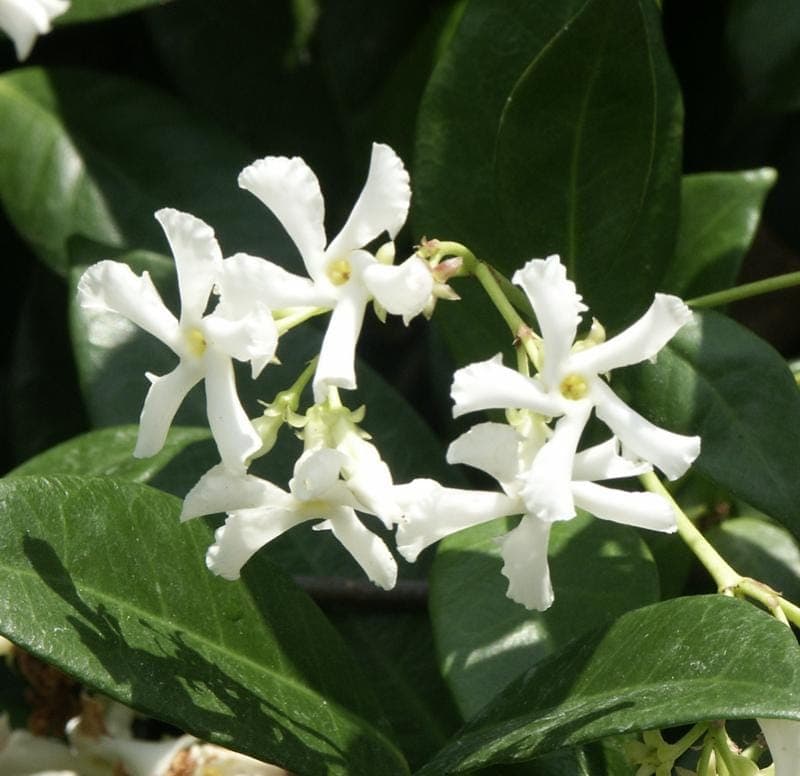
Scott Zona from USA / CC BY 2.0, via Wikimedia Commons
Star jasmine: complete guide
Trachelospermum jasminoides
Want to see Star jasmine: complete guide in your garden?
1 minute, no credit card
Overview
Star Jasmine (Trachelospermum jasminoides) is the climbing plant that has it all: evergreen foliage, intoxicatingly fragrant white flowers, an elegant twining habit, and - surprisingly for a plant that looks so exotic - reasonable cold tolerance in sheltered gardens across much of temperate Europe, the southern United Kingdom, and the warmer parts of the United States and Australia. This twining climber from China and Japan has made a remarkable advance into Western gardens over the past decade, driven by rising temperatures and a growing appetite for year-round green screening.
Star Jasmine is not a true jasmine (Jasminum) at all, but its fragrance makes the comparison inevitable: sweet, warm, with a hint of vanilla that fills an entire garden on still summer evenings. On gardenworld.app you can create a garden design where star jasmine clothes a fence, pergola, or wall, providing a green backdrop twelve months of the year. The plant climbs to 6–9 metres and spreads 2–3 metres wide. The glossy, dark green leaves are 3–6 cm long and take on bronze-red tones in winter - a bonus ornamental feature. The white, star-shaped flowers of 2–3 cm across appear in June and July in dense clusters.
Appearance and bloom
The foliage of star jasmine is an attraction in its own right. The oval, leathery leaves remain glossy dark green throughout the year and form a dense, decorative screen. In autumn and winter, the outer leaves colour bronze to reddish-brown, giving the plant a warm winter face. The leaves sit opposite each other on slender, twining stems that wrap themselves unaided around wires, slats, and trellis.
The flowering period in June and July is the absolute highlight. Dozens of white, star-shaped flowers of 2–3 cm open in dense clusters (cyme-like inflorescences) along the stems. The five twisted petals give each flower its characteristic pinwheel appearance. The fragrance is intense, sweet, and carries tens of metres - plant star jasmine beside a seating area, terrace, or bedroom window for maximum enjoyment. After flowering, slender seed pods occasionally form, but seed set is rare in cooler climates. When damaged, the plant exudes a milky sap that can cause mild skin irritation - wear gloves when pruning.
Ideal location
Star jasmine performs best in a warm, sheltered position in full sun to partial shade. A south-west- or south-facing wall that stores and radiates heat is the dream location. The wall acts as a kind of night-storage heater, protecting the plant from overnight frost and cold wind. A west-facing fence or pergola in a courtyard garden also works well.
Avoid exposed, windy sites and cold north-facing aspects. The plant prefers morning sun or afternoon sun with protection from the sharpest winter cold. In urban gardens, star jasmine benefits from the heat-island effect and grows noticeably more lushly than in rural settings. Along the coast of southern England, in sheltered London gardens, and across much of the south-eastern United States (USDA 8–10), it thrives with minimal fuss. In South Africa and coastal Australia, it is virtually carefree. Provide a climbing support: trellis, tensioned wires, or a pergola. Star jasmine does not produce adhesive pads and will not damage masonry.
Soil requirements
Star jasmine is fairly tolerant of different soils but grows best in fertile, well-drained ground that retains some moisture. The ideal soil pH sits between 6.0 and 7.5. When planting, work in compost and a little garden peat or coir to raise the humus content. In heavy clay, add a layer of gravel to the planting hole for extra drainage.
The plant tolerates light sandy soil provided you mulch regularly and feed, since sandy ground leaches nutrients quickly. Plant the star jasmine at least 30 cm from the wall or fence so the roots have access to rainwater and are not stranded in the dry rain-shadow of the foundation. In containers, use a quality peat-free compost mixed with perlite for drainage.
Watering
Star jasmine has moderate water needs: the soil should stay moist but never waterlogged. During the first and second year after planting, regular watering is essential for good establishment. Give 10 litres per plant once or twice a week, depending on the weather. Mulch the base with a 5–8 cm layer of compost or bark chips to conserve moisture.
From the third year onward the plant is reasonably drought-tolerant, but during prolonged heat and drought in July and August, supplementary watering is sensible - drought stress reduces flowering the following year. Always water at the base and avoid wetting the foliage. Against a wall, the soil can be surprisingly dry because the eaves or wall cap deflect rainwater - check this regularly. Star jasmine in a large pot (minimum 40 cm diameter) needs watering two to three times per week in summer.
Free design
Want to see Star jasmine: complete guide in your garden? Make a free design now.
Pruning
Star jasmine has a moderate growth rate and does not need aggressive pruning. The plant flowers on the previous year's wood, so always prune immediately after flowering in July or August - that way you avoid removing wood that would flower the following season.
During the annual prune, remove spent flower clusters, any dead or damaged stems, and guide growth in the desired direction. Trim overlong shoots back to a junction. If the plant becomes too dense or heavy after several years, you can cut it back more drastically in spring - prune to 30–50 cm from the main framework. The plant recovers within a single growing season, but flowering will be reduced that year. Wear gloves because of the irritant milky sap.
Maintenance calendar
March–April: Check for frost damage and remove any dead wood. Apply a layer of compost around the base. Reattach any stems that have come loose from the support.
May: Active growth resumes. Train new shoots along the climbing support. Apply the first feed with a balanced slow-release fertiliser.
June–July: Peak flowering. Enjoy the fragrance. Water during dry spells to support the bloom.
August: Prune immediately after flowering. Remove spent clusters and redirect growth. Second feed.
September–October: The plant is forming the wood on which next year's flowers will appear. Avoid pruning during this period. Check winter protection and repair any trellis or fence damage.
November–February: In cold regions, wrap the base and lower stems with horticultural fleece or hessian. In mild-winter areas, no protection is needed. Keep the soil on the dry side.
Winter hardiness
Star jasmine is hardy to approximately -10°C to -12°C (USDA zones 8–10), making it suitable for sheltered locations across much of southern and western England, coastal Wales, London gardens, and mild areas of the south-eastern United States, coastal Australia, and South Africa. In colder inland areas and northern regions, winter protection is necessary.
At temperatures below -10°C the above-ground growth may freeze back, but the plant often resprouts from the base if the roots are protected. Shield the root zone with a thick mulch layer (15–20 cm of straw or leaves) and wrap the lower stems in fleece or hessian. Do not place plastic sheeting directly on the plant - it causes condensation and frost burn. In a container, star jasmine is more vulnerable: stand the pot against a sheltered wall, insulate with bubble wrap, and cover the soil surface with straw.
Companion plants
Star jasmine is striking as a standalone climber but combines well with other plants too. At the base, lavender (Lavandula angustifolia) and woodland sage (Salvia nemorosa) look superb: they mask the bare lower stems and add colour contrast while sharing the preference for sunny, well-drained soil.
For a layered, lush effect, pair star jasmine with a clematis that flowers at a different time - Clematis viticella in late summer makes a fine successor. Hydrangea (Hydrangea macrophylla) in the partial shade at the foot offers a compelling texture contrast. In a Mediterranean scheme, plant star jasmine alongside potted olive trees, rosemary, and Pittosporum. Wisteria is a spectacular climbing companion on a large pergola, but give both plants ample room to develop.
Closing
Star jasmine proves that you do not need a subtropical climate to enjoy a fragrant, evergreen climber. Given the right position - a warm, sheltered wall or fence - and minimal winter protection in colder regions, this plant flourishes in an increasing number of gardens across temperate zones worldwide. The reward: twelve months of glossy green foliage and, in summer, weeks of enchanting, sweet fragrance.
Purchase your star jasmine from a reputable nursery and plant it in spring so it can root well before winter arrives. On gardenworld.app you can create a garden design that integrates star jasmine as an evergreen backdrop for your terrace, pergola, or fence - an investment that pays dividends for decades.
Want to see Star jasmine: complete guide in your garden? Make a free design now.
Upload a photo, pick a style, and get a photorealistic design with plant list in under a minute.
No credit card required


Similar plants
Chinese Wisteria: complete guide
Wisteria sinensis
Everything about Chinese Wisteria (Wisteria sinensis): planting, pruning, training and care. Expert tips for breathtaking cascading blooms.
Bigleaf Hydrangea: complete guide
Hydrangea macrophylla
Everything about the Bigleaf Hydrangea (Hydrangea macrophylla): planting, pruning, flower colour control and winter protection. Practical tips for lush blooms.
English Lavender: complete guide
Lavandula angustifolia
Everything about English Lavender (Lavandula angustifolia): planting, pruning, care and overwintering. Practical tips for lush purple blooms.