
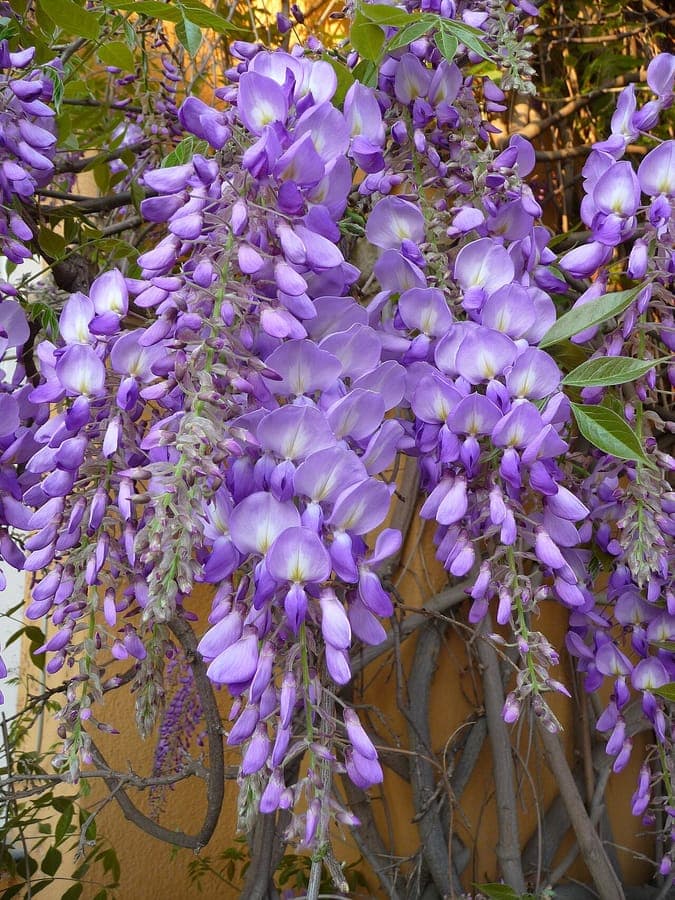
3268zauber / CC BY-SA 3.0, via Wikimedia Commons
Chinese Wisteria: complete guide
Wisteria sinensis
Want to see Chinese Wisteria: complete guide in your garden?
1 minute, no credit card
Overview
Chinese Wisteria (Wisteria sinensis) ranks among the most dramatic climbing plants a gardener can grow in a temperate climate. When this deciduous twiner unfurls its pendulous racemes of blue-purple flowers in April and May - each truss reaching 30 to 50 cm in length - every passer-by stops to stare. Native to China, the species was introduced to Europe in the early nineteenth century and quickly became a fixture on manor houses, townhouse facades, and garden pergolas from London to Lisbon.
On gardenworld.app you can create a garden design that places wisteria centre-stage, whether you envision a romantic pergola, a wall-trained specimen, or a free-standing standard tree. Wisteria sinensis can reach 10 to 15 metres and therefore demands a robust support structure of galvanised steel wire or heavy timber. The flowers appear before the leaves emerge, which makes the trusses all the more striking against the bare branches. After flowering, fresh green pinnate foliage unfolds to form a dense leafy canopy for the rest of summer.
Appearance and bloom
The flower racemes of Wisteria sinensis are among the most spectacular sights the plant kingdom has to offer. Each raceme consists of dozens of individual pea-shaped florets, ranging from soft lilac to deep violet-blue, opening progressively from top to bottom. The flowers release a sweet, grape-like fragrance that carries for metres. Bloom occurs in April and May, and a well-tended plant may produce a modest second flush later in summer.
The twining stems coil anticlockwise (viewed from above) - this distinguishes the Chinese species from the Japanese Wisteria floribunda, which twines clockwise. Over time, the trunk can exceed 15 cm in diameter and develops a gnarled, picturesque character that adds year-round interest. The compound leaves carry 7 to 13 leaflets, each 5 to 8 cm long. In autumn, the foliage turns butter-yellow before falling. After flowering, flat, velvety seed pods of 10 to 15 cm form and persist through winter, adding sculptural value to the bare silhouette.
Ideal location
Full sun is non-negotiable for good flowering - a minimum of six hours of direct sunlight daily. A south- or southwest-facing wall is ideal: heat stored by the masonry during the day radiates back at night and shields the early flowers from late frost. A sunny pergola above a patio works equally well. Avoid north-facing walls and shaded corners; there the plant produces foliage but scarcely any flowers.
Be realistic about the sheer vigour of wisteria. The plant can dislodge roof tiles, buckle drainpipes, and damage weak brickwork. Mount the support framework away from the wall with spacers of at least 10 cm and use steel cables or heavy battens. In a small courtyard, a freestanding arbour or sturdy overhead frame is the safest option. Inspect the support structure annually for wear, especially after winter storms - the weight of a mature wisteria in full leaf is considerable.
Soil requirements
Wisteria sinensis is not especially fussy about soil type, but good drainage is essential. Waterlogged roots invite root rot and suppress flowering. In heavy clay - common across much of lowland England - work coarse grit and compost into the planting pit to improve drainage. In lighter, sandy soils, wisteria is perfectly content.
Aim for a soil pH of 6.0 to 7.0 - slightly acidic to neutral. Avoid heavy nitrogen feeding: it drives lush shoot and leaf growth at the expense of flowers. If your plant has not bloomed after several years, apply a potassium-rich fertiliser (sulphate of potash at 50 g per square metre) in March to encourage flower-bud formation. Never dig fresh manure into the root zone - use well-rotted garden compost or a light leaf-mould mulch instead.
Watering
A newly planted wisteria needs regular watering during its first and second years to establish a strong root system. Provide 10 to 15 litres weekly, particularly during dry spells from May to September. Water at the base and keep moisture off the flowers, as wet blooms deteriorate faster.
From the third year onward, Wisteria sinensis is reasonably drought-tolerant thanks to its deep root network. Supplementary watering is then only necessary during prolonged dry periods exceeding three weeks. Winter watering is unnecessary. Plants in large containers on a terrace dry out more quickly and should be checked every two to three days in summer. Always provide drainage holes and a layer of crocks or expanded clay at the bottom of the pot.
Free design
Want to see Chinese Wisteria: complete guide in your garden? Make a free design now.
Pruning
Pruning is by far the most important maintenance task for wisteria - and the difference between a plant that flowers profusely and one that simply grows. Wisteria is pruned twice a year: once in summer (July–August) and once in late winter (February).
The summer prune aims to shorten the vigorous new side shoots. Cut every new lateral back to five or six leaf nodes (roughly 20 cm) from its base. This prevents the plant from pouring energy into extension growth and redirects it toward flower-bud formation. The winter prune (February, before bud-break) shortens those same laterals further to two or three buds (approximately 5–8 cm). This concentrates the plant's reserves in the remaining buds, resulting in heavier flowering.
For young plants that still need training: select two or three main stems and tie them along the support framework. Remove all other shoots. After three to four years, the structural framework is complete and you switch to the regular pruning regime. Sharp tools are essential - use quality secateurs and a pruning saw for thicker stems.
Maintenance calendar
January–February: Winter prune. Shorten the summer-pruned laterals to 2–3 buds. Inspect the support framework for storm or frost damage and repair as needed.
March–April: Flower buds swell. Apply a light potassium feed. If late frost below -3°C is forecast, drape horticultural fleece over the buds to prevent damage.
May: Full bloom. Enjoy the spectacle. Remove spent racemes to conserve the plant's energy, unless you wish to keep the ornamental seed pods.
June: Foliage is now fully developed. Tie in new training shoots along the framework. Check for aphids - dislodge them with a strong jet of water or introduce ladybirds.
July–August: Summer prune. Shorten all new laterals to 5–6 leaf nodes. This is the most time-critical pruning session of the year.
September–October: Final check for loose or wayward branches. Clear fallen leaves from the base to discourage fungal problems.
November–December: Dormancy. No action needed beyond a visual check of the support structure.
Winter hardiness
Wisteria sinensis is hardy to approximately -20°C (USDA zones 5 to 9) and therefore survives the vast majority of winters across the UK, coastal Australia, and the temperate United States without difficulty. The plant itself is robust, but the early flower buds are vulnerable to late spring frosts in March and April. A sudden drop to -5°C can destroy an entire season's bloom.
In frost-prone regions, protect the buds with horticultural fleece when overnight frost is forecast. This applies particularly to plants on east-facing walls, where morning sun thaws frozen buds too rapidly - it is precisely this fast thawing that causes tissue damage. Young plants (first two years) benefit from a thick layer of straw or bark mulch around the base. A mature wisteria with a thickened trunk is virtually indestructible.
Companion plants
Wisteria blooms in April and May, so ideal companions fill the remaining seasons with colour. Underplanting with lavender (Lavandula angustifolia) and catmint (Nepeta) continues the purple theme through summer. Early bulbs such as grape hyacinth (Muscari) and tulips flower alongside the wisteria and amplify the spring display.
For autumn interest, pair wisteria with hydrangeas (Hydrangea macrophylla), which thrive in the dappled shade beneath the canopy. Climbing roses (Rosa) can share the pergola - they take over when the wisteria's bloom fades. At the base, shade-tolerant ground covers such as foxglove (Digitalis), lady's mantle (Alchemilla mollis), and wild strawberry work beautifully. In the southern United States and South Africa, combine wisteria with jasmine for a fragrance-layered entrance.
Closing
Chinese Wisteria is not a plant for the impatient or the absent-minded gardener - it demands disciplined twice-yearly pruning and a support structure capable of handling its extraordinary vigour. But for those who invest the effort, the reward is a flowering spectacle without equal. The cascading trusses, the intoxicating scent, and the sculptural winter silhouette make Wisteria sinensis a living masterpiece that matures with your garden over decades.
On gardenworld.app you can create a garden design where wisteria takes the starring role, complete with the right support structure and companion plants for your situation. Source a quality grafted plant from a reputable nursery, choose the sunniest wall or pergola you have, and begin your own wisteria story this spring.
Want to see Chinese Wisteria: complete guide in your garden? Make a free design now.
Upload a photo, pick a style, and get a photorealistic design with plant list in under a minute.
No credit card required


Similar plants
Bigleaf Hydrangea: complete guide
Hydrangea macrophylla
Everything about the Bigleaf Hydrangea (Hydrangea macrophylla): planting, pruning, flower colour control and winter protection. Practical tips for lush blooms.
English Lavender: complete guide
Lavandula angustifolia
Everything about English Lavender (Lavandula angustifolia): planting, pruning, care and overwintering. Practical tips for lush purple blooms.
Rugosa Rose: complete guide
Rosa rugosa
Everything about the Rugosa Rose (Rosa rugosa): planting, pruning, care and winter hardiness. Practical tips for abundant blooms in your garden.