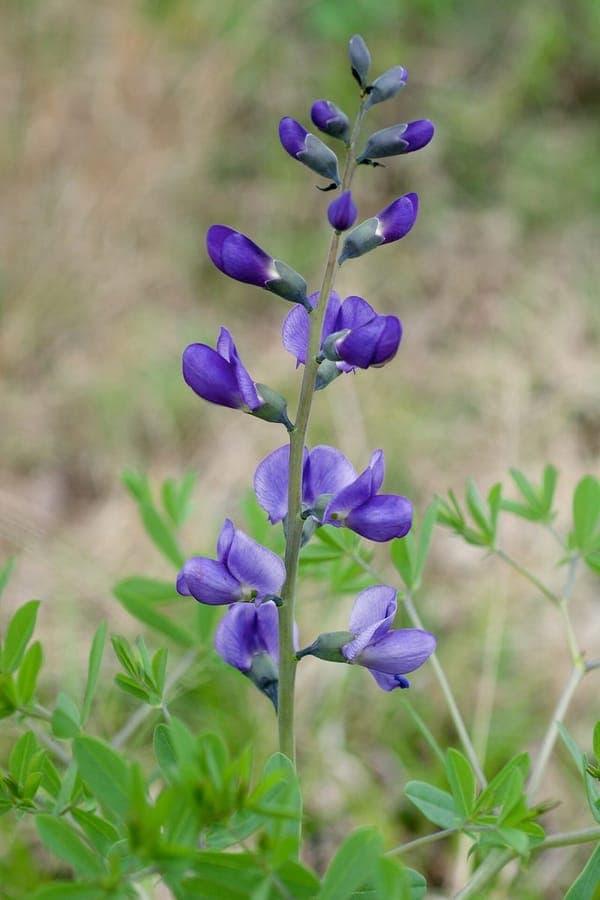
Eric Hunt / CC BY-SA 4.0, via Wikimedia Commons
Blue false indigo: complete guide
Baptisia australis
Want to see Blue false indigo: complete guide in your garden?
Full design in HD: €7.99
Look after your Blue false indigo with the GardenWorld app
Identify plants with your camera and get a care calendar with reminders for this plant.


Overview
Blue false indigo (Baptisia australis), also called blue wild indigo, is one of the longest-lived perennials you can plant. A well-established clump stays in the same spot for decades and grows fuller and finer every year. In May and June upright spikes of indigo-blue pea flowers rise above blue-green, clover-like foliage. They are followed by inflated seed pods that turn almost black in autumn and rattle in the wind. It has the presence of a small shrub, yet it dies back to the ground every winter.
The species is native to central and eastern North America, where it grows on prairies, in open woodland and along riverbanks. It belongs to the pea family (Fabaceae) and, thanks to nodules on its roots, fixes its own nitrogen from the air. Early settlers used it as a substitute for true indigo to dye cloth blue, although the result was paler, which explains its common name. In 2010 the Perennial Plant Association in the United States named it Perennial Plant of the Year.
A mature plant grows 90 to 120 cm tall and as wide. For the first two or three years it puts most of its energy into a deep taproot and flowers only modestly, but after that it is almost unstoppable. Hybrids with other Baptisia species exist, such as 'Purple Smoke', but the true species remains one of the finest blue perennials. On gardenworld.app you can have a garden design made in which blue false indigo forms a permanent backbone in a sunny border or prairie planting.
Please note: blue false indigo is poisonous. All parts contain quinolizidine alkaloids such as cytisine, similar to those found in lupins and laburnum. If eaten they can cause nausea, vomiting, diarrhoea and, in larger amounts, muscle weakness. Seeds and young shoots carry the greatest risk. Horses and cattle can suffer colic if the plant ends up in hay. Avoid planting it where small children play or where dogs like to chew plants, and do not let children play with the rattling pods.
Appearance and bloom cycle
In April thick, asparagus-like shoots push through the soil, often with a bluish-purple bloom. They quickly develop into branching stems with three-part leaves. Each leaflet is 4 to 7 cm long, smooth and blue-green. The foliage stays healthy all season and gives the plant a fresh, shrubby outline.
Flowering runs from late May to late June. The spikes are 20 to 30 cm long and carry dozens of flowers about 2.5 cm across, ranging from violet-blue to deep indigo. Bumblebees and other bees love them. After flowering, pods 3 to 6 cm long develop; they start green and turn charcoal grey after the first frosts. They look lovely in dried arrangements but should be kept out of children's reach. After a hard frost the stems turn black too, which can look strikingly graphic in a winter garden.
Ideal location
Give blue false indigo a spot in full sun, with at least six hours of direct light a day. It will grow in light shade, but it flowers less and the stems flop open more easily. It copes well with wind and suits an open, sunny border, a prairie-style garden or a large front garden.
Choose the site carefully, because moving it after a few years is almost impossible. The taproot goes deep and snaps when you dig it up. Allow roughly 1 m² per plant and think about its eventual size. It looks best as a specimen among lower perennials or as a group of three in a large border.
Soil requirements
Blue false indigo is not fussy. It grows in sand, loam and even fairly heavy clay, as long as the ground does not lie waterlogged in winter. Anything from slightly acidic to slightly alkaline is fine. Because it fixes its own nitrogen, it does not need rich soil; in fact, overly fertile ground produces long, floppy stems.
Dig a generous planting hole and loosen the soil to at least 40 cm, so the taproot can develop properly. On heavy clay, mix in some coarse grit and compost. After that, feeding is unnecessary. A thin layer of compost every two or three years is more than enough.
Free preview
Want to see Blue false indigo: complete guide in your garden? Make a free preview of your design.
Watering
Young plants need regular watering in their first year, roughly 5 to 10 litres a week in dry weather. Once the taproot has gone deep enough, usually from the second or third year, the plant is remarkably drought tolerant and draws moisture from lower soil layers by itself.
Established plants seldom need watering, even in dry summers. Only during long spells of heat and drought on light, sandy soil is a good soak welcome. Always water at the base. No extra water is needed in winter; wet roots combined with frost are the only thing it genuinely dislikes.
Pruning
After flowering you have a choice. Leave the spent spikes and you will get the attractive black pods. For a more compact plant, cut back about a third of the stems straight after flowering. The foliage then stays handsome until autumn, but you lose the pods.
The full cut-back takes place in late autumn or in February: cut all stems down to a few centimetres above the ground. Wear gloves when pruning and when handling the pods. On a site that is a little too shady or too rich the plant may flop, so place a round plant support over the young shoots in April. Dividing is not recommended, as the plant recovers poorly. Propagation is easier from seed sown in autumn.
Maintenance calendar
March: Cut away old stems if they are still standing. Plant new specimens from late March.
April: Shoots emerge. Add a round support if needed. Watch for slugs on young shoots.
May-June: Full bloom. Water young plants in dry spells.
July: Cut back by a third for a more compact shape, or let the pods ripen.
August-September: The pods darken. Harvest them with gloves for dried arrangements or seed.
October-November: After the first frosts, stems and pods turn black. Leave them standing as a winter silhouette.
December-February: Dormancy. Cut everything down in February. Note the key dates in the plant calendar on gardenworld.app so you do not forget the cut-back.
Winter hardiness
Baptisia australis is extremely hardy and tolerates temperatures down to about -35 °C. Anywhere in Britain and Ireland it needs no winter protection. The plant dies back in autumn and reappears in April from its deep rootstock.
The only risk is soil that stays wet and compacted for long periods in winter, which can rot the roots. On a free-draining site this is not a concern. Young plants in pots are best placed against a wall or plunged into the ground for winter, and planted out as soon as possible.
Companion plants
Blue false indigo fits perfectly into a prairie or naturalistic border. Purple coneflower (Echinacea purpurea) and other summer flowers take over once it has finished. Balkan clary (Salvia nemorosa) and Siberian iris (Iris sibirica) flower at the same time and echo its blue and purple tones.
Ornamental grasses such as switchgrass (Panicum virgatum) provide an airy contrast to the solid foliage. Eastern bluestar (Amsonia tabernaemontana), with pale blue starry flowers and yellow autumn colour, is another fine partner. Place low perennials such as hardy geraniums or catmint at the front to hide the base of the clump. Avoid spots with heavy competition from tree roots.
Final thoughts
Blue false indigo (Baptisia australis) is an investment for life: a little patience in the early years pays off with decades of blue flowers, healthy foliage and decorative pods. It asks for full sun, well-drained soil and above all a permanent place where it can grow undisturbed.
Do remember that the plant is poisonous, so choose a spot out of reach of young children and pets that like to chew. Bear that in mind and you will have one of the toughest and most dependable perennials in the garden.
Pruning
Frequently asked questions about Blue false indigo
Is Blue false indigo winter hardy?
Baptisia australis is extremely hardy and tolerates temperatures down to about -35 °C. Anywhere in Britain and Ireland it needs no winter protection.
When and how do you prune Blue false indigo?
After flowering you have a choice. Leave the spent spikes and you will get the attractive black pods.
How much water does Blue false indigo need?
Young plants need regular watering in their first year, roughly 5 to 10 litres a week in dry weather. Once the taproot has gone deep enough, usually from the second or third year, the plant is remarkably drought tolerant and draws moisture from lower soil layers by itself.
Where does Blue false indigo grow best?
Give blue false indigo a spot in full sun, with at least six hours of direct light a day. It will grow in light shade, but it flowers less and the stems flop open more easily.
What soil does Blue false indigo need?
Blue false indigo is not fussy. It grows in sand, loam and even fairly heavy clay, as long as the ground does not lie waterlogged in winter.

See it in your garden
See Blue false indigo in your garden
One photo of your garden and a few questions. You see the result in about a minute.
Try it with a photoIdentify this plant in your own garden. Identify a plant
Similar plants
Purple coneflower: complete guide
Echinacea purpurea
Everything about Purple Coneflower (Echinacea purpurea): planting, care, pruning and combinations. Expert tips for a thriving prairie-style garden.
Woodland sage: complete guide
Salvia nemorosa
Everything about Woodland Sage (Salvia nemorosa): planting, care, pruning and combinations. Expert tips for months of blue-violet flower spikes.
Iris sibirica: complete guide
Iris sibirica
Discover elegant Iris sibirica with fine blue flowers. Perfect for moist soils, 60-80cm tall. Excellent in groups and as a cut flower.
