
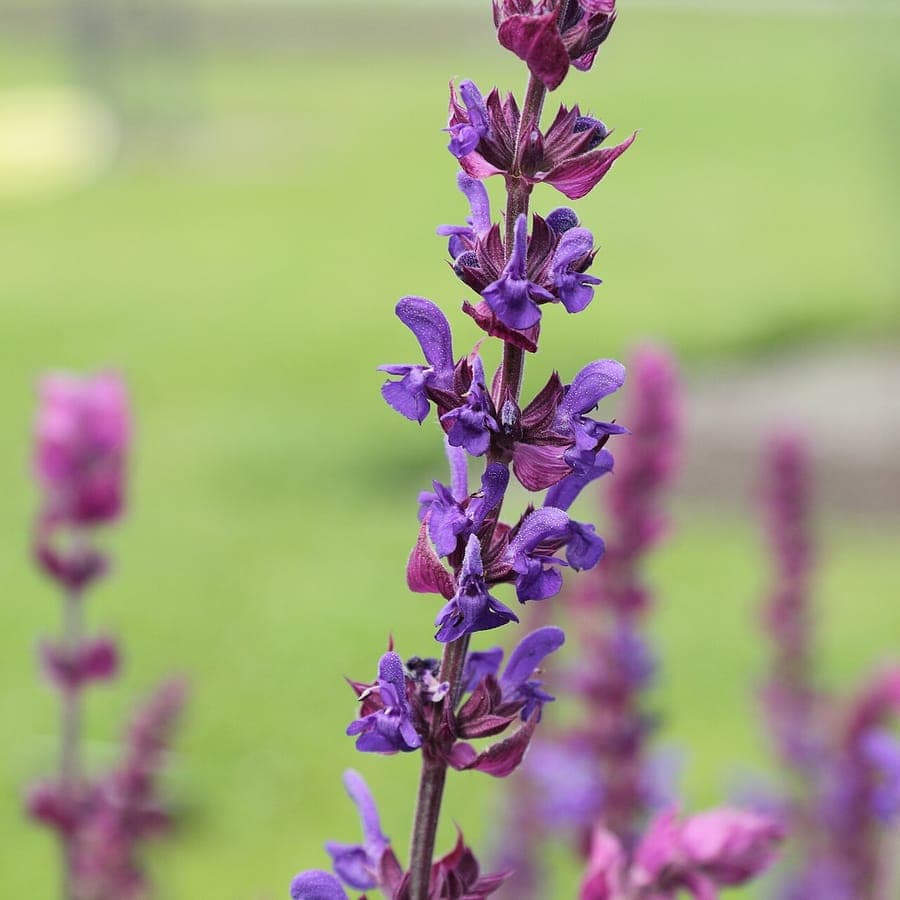
C T Johansson / CC BY-SA 3.0, via Wikimedia Commons
Woodland sage: complete guide
Salvia nemorosa
Want to see Woodland sage: complete guide in your garden?
1 minute, no credit card
Overview
Woodland Sage (Salvia nemorosa) - also sold as meadow sage or Balkan clary - is one of the most rewarding perennials you can plant. From May to September, this compact plant sends up slender, densely packed flower spikes in colours ranging from deep violet through lavender-blue to pure white. It is the plant that gives borders and prairie plantings their characteristic vertical rhythm, draws butterflies and bees like a magnet, and cheerfully blooms again after being cut back.
Salvia nemorosa hails from the steppes and forest margins of Central and Eastern Europe through to Western Asia, which explains why it performs so reliably in British, northern European, and temperate North American gardens. On gardenworld.app you can create a garden design where woodland sage serves as the unifying thread - along a garden path, as a low edging, or as a blue counterpoint to warm roses and orange coneflowers. The plant reaches 30–60 cm in height and forms tidy clumps 30–40 cm across. Top cultivar 'Caradonna' stands out for its dark purple stems and intense violet-blue flowers. 'Ostfriesland' (East Friesland) is a tried-and-true classic with deep blue spikes, 'Mainacht' (May Night) is the earliest to flower, and 'Schneehügel' (Snow Hill) offers crisp white as contrast.
Appearance and bloom
The flower spikes of woodland sage are slender and upright, 15–25 cm long, densely packed with small lipped flowers each just 1–1.5 cm across. It is the calyces that remain coloured after the petals drop, extending the ornamental display - in 'Caradonna' these are dark purple, keeping the plant decorative well after peak bloom. The foliage is grey-green, crinkled, aromatic when brushed, and forms a compact basal rosette.
The flowering season begins in May and lasts, with deadheading, deep into September. The first flush continues for four to six weeks. Cut the spent spikes back to just above the basal foliage and a complete second flush appears within three to four weeks, nearly as abundant as the first. With some cultivars, a third round is possible. This phenomenal flowering duration makes woodland sage one of the most valuable border plants in existence.
Ideal location
Woodland sage is a confirmed sun-lover and performs best in full sun - six to eight hours of direct sunlight per day. In partial shade the plant flowers less freely and the stems grow taller and floppier, prone to toppling. A south- or west-facing border, a dry bank, or a sunny gravel garden are ideal locations.
The plant tolerates heat, drought, and wind without complaint. In urban gardens it is an excellent choice for the hot, dry strip along a wall or fence. Its compact habit also makes it suitable for raised beds or large containers on a terrace. A spacing of 30–40 cm produces a pleasingly dense effect without overcrowding. In the USA, woodland sage thrives across a wide band from New England through the Midwest, and performs equally well in the dry summers of South Africa and southern Australia.
Soil requirements
Woodland sage demands well-drained soil above all else. In wet, heavy clay that stays waterlogged through winter, the roots rot away - this is the primary killer. If your soil is heavy, work coarse grit or gravel (20–30%) into the top 30 cm to improve drainage. Sandy and loamy soils suit the plant perfectly.
The ideal soil pH ranges from 6.0 to 8.0 - the plant favours neutral to slightly alkaline conditions. Unlike many perennials, woodland sage performs better in lean soil than in rich, heavily manured ground. Too much feeding produces lush foliage and floppy stems but fewer flowers. Add at most a modest amount of compost when planting, and avoid nitrogen-heavy fertilisers. Most garden centres stock Mediterranean or steppe-plant compost that works well.
Watering
Once established, woodland sage ranks among the most drought-tolerant perennials in the border. Its root system reaches deep, and the plant has a natural adaptation to dry summers. During the first growing season after planting, water weekly - roughly 5 litres per plant - to help the roots establish. Water at the base, not over the foliage.
From the second year onward, supplementary watering is only needed during extreme drought exceeding three weeks. In an average British or northern European climate, an established woodland sage almost always manages on rainfall alone. Too much water is far more damaging than too little: soggy feet lead to root rot and fungal disease. Container-grown plants dry out faster and need watering every two to three days during warm spells. Always ensure drainage holes and never stand the pot in a saucer.
Free design
Want to see Woodland sage: complete guide in your garden? Make a free design now.
Pruning
Pruning is the secret to a long-flowering woodland sage. The single most important task is cutting back the first flush of spent spikes in June or July. Trim the flower stems to just above the basal leaf rosette - this activates dormant buds and produces a complete second flush within three to four weeks. In 'Caradonna' and 'Ostfriesland', this second bloom is nearly as impressive as the first.
In autumn, after the final flush, leave the plant intact. The basal leaf rosettes stay partly green and offer the plant some winter protection. In early spring (March), cut away old flower stems and any brown foliage just before new growth begins. Give the clump a light trim to tidy the edges. Every three to four years, divide overcrowded clumps in spring - this rejuvenates the plant and maintains flowering vigour.
Maintenance calendar
March–April: Remove old stems and dead foliage. Divide overcrowded clumps if needed. Spread a thin layer of compost around the plants.
May: Flowering begins. Enjoy the first spikes. The plant needs no special attention at this stage.
June–July: First flush ends. Cut back spent spikes for a second bloom. This is the most important maintenance moment of the year.
August–September: Second (and sometimes third) flush. Keep the soil lightly moist only during extreme drought. No feeding after July.
October–November: Flowering is over. Leave basal foliage intact as winter protection. Optionally mulch lightly with leaf mould.
December–February: Winter dormancy. Order new cultivars from specialist nurseries if desired.
Winter hardiness
Salvia nemorosa is thoroughly winter-hardy and suited to USDA zones 4 to 8, covering temperatures down to approximately -30°C. Across the UK, the Netherlands, Belgium, and most of Germany, woodland sage overwinters without any protection whatsoever. The above-ground parts die back partially, but the rootstock and basal rosette survive the winter.
The greatest winter threat is - again - wetness, not cold. In well-drained soil there are no issues. In waterlogged clay, the rootstock can rot during a wet winter. Good drainage is therefore the best winter insurance. In extremely severe winters (below -25°C), you can lay a light covering of straw or leaves over the basal rosette, but in practice this is rarely necessary in temperate regions. Container plants are slightly more vulnerable: position the pot in a sheltered spot and insulate with bubble wrap in hard frost.
Companion plants
Woodland sage is the ultimate connector plant in the border: its vertical flower spikes bind round-flowered plants like roses and echinacea into a cohesive whole. The classic pairing is woodland sage with roses - the blue-violet spikes create a spectacular contrast against pink and red roses. This combination is the backbone of countless award-winning garden designs.
Other excellent partners include lavender (Lavandula angustifolia), which shares the same growing conditions, Stachys byzantina (lamb's ears) as a silvery carpet at the front, and ornamental grasses such as Stipa tenuissima for texture. Achillea (yarrow) in yellow or salmon creates a warm colour contrast. Echinacea purpurea and Rudbeckia provide taller accents behind the sage. For a prairie planting, combine woodland sage with Perovskia, Verbena bonariensis, and Gaura - an ensemble that flowers for months on end.
Closing
Woodland sage is the workhorse of the summer border: reliable, modest in its demands, yet spectacular in its performance. Few perennials offer such extended flowering, such intense colour, and such value for pollinators in so compact a package.
Start with a group of five to seven plants of the same cultivar for a powerful mass effect. 'Caradonna' is the safest pick for beginners: strong, elegant, and virtually indestructible. Garden centres carry the most popular varieties, and specialist perennial nurseries stock the full range. On gardenworld.app you can create a garden design that combines woodland sage with the perfect partners for your specific plot. Plant a drift of woodland sage along your garden path this spring and marvel at the endless parade of blue-violet spikes all summer.
Want to see Woodland sage: complete guide in your garden? Make a free design now.
Upload a photo, pick a style, and get a photorealistic design with plant list in under a minute.
No credit card required


Similar plants
English Lavender: complete guide
Lavandula angustifolia
Everything about English Lavender (Lavandula angustifolia): planting, pruning, care and overwintering. Practical tips for lush purple blooms.
Purple coneflower: complete guide
Echinacea purpurea
Everything about Purple Coneflower (Echinacea purpurea): planting, care, pruning and combinations. Expert tips for a thriving prairie-style garden.
Rugosa Rose: complete guide
Rosa rugosa
Everything about the Rugosa Rose (Rosa rugosa): planting, pruning, care and winter hardiness. Practical tips for abundant blooms in your garden.