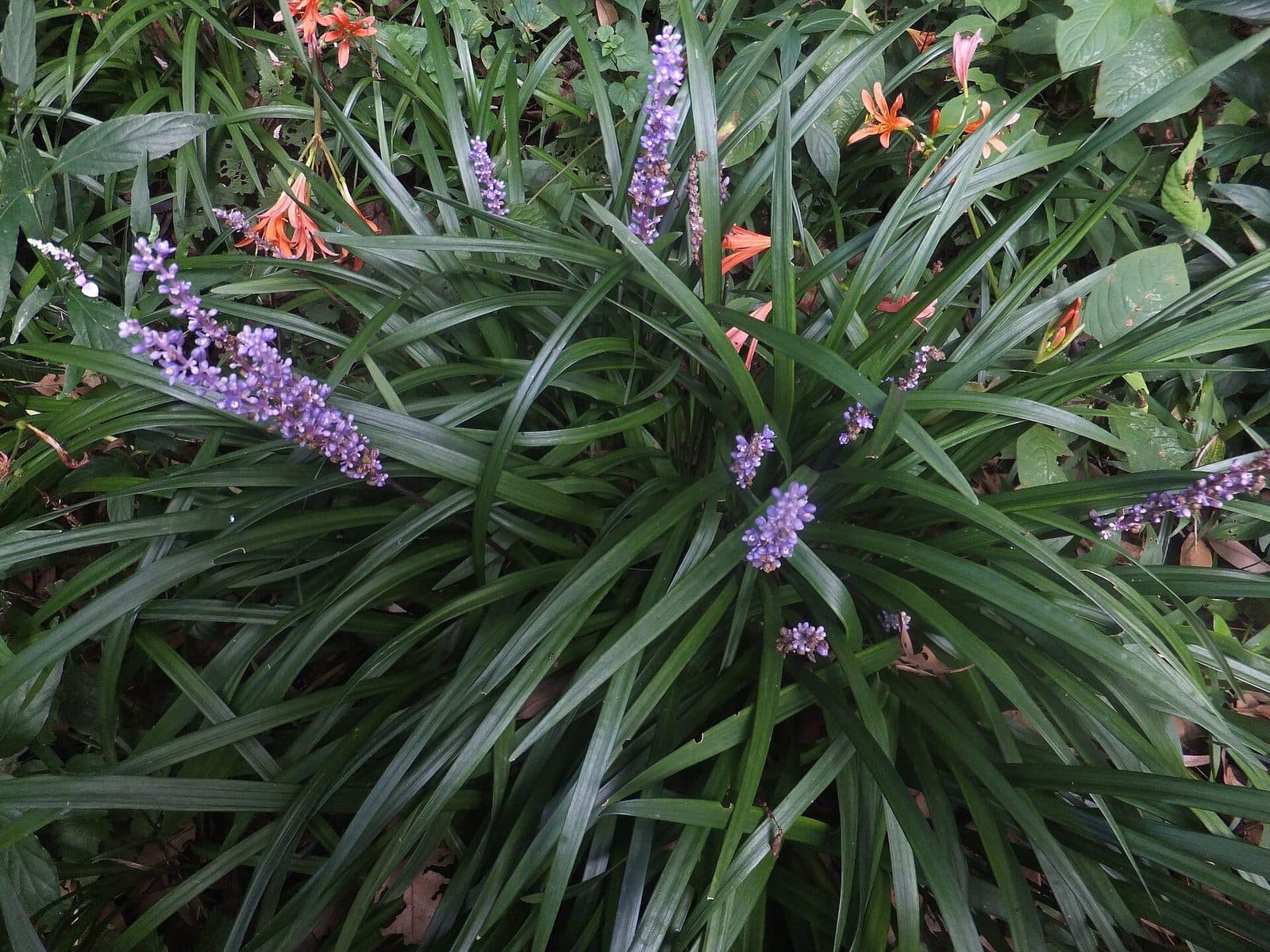
Syrio / CC BY-SA 4.0, via Wikimedia Commons
Lilyturf: complete guide
Liriope muscari
Want to see Lilyturf: complete guide in your garden?
Full design in HD: €7.99
Look after your Lilyturf with the GardenWorld app
Identify plants with your camera and get a care calendar with reminders for this plant.


Overview
Lilyturf (Liriope muscari) is a plant you appreciate most when the rest of the border is winding down. From August to October, when many perennials have finished, it sends up dense violet spikes above its dark green clumps. And when the border is bare in winter, the foliage simply stays green. It comes from woodland and hillsides in East Asia, from China and Taiwan to Korea and Japan, and belongs to the asparagus family (Asparagaceae), so despite its looks it is neither a grass nor a true lily. The species name muscari refers to the flower spikes, which resemble those of the grape hyacinth.
It forms tidy clumps 30 to 45 cm high and wide. Unlike its relative Liriope spicata, which runs by underground stolons, Liriope muscari spreads only slowly and stays where you put it. That makes it ideal for edging borders and paths and as ground cover beneath shrubs. Most garden centres stock the species and 'Big Blue', while specialist nurseries also offer deep purple 'Moneymaker', white 'Monroe White' and yellow-striped 'Variegata'. On gardenworld.app you can create a garden design in which lilyturf edges and anchors your planting through every season.
Appearance and bloom
The leaves are narrow and strap-like, 1 to 1.5 cm wide and 30 to 45 cm long, dark green with a soft sheen. They rise upright at first and then arch over gracefully. New leaves emerge from the heart of the clump in April and May.
Flower spikes appear in late July or August and continue into October. Each spike is 20 to 35 cm long and densely packed with small round buds that open into violet flowers about half a centimetre across, held just above or among the leaves. Bees and bumblebees visit them eagerly, as there is little other nectar around in autumn. Glossy black berries follow and last well into winter. They are not edible, but they are a lovely detail in a winter garden.
Ideal location
Lilyturf does best in partial shade: morning sun with afternoon shade, or beneath the light canopy of a tree. It also grows in full sun provided the soil does not dry out. In deep shade the foliage stays handsome but flowering is sparse. White 'Monroe White' and variegated 'Variegata' are happier in shade than in sun, as their leaves can scorch in bright light.
Shelter helps in colder gardens. Harsh easterly winds in winter can brown the leaf tips. That does no lasting harm, as the old foliage is cut back in late winter anyway, but the plant looks better all winter in a protected corner.
Soil
Liriope muscari grows in almost any well-drained garden soil. Ideal is a humus-rich, slightly acid to neutral soil with a pH of 5.5 to 7. On heavy clay that stays wet in winter, the heart of the clump can rot, so work compost and some grit into the top 20 cm. On sandy soil, a layer of compost at planting time is enough.
Space plants 30 to 40 cm apart, which works out at seven to nine per square metre for complete ground cover. For an edging, set them 30 cm apart in a line. The best planting times are March to May and September to mid October. Keep the crown at the same level as in the pot, since planting too deep encourages crown rot.
Watering
In its first year, lilyturf needs regular water, especially in dry summers: one generous soaking a week so that moisture reaches deeper soil. After that it is surprisingly drought tolerant, thanks to fleshy roots with small tubers that store water and nutrients. Under trees, where roots compete for every drop, it carries on where many perennials give up.
Overwatering causes more trouble than drought. Winter waterlogging can rot the crown, and wet summers give slugs and snails a better chance at the young leaves. A light feed of compost or organic fertiliser in April is plenty. Too much nitrogen gives floppy leaves and fewer flowers.
Free preview
Want to see Lilyturf: complete guide in your garden? Make a free preview of your design.
Pruning
Lilyturf is evergreen, but after a winter the foliage often looks ragged or brown at the tips. In late winter, in February or early March at the latest, cut all the old leaves back to 5 to 8 cm above the ground. Do this before new leaves appear from the centre; cut too late and you clip the tips of the new growth, which then stay blunt all season. Hedge shears make quick work of it, and large plantings in public spaces are sometimes simply mown with the mower on its highest setting.
Faded flower spikes can stay through autumn for the black berries; they disappear with the winter trim. Every three or four years, or when the centre of a clump becomes bare, divide it in March or April. Slice the clump with a spade into pieces with several fans of leaves and a good root system each, and replant straight away.
Maintenance calendar
- January: nothing to do; leave the foliage as protection.
- February and early March: cut old leaves back to 5 to 8 cm before new growth appears.
- March and April: divide and replant; spread compost around the clumps.
- April and May: fresh new leaves; watch for slugs in damp weather.
- June and July: water young plantings during long dry spells.
- August to October: flowering; bees and bumblebees on the spikes.
- September and October: good time to plant new clumps.
- November and December: black berries decorate the winter garden; foliage stays green.
Winter hardiness
Liriope muscari is hardy in USDA zones 6 to 10, which means it tolerates frost down to about -20 °C. Throughout most of Britain and Ireland it overwinters without protection. In an exceptionally hard winter the foliage may turn brown, but the clump regrows normally in spring.
Protection is only needed for plants in containers or in wet soil. Stand pots against a wall on pot feet over winter so excess water can drain away. In the open ground, good drainage is the best winter protection: frost is rarely the problem, wet roots are.
Companion plants
Lilyturf works well with other plants for part shade and shade. Broad-leaved Hosta sieboldiana makes a striking contrast with its narrow leaves. Alumroot adds red, bronze or silver foliage that lasts through winter, and Carex morrowii is another evergreen clump of similar shape, useful to alternate along a long edge. The Christmas rose flowers from December to March, picking up just as lilyturf rests.
Note the difference with Japanese lilyturf, often called mondo grass. It looks very similar but is finer and lower, and its white to lilac flowers are hidden among the leaves. Planted together, mondo in front and liriope behind, they make a calm evergreen edging in two heights.
Closing
Lilyturf is a plant for gardeners who value calm and structure: evergreen foliage, violet spikes when the border fades, black berries in winter and very little work. Give it part shade, soil that does not stay wet in winter and cut back the old leaves in late February, and it will last for many years. On gardenworld.app you can see how Liriope muscari would edge a border or fill a shady corner under trees in your own garden.
Frequently asked questions about Lilyturf
Is Lilyturf winter hardy?
Liriope muscari is hardy in USDA zones 6 to 10, which means it tolerates frost down to about -20 °C. Throughout most of Britain and Ireland it overwinters without protection.
When and how do you prune Lilyturf?
Lilyturf is evergreen, but after a winter the foliage often looks ragged or brown at the tips. In late winter, in February or early March at the latest, cut all the old leaves back to 5 to 8 cm above the ground.
How much water does Lilyturf need?
In its first year, lilyturf needs regular water, especially in dry summers: one generous soaking a week so that moisture reaches deeper soil. After that it is surprisingly drought tolerant, thanks to fleshy roots with small tubers that store water and nutrients.
Where does Lilyturf grow best?
Lilyturf does best in partial shade: morning sun with afternoon shade, or beneath the light canopy of a tree. It also grows in full sun provided the soil does not dry out.
What soil does Lilyturf need?
Liriope muscari grows in almost any well-drained garden soil. Ideal is a humus-rich, slightly acid to neutral soil with a pH of 5.5 to 7.

See it in your garden
See Lilyturf in your garden
One photo of your garden and a few questions. You see the result in about a minute.
Try it with a photoIdentify this plant in your own garden. Identify a plant
Similar plants
Hosta sieboldiana: complete guide
Hosta sieboldiana
Hosta sieboldiana growing guide: large blue-green shade plant from Japan. Complete care tips, placement and maintenance for shady gardens and woodland areas.
Alumroot: complete guide
Heuchera micrantha
Discover how to grow and care for Heuchera micrantha: ideal light, soil, watering, and seasonal maintenance for thriving plants in your garden.
Carex morrowii: complete guide
Carex morrowii
Japanese sedge (Carex morrowii) is an elegant shade groundcover for cool gardens. Learn how to grow this bird-friendly sedge for year-round foliage interest.