
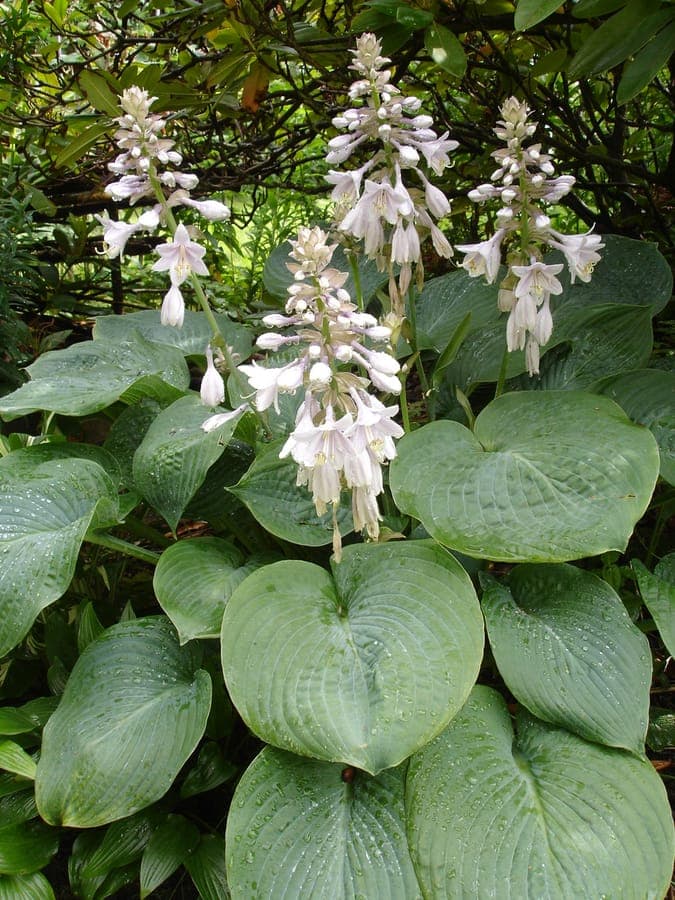
Epibase / CC BY 2.5, via Wikimedia Commons
Hosta sieboldiana: complete guide
Hosta sieboldiana
Want to see Hosta sieboldiana: complete guide in your garden?
1 minute, no credit card
Overview
Hosta sieboldiana is an elegant foliage plant native to Japan, particularly from woodland shade areas of northern Honshu. This large, beautiful shade plant is especially renowned for its waxy blue-green leaves that are deeply textured with prominent veins. This is ideal for shady gardens where little else will grow or where you need structure and visual interest. Hosta sieboldiana is a true shade hero and grows where many other plants struggle. The plant belongs in shade and looks most beautiful nestled between ferns and shade-lovers.
Appearance and bloom
This Hosta reaches an impressive height of 60 to 80 centimeters and width of approximately 100-120 centimeters at maturity. Leaves are very large, up to 30 centimeters long and 20 centimeters wide, thick, fleshy and waxy blue-green. Leaves have deep wrinkles and prominent veins. Flowers are lavender to purple, appear in June-July on upright, thick stems. Flowers are pleasantly fragrant. Planted in groups forms excellent groundcover effect.
Ideal location
Plant in dappled to deep shade for best foliage appearance. While full sun is technically possible, leaves discolor severely in too much direct sunlight and sometimes burn. Protect absolutely from intense midday sun which causes damage. Ideal under large trees and against shaded walls. In very cold areas, protection from cold winds is valuable. Vary plant sizes for visual depth and interest.
Soil
Moisture-retentive, humus-rich soil is absolutely ideal for optimal growth. pH between 5.5 and 7.5 is suitable. Add leaf mould, peat and compost to native soil. Well-drained soil prevents root problems and rot. Hostas grow in various soil types as long as they remain moist but not waterlogged. Rotating organic matter addition helps greatly.
Free design
Want to see Hosta sieboldiana: complete guide in your garden? Make a free design now.
Watering
Keep soil moister than with most garden plants, but absolutely not waterlogged. Water well during dry periods, especially first season. Mulch of 5-7 centimeters helps retain moisture strongly. Drip irrigation is ideal if available. Water in early morning prevents leaf diseases and fungal problems.
Pruning
Minimal pruning needed for healthy growth. Remove damaged, discolored or diseased leaves carefully. After blooming, flower stems can be removed or left for seed. Compost damaged parts. Leaving dead leaves for winter protection helps.
Maintenance calendar
April-May: Growth period begins, moisture management starts. June-July: Full growth and bloom. August-September: Leaf care and moisture management. October: Winter preparation, leave foliage for protection.
Winter hardiness
Hosta sieboldiana is very winter hardy to minus 35 degrees Celsius and even colder. Excellent frost resistance in Northern climates. Plant does not die back except in extreme weather. Protection helps in harsh locations.
Companion plants
Plant alongside other shade plants such as ferns, bleeding heart, anemone, heuchera, astilbe and epimedium. Beautiful effect with white-flowering plants like astilbe 'Bridal Veil'. Form groundcover groups for visual impact. Combines well with variegated foliage. Mix different hosta varieties.
Closing
With this complete guide, you enjoy a beautiful, healthy Hosta for many years. Find quality plants at garden centers. For more professional gardening tips, visit gardenworld.app for additional plant guides. Hosta sieboldiana brings elegance and structure to the shadiest corners of your garden!
Want to see Hosta sieboldiana: complete guide in your garden? Make a free design now.
Upload a photo, pick a style, and get a photorealistic design with plant list in under a minute.
No credit card required


Similar plants
Narrow-leaved dracaena: complete guide
Dracaena angustifolia
Everything about Dracaena angustifolia - the narrow-leaved dracaena: location, care, overwintering and use as a houseplant or patio plant.
Chaparral yucca: complete guide to Hesperoyucca whipplei
Hesperoyucca whipplei
Hesperoyucca whipplei (Our Lord's candle) is a dramatic rosette-forming plant from California that produces a towering flower spike, ideal for dry and gravel gardens.
False lily-of-the-valley: complete guide
Maianthemum dilatatum
Everything about Maianthemum dilatatum, the false lily-of-the-valley. Care, shade location, propagation and garden combinations for this popular shade ground cover.