
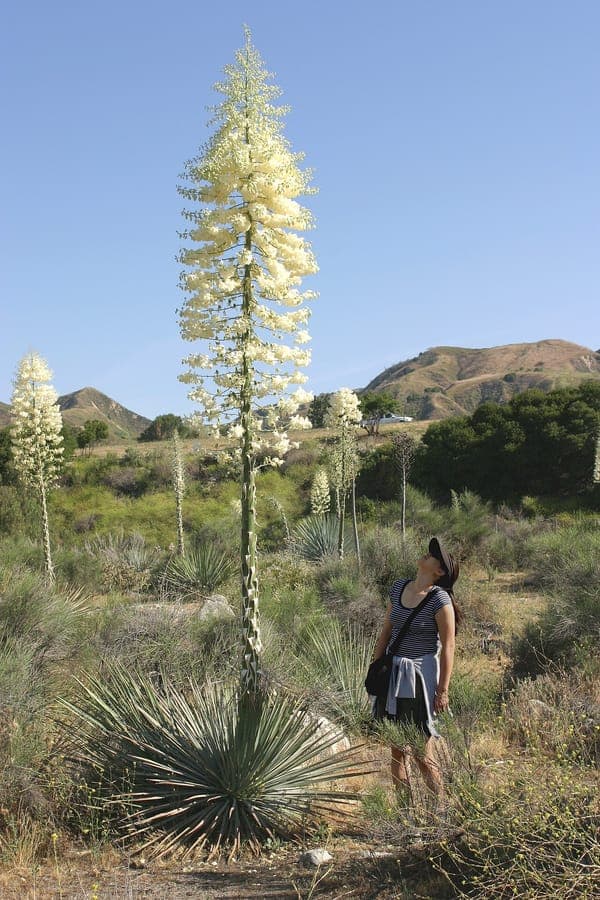
The original uploader was Vgrubsky at English Wikipedia. / CC BY-SA 3.0, via Wikimedia Commons
Chaparral yucca: complete guide to Hesperoyucca whipplei
Hesperoyucca whipplei
Want to see Chaparral yucca: complete guide to Hesperoyucca whipplei in your garden?
1 minute, no credit card
Overview
Hesperoyucca whipplei, commonly known as chaparral yucca, our Lord's candle, or quixote yucca, is one of the most architecturally dramatic plants available for dry, sunny gardens. A member of the Asparagaceae family, it is closely related to true yuccas and shares their bold, spiky character. The botanical name honours Amiel Whipple, the American officer who led a surveying expedition through the American Southwest in the 1850s and first documented the plant scientifically.
In nature, Hesperoyucca whipplei is native exclusively to California and the neighbouring northwest of Mexico, particularly Baja California. It grows on dry, rocky slopes and coastal plains at elevations from sea level to around 1,800 metres, where it is a defining component of the chaparral - the iconic California dry shrubland dominated by drought-adapted woody shrubs. In this setting it grows alongside Arctostaphylos (manzanita), Ceanothus (California lilac), and various Salvia species.
What makes Hesperoyucca whipplei genuinely remarkable is its once-in-a-lifetime flowering event. The plant grows for many years as a compact rosette of stiff, spine-tipped leaves before producing a single towering flower spike, sometimes exceeding 3 metres in height, bearing hundreds of creamy white flowers. After this explosive blooming the central rosette dies, but offsets around the base continue the colony. Gardeners looking to create bold, drought-resistant garden designs can find expert planting advice and inspiration at gardenworld.app.
This unique lifecycle combined with its year-round sculptural presence makes chaparral yucca increasingly popular in European gravel gardens, Mediterranean-style landscapes, and contemporary low-maintenance designs where strong structure is prized.
Appearance and bloom cycle
Hesperoyucca whipplei forms a dense, globe-shaped rosette of long, narrow, blue-grey-green leaves growing to 80 cm in length and only 1 to 2 cm in width. The leaves are rigid and straight, each ending in a sharp, needle-like point capable of inflicting a painful wound. Leaf margins are finely toothed and produce distinctive white threads that unravel and curl outward, creating a distinctive frayed appearance.
The rosette typically reaches 60 to 150 cm in diameter and 30 to 90 cm in height during its vegetative phase. After several years of growth - typically between 5 and 25 years depending on conditions - the plant sends up a central flower stalk that races upward, sometimes reaching 200 to 360 cm. This stalk carries hundreds of pendant, creamy white, lightly fragrant flowers arranged in a dense panicle. Bloom time falls in spring to early summer, from April to June in the wild.
After flowering, the central rosette dies. Where offset rosettes have formed at the base - as they do in most specimens - these continue growing and will eventually flower themselves. The dried flower stalks remain decorative for months, adding structural winter interest to the garden.
Growth rate is slow, which is an important practical consideration: this is a plant that rewards patience but is not suitable for gardeners wanting quick results.
Ideal location
Hesperoyucca whipplei demands full sun without compromise. It will not thrive in partial shade and will certainly never flower in insufficient light. At least eight hours of direct sunlight daily is a minimum requirement. It performs best in hot, sheltered positions that maximise heat absorption - against a south-facing wall or among pale-coloured rocks that reflect heat back onto the plant.
This plant is exceptionally well suited to gravel gardens, xeriscape designs, Mediterranean-style plantings, rock gardens, and as a bold focal point specimen. Its symmetrical rosette gives it strong sculptural value throughout the year, making it excellent for modern garden design. It also performs very well in large containers on sun-drenched patios and terraces.
Sites on slopes, in raised beds, or on elevated ground provide the fast drainage this plant needs. Avoid any low-lying position where water collects after rain. In high-humidity or high-rainfall regions, an elevated planting position is especially important to prevent root rot.
For garden designers and home gardeners alike, gardenworld.app offers tailored garden design services that incorporate striking drought-tolerant specimens like chaparral yucca into beautiful, practical planting schemes.
Soil
The soil requirements of Hesperoyucca whipplei are both simple and strict: drainage must be outstanding. No other soil characteristic is as important to this plant's survival as the ability to shed excess water rapidly. In its natural habitat it grows in thin, rocky, sandy, or gravelly soils that dry out within hours of rainfall.
Soil pH can range from slightly acid to strongly alkaline (pH 6.4 to 8.5), making the plant tolerant of a wide range of garden soils from chalk-based to moderately acidic. Nutrient requirements are minimal - lean, poor soil is actually preferred over rich, fertile garden ground. Excessive nitrogen produces lush but soft growth that is more vulnerable to disease and frost damage.
In heavy clay or loam soils, significant improvement is essential before planting. Excavate a planting hole at least 60 cm in diameter and 50 cm deep. Backfill with a mixture of 50% coarse grit or gravel and 50% lean, sandy topsoil. Add an additional drainage layer of coarse gravel at the base. In regions with high rainfall, a raised bed 30 to 40 cm above surrounding grade can make the difference between success and failure.
Fertilise very sparingly: a small amount of low-nitrogen, slow-release fertiliser once every two years in spring is sufficient in genuinely poor soils. Skip fertilising altogether in average garden soils.
Free design
Want to see Chaparral yucca: complete guide to Hesperoyucca whipplei in your garden? Make a free design now.
Watering
Hesperoyucca whipplei is among the most drought-tolerant garden plants available. Once well established - a process that takes two to three years - it needs little or no supplemental watering in Mediterranean climates and survives extended periods of complete drought in its California homeland.
In the first year after planting, cautious and infrequent watering helps support root establishment. Water once every two to three weeks, and only when the soil has dried out completely. In years two and three, gradually reduce watering frequency further. Established plants in the ground in a European climate with regular seasonal rainfall typically need no supplemental watering during the growing season.
The most common mistake with this plant is overwatering. Persistent soil moisture invariably leads to root rot - the leading cause of death. In case of uncertainty, give no water rather than too much. In northern European winters, ensuring the plant does not stand in pooled rainwater is critical.
Container specimens are easier to manage in terms of watering: allow the growing medium to dry out completely between waterings during the growing season, and keep entirely dry from November to March.
Pruning
Hesperoyucca whipplei requires minimal pruning, but what pruning is done must be carried out carefully given the sharp, spine-tipped leaves. Thick leather gloves and protective clothing are essential.
Living rosette leaves are never pruned: they are essential for photosynthesis and for forming the flower bud. Remove only the dead, brown leaves found at the outer edges of the rosette. These can be cut away cleanly at the base or carefully pulled downward and stripped from the stem.
After flowering, the central rosette will die. Dead leaves and stems can be removed once completely dry. Take care not to damage the living offset rosettes that have formed around the dying parent. The dried flower stalk can be left in place for a season as a structural element if desired.
In containers, remove dead outer leaves each spring to keep the plant tidy and eliminate potential disease sites.
Maintenance calendar
March-April: Inspect the plant after winter. Remove dead or damaged leaves. Check for offset rosettes forming at the base. Apply a very small amount of slow-release fertiliser in well-drained conditions if desired.
May-June: Peak flowering period for mature specimens. Enjoy the spectacular display. In very dry regions, water extremely sparingly if there has been no rain for several weeks.
July-August: Driest period. No or minimal watering. Remove any weeds growing close to the plant.
September-October: Inspect for signs of root rot if summer rainfall was heavy. Check drainage around the base of the plant.
November-February: Dormancy. No watering. Protect containers from hard frost. In the open ground in mild climates, no protection is usually needed.
Winter hardiness
Hesperoyucca whipplei is considerably hardier than its exotic appearance suggests. It is classified in USDA hardiness zones 7 to 10, meaning it can tolerate temperatures down to approximately -12 to -15 degrees Celsius - provided the soil drainage is excellent. In wet, waterlogged soil, frost hardiness is significantly reduced.
In the Netherlands and Belgium it can overwinter outdoors in well-sheltered, well-drained positions. The combination of frost and waterlogged soil during winter is the greatest threat. In the most maritime-influenced parts of the Netherlands and Belgium - coastal and south-western areas - outdoor overwintering is feasible with good drainage. In other regions, some protection is advisable.
Winter protection measures include: tying the leaves loosely upright around the central growing point to protect it from frost, applying a layer of dry mulch around (but not touching) the base of the plant, and covering with horticultural fleece during prolonged cold spells.
Container specimens are easily overwintered frost-free in an unheated greenhouse, garden room, or on a cool windowsill indoors. Keep completely dry throughout winter. The plant overwinters better in a cool, dry environment than in a warm, centrally heated room.
Companion plants
Chaparral yucca works best as a bold architectural specimen in combination with other drought-tolerant, Mediterranean-character plants. For a personalised garden design that features Hesperoyucca whipplei as a focal point, gardenworld.app offers expert design services tailored to your specific site conditions.
Excellent companions include Agave americana, Stipa tenuissima (feather grass), Festuca glauca (blue fescue), Lavandula angustifolia (lavender), Euphorbia characias (spurge), Salvia officinalis, various Cistus species, and Phlomis fruticosa. Low-growing Sedum or Delosperma species work well as ground-cover beneath and around the rosette.
In a gravel or stone garden, the sculptural form of the rosette is shown to best advantage. Combine with large decorative boulders and a deep gravel mulch for a genuinely arid landscape effect. Avoid combining with moisture-loving plants whose irrigation needs conflict with this plant's requirements.
Look for chaparral yucca and related species at specialist nurseries and garden centres. Named cultivars and subspecies may offer variation in leaf colour, plant size, and hardiness.
Closing thoughts
Hesperoyucca whipplei is a plant for patient gardeners - but the wait is repaid with one of the most spectacular events the plant world has to offer. The combination of year-round sculptural elegance and a once-in-a-lifetime flowering explosion makes it unique among garden plants.
It is perfectly suited to the growing gardening trends of xeriscaping, gravel gardening, and low-maintenance design. Its structural presence endures long before and long after the dramatic flowering moment. Visit gardenworld.app for personalised garden design incorporating drought-tolerant architectural plants that suit your garden and lifestyle.
Want to see Chaparral yucca: complete guide to Hesperoyucca whipplei in your garden? Make a free design now.
Upload a photo, pick a style, and get a photorealistic design with plant list in under a minute.
10,000+ gardens designed already
No credit card required


Similar plants
Fivenerve helianthella: complete guide
Helianthella quinquenervis
Helianthella quinquenervis is a tough, sunflower-like perennial native to the Rocky Mountains, perfect for dry, sunny gardens and naturalistic borders.
Swamp sunflower: complete guide to Helianthus angustifolius
Helianthus angustifolius
Helianthus angustifolius, the swamp sunflower, is a tall, late-flowering perennial with masses of golden blooms in autumn, ideal for moist borders and wildlife gardens.