
Eric Hunt / CC BY-SA 4.0, via Wikimedia Commons
Swamp sunflower: complete guide to Helianthus angustifolius
Helianthus angustifolius
Want to see Swamp sunflower: complete guide to Helianthus angustifolius in your garden?
1 minute, no credit card
Overview
Helianthus angustifolius, commonly known as swamp sunflower or narrow-leaf sunflower, is one of the most spectacular late-season perennials available to gardeners. A member of the daisy family (Asteraceae), it earns its 'swamp' common name from its natural preference for moist, even wet ground - quite unlike the better-known annual sunflower. The species name 'angustifolius' derives from Latin meaning 'narrow-leaved', describing the distinctive long, slender leaves that set it apart from other Helianthus species.
Native to the central and eastern United States, swamp sunflower grows naturally in a broad arc from Florida, Alabama, Mississippi, Louisiana, and Texas along the Gulf Coast, through the Mid-Atlantic states of Virginia, North Carolina, and South Carolina, and north to New York, New Jersey, and Pennsylvania. Inland populations occur in Missouri, Indiana, Iowa, Kentucky, Ohio, and the Appalachian states. In all these locations it typically occupies low, wet ground along stream banks, in marshes, and across moist open fields.
In garden cultivation across Europe and beyond, swamp sunflower has become increasingly sought after for a straightforward reason: it provides masses of brilliant golden-yellow flowers at precisely the time of year when most other perennials have finished. This late-season performance, running from September through November, fills a genuine gap in the gardening calendar. Gardeners looking for autumn-flowering plant combinations can explore gardenworld.app for tailored design inspiration.
Beyond its garden value, swamp sunflower is an important plant for late-season pollinators. Bees, butterflies, and hoverflies find rich nectar in the flowers at a time when few other plants are in bloom. As the flowers fade, the seed heads provide food for seed-eating birds through the winter months.
Appearance and bloom cycle
Swamp sunflower is a bold, upright perennial that commands attention through its sheer size. Under good growing conditions it typically reaches 150 to 200 cm in height, with exceptional specimens in rich, moist soil sometimes exceeding 250 cm. The stems are strong, somewhat woody at the base, and branch only in the upper half, giving the plant a distinctive candelabra-like form when in full bloom.
The leaves are long and narrow - up to 20 cm in length but only 1 to 2 cm wide - giving the plant a fine-textured, almost grass-like quality that contrasts beautifully with its large flowers. Leaf surfaces are rough and slightly bristly. Stems can have a reddish tinge, adding another subtle decorative detail.
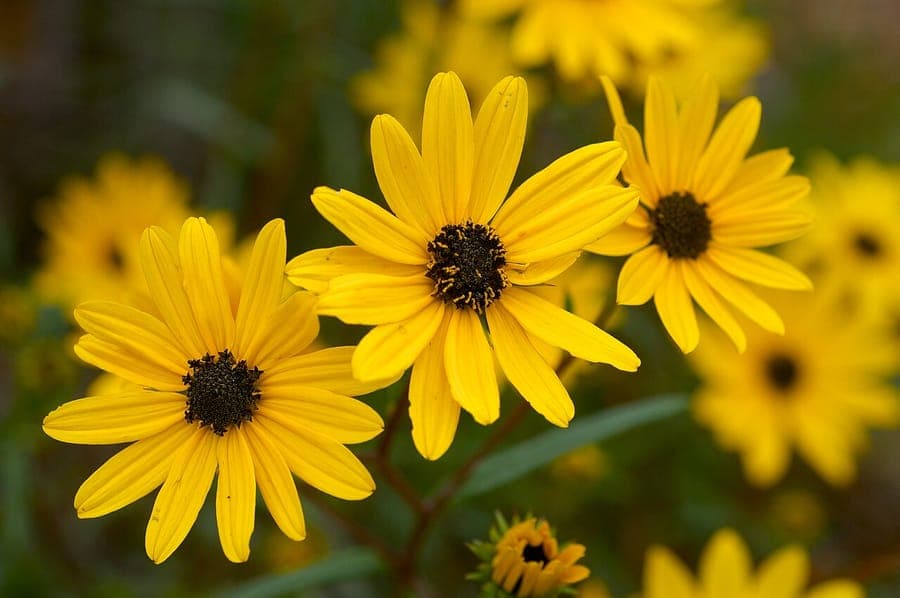
The flowers are classic sunflower forms: bright yellow ray florets surrounding a dark purple-brown central disc. Individual flower heads measure 5 to 7 cm across. At the peak of flowering in October, a well-grown plant can carry hundreds of flower heads simultaneously, creating a spectacular mass of gold that catches the low autumn sunlight beautifully.
Flowering runs from September through November, occasionally extending into December in mild autumns. Swamp sunflower is a rhizomatous plant that slowly spreads via underground runners, eventually forming colonies. This spreading habit is an asset in large gardens but needs monitoring in smaller spaces.
Ideal location
Swamp sunflower demands full sun for best performance. Six or more hours of direct sunlight per day is essential - in too much shade plants grow vigorously but produce few flowers and tend to flop. In its natural range it always occupies open, sun-drenched positions rather than shaded woodland.
The plant's natural habitat of stream banks, marshes, and moist meadows tells us clearly that it prefers consistently moist growing conditions - more moisture-tolerant than most other Helianthus species. This makes it particularly valuable for damp corners, rain gardens, and pond-side plantings where other sun-lovers would struggle.
At the back of a large border, swamp sunflower provides tremendous late-season height and colour. It works particularly well as a screen or backdrop plant alongside fences and walls. In cottage and naturalistic garden styles it fits in naturally alongside other tall late-season perennials.
For wildlife garden design, swamp sunflower is close to ideal. It attracts late-flying pollinators, supports seed-eating birds in winter, and its dense colony structure provides shelter for beneficial insects. Get personalised garden design advice incorporating swamp sunflower at gardenworld.app.
Soil
Swamp sunflower is not especially fussy about soil type provided moisture is adequate. It performs best in consistently moist to occasionally wet soil with reasonable organic matter content. Heavy clay soils work well, especially if they retain moisture through the summer months. Sandy or gravelly soils need significant improvement with organic matter to hold enough moisture for good growth.
The soil pH tolerance is broad, from moderately acid to neutral (pH 4 to 7). This flexibility means swamp sunflower adapts to a wide range of garden soils without amendment of pH. Annual additions of well-rotted compost or leaf mould improve both moisture retention and nutrient levels, promoting lush growth and abundant flowering.
One important note: despite its tolerance for very wet conditions, swamp sunflower does not thrive in anaerobic, stagnant water with no oxygen circulation. It tolerates temporary flooding and consistently wet soil, but needs some soil aeration for the roots to function properly.
In drier garden soils, the plant can still succeed with supplemental watering, but will not reach its full potential height or produce as many flowers as in its preferred moist conditions.
Free design
Want to see Swamp sunflower: complete guide to Helianthus angustifolius in your garden? Make a free design now.
Watering
Consistent moisture is the key to swamp sunflower success. This distinguishes it from drought-tolerant prairie sunflowers: Helianthus angustifolius genuinely needs regular watering during dry spells to perform at its best.
In the growth period from May through September, keep the soil consistently moist but not waterlogged. The plant signals water stress clearly: leaves begin to wilt before flowers are affected, and recovery after watering is rapid. In hot, dry summers, watering two to three times per week may be necessary on free-draining soils.
A generous layer of organic mulch - 5 to 8 cm of composted bark, garden compost, or leaf mould - around the base of the plants makes a significant difference in moisture retention. This reduces watering frequency and keeps roots cool in summer heat.
In naturally moist gardens, bog gardens, or pond-side plantings, supplemental watering is rarely needed. In average garden soil in a typical summer, weekly deep watering provides a useful guideline. Always water at the base rather than overhead to avoid promoting fungal problems on the foliage.
Pruning
Swamp sunflower benefits from a specific pruning approach that significantly improves its garden performance. The 'Chelsea chop' - cutting all stems back by one-third to one-half in mid-May - results in shorter, more branched plants with a much longer flowering period. The technique delays flowering by only two to three weeks while greatly improving plant structure and flower count.
For gardeners who want maximum height, cut only half the stems back and leave the rest intact. This staggers the flowering season and gives the planting a more natural appearance.
After the main flowering period, once frost has damaged the upper portions, cut stems back to 20 to 30 cm above ground level. Leave seed heads in place as long as birds are actively feeding on them - typically through December or January. Remove the remaining stubs entirely in late winter, before new growth appears in early spring.
Spread control is the other important pruning task. Every two to three years in spring, dig around the colony with a sharp spade to remove outermost rhizomes and restrict the spread. Divisions can be replanted elsewhere or shared with other gardeners - a practical benefit of this plant's enthusiasm for spreading.
Maintenance calendar
March-April: Remove remaining old stems completely. New shoots emerge early; these are the first sign of the season's growth. Apply a generous layer of compost as mulch. Check colony edges and remove outward-spreading rhizomes if needed.
May-June: Apply the Chelsea chop around mid-May if desired. Water regularly during dry spells. Remove weeds competing within the colony.
July-August: Rapid growth phase. Keep soil consistently moist. Stake the tallest plants in windy positions or where the colony borders a path.
September-October: Peak flowering season. No pruning needed. Enjoy the display and observe the pollinators and birds visiting the flowers.
November-February: After frost, cut back to 20-30 cm. Leave seed heads for birds. Remove all stems in late February before the new growing season begins.
Winter hardiness
Helianthus angustifolius is a reliably hardy perennial for most of north-western Europe. Its persistent underground rhizomes survive even hard winters without difficulty, as the storage organs lie below the frost line in typical garden soils. The plant is classified in USDA hardiness zones 6 to 9, though it has proven hardy to zone 5 conditions in practice when given good drainage in winter.
In typical Dutch and Belgian winters - with temperatures occasionally reaching -10 to -15 degrees Celsius - no special winter protection is required. The rhizomes are well protected beneath the soil surface. Only in exceptionally cold winters, where the ground freezes deeply, might a layer of dry mulch provide useful additional insulation.
An important distinction from summer: while swamp sunflower loves moisture in the growing season, the dormant rhizomes are more vulnerable to rot in waterlogged winter soil than to frost damage. Ensure that winter drainage is adequate, even if moisture levels are maintained during the growing season.
After very cold winters, new growth may appear later than usual - sometimes not until April or even early May. Patience is worth exercising before assuming the plant has not survived.
Companion plants
Swamp sunflower is a natural partner for other tall, late-season perennials in large borders and naturalistic plantings. For a complete autumn-themed border design, visit gardenworld.app for personalised planting advice.
Ideal companions include Aster novi-belgii and Aster x frikartii (Michaelmas daisies), Rudbeckia fulgida (black-eyed Susan), Eupatorium purpureum (Joe Pye weed), Vernonia noveboracensis (ironweed), Sanguisorba officinalis (great burnet), and Persicaria amplexicaulis (red bistort). Tall ornamental grasses such as Miscanthus sinensis and Panicum virgatum complement the plant in texture and seasonal timing.
For dramatic colour contrast, combine the golden yellow of swamp sunflower with the deep crimson of Canna indica or the rich purple of Vernonia. These combinations are at their most spectacular in October under low autumn sunlight.
Check specialist nurseries and garden centres for named cultivars. 'Mellow Yellow' is a popular compact selection, while 'First Light' begins flowering in August rather than September - both worth seeking out for specific garden situations.
Closing thoughts
Swamp sunflower is one of the finest autumn-flowering perennials for gardens in north-western Europe. Its generous golden display arrives just when the garden needs colour most, and its value to late-season pollinators and seed-eating birds makes it a genuinely worthwhile addition to any wildlife-friendly planting scheme.
Requiring some space and occasional division to keep it in check, it repays this modest investment with years of spectacular late-season colour. Find it at specialist perennial nurseries and garden centres. For design ideas that put swamp sunflower centre stage in a beautiful autumn border, gardenworld.app offers expert plant combinations and full garden design services.
Want to see Swamp sunflower: complete guide to Helianthus angustifolius in your garden? Make a free design now.
Upload a photo, pick a style, and get a photorealistic design with plant list in under a minute.
10,000+ gardens designed already
No credit card required


Similar plants
Fivenerve helianthella: complete guide
Helianthella quinquenervis
Helianthella quinquenervis is a tough, sunflower-like perennial native to the Rocky Mountains, perfect for dry, sunny gardens and naturalistic borders.
Chaparral yucca: complete guide to Hesperoyucca whipplei
Hesperoyucca whipplei
Hesperoyucca whipplei (Our Lord's candle) is a dramatic rosette-forming plant from California that produces a towering flower spike, ideal for dry and gravel gardens.