
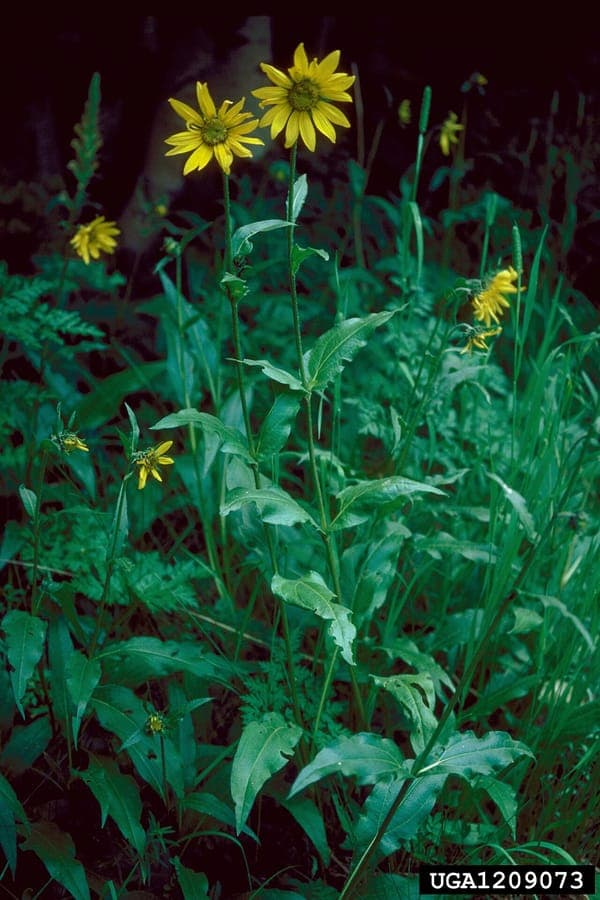
Dave Powell, USDA Forest Service, Bugwood.org / CC BY 3.0 us, via Wikimedia Commons
Fivenerve helianthella: complete guide
Helianthella quinquenervis
Want to see Fivenerve helianthella: complete guide in your garden?
1 minute, no credit card
Overview
Helianthella quinquenervis, commonly known as fivenerve helianthella, is a striking perennial member of the daisy family (Asteraceae) native to the western United States and northern Mexico. The species name 'quinquenervis' translates from Latin as 'five-nerved', referring to the five prominent veins that run the length of each leaf - a distinctive feature that makes identification straightforward. The plant is closely related to true sunflowers (Helianthus) but tends to be shorter, more compact, and far better suited to dry, rocky mountain conditions.
In nature, fivenerve helianthella ranges across an impressively wide territory: from Arizona and Nevada in the south to Montana, Wyoming, and South Dakota in the north, with populations also found in Oregon, Idaho, Colorado, and New Mexico, as well as in northeastern and northwestern Mexico. This broad natural range reflects the species' remarkable adaptability to differing climates, elevations, and soil conditions. Gardeners looking for similar tough prairie plants can explore a wealth of options at gardenworld.app.
In garden settings outside its native range, fivenerve helianthella has been gaining recognition as a reliable, low-maintenance alternative to common sunflowers. Its more restrained habit and extended bloom period make it an excellent candidate for naturalistic planting schemes, wildlife gardens, and drought-tolerant borders that are becoming increasingly popular across Europe.
Appearance and bloom cycle
Fivenerve helianthella grows from a persistent rootstock as a multi-stemmed, upright perennial reaching between 60 and 120 cm in height, depending on growing conditions and elevation. The stems are stout and slightly hairy, giving them a rough texture. The leaves are broadly lance-shaped, prominently veined with five main ribs, and covered with stiff hairs that make them feel coarse to the touch.
The flowers are typical of the daisy family: each flower head consists of bright yellow ray florets surrounding a central disc of smaller yellow tubular florets. Individual flower heads measure 5 to 8 cm across and are carried on long, slightly nodding stems, giving the plant an elegant, naturalistic quality. The nodding character distinguishes it from the more rigidly upright common sunflower.
Bloom time runs from June through August, though at high elevations in the Rocky Mountains flowering may be delayed until July or August. After the flowers fade, attractive seed heads develop that provide valuable food for seed-eating birds including various sparrows and finches. Leaving the seed heads on the plant through autumn and early winter significantly boosts the wildlife value of your garden.
As a herbaceous perennial, the above-ground stems die back each autumn and regrow from the rootstock each spring. This predictable seasonal rhythm makes it easy to plan garden maintenance and companion planting around the plant's growth cycle.
Ideal location
Fivenerve helianthella thrives in full sun to light partial shade. A minimum of six hours of direct sunlight per day is needed for robust growth and good flowering. In its native range it grows in open grasslands, mountain meadows, and along forest edges at elevations from 1,500 to over 3,000 metres above sea level - conditions that tell us a great deal about its preferred growing environment.
This plant is particularly well suited to rock gardens, dry borders, prairie-style plantings, and wildlife gardens. It serves as a valuable nectar source for butterflies, bees, and hoverflies, with bumblebees showing particular enthusiasm for the flowers. The seed heads attract various finch species in autumn.
Fivenerve helianthella does not need protection from wind - in its mountain habitat it routinely faces strong gusts and exposed positions. This makes it a good choice for windswept garden sites where other perennials struggle. In sheltered, fertile garden positions the stems may grow somewhat taller and could benefit from staking.
In smaller gardens or patio situations, fivenerve helianthella can be grown successfully in large containers or planters, provided they receive plenty of sun and drain freely. Choose a container at least 40 cm deep and wide to allow adequate root development.
Soil
Fivenerve helianthella is not a demanding plant when it comes to soil, but good drainage is absolutely non-negotiable. Standing water around the roots - even briefly - can cause root rot and plant death. In its natural habitat it typically grows in rocky, lean soils with minimal organic matter and very free drainage.
The soil pH range tolerated is slightly acidic to alkaline, with an optimal range of pH 7 to 8. This makes the plant particularly suitable for chalky and limestone-based soils, which are common in many parts of Europe. Heavy clay soils should be improved with grit, coarse sand, or horticultural perlite before planting.
Once established, fivenerve helianthella actually performs better in poorer soils than in rich, fertile ground. Overly fertile soil leads to lush foliage at the expense of flowers, and may cause the stems to become weak and floppy. A modest amount of balanced slow-release fertiliser applied in spring is all that is needed in genuinely impoverished soils.
In borders, planting on a slight slope or raised bed helps ensure excess water drains away quickly. A layer of coarse grit or gravel around the base of the plant as a mulch improves drainage, reduces moisture evaporation in summer, and helps prevent fungal diseases affecting the lower stems.
Free design
Want to see Fivenerve helianthella: complete guide in your garden? Make a free design now.
Watering
Once established, fivenerve helianthella is highly drought tolerant and requires very little supplemental watering except during extended dry spells. This makes it an excellent choice for water-wise gardening and low-maintenance planting schemes.
In the first growing season, regular watering is important to help the plant develop its deep root system. Water deeply but infrequently during this establishment period - allow the soil to dry out partially between waterings to encourage the roots to grow downwards in search of moisture. Shallow, frequent watering produces shallow roots that are more vulnerable to drought.
Established plants benefit from a thorough soaking once every two to three weeks during hot, dry periods. Avoid frequent light watering which only wets the top few centimetres of soil. Drip irrigation directed at the base of the plant is more efficient than overhead sprinkling and reduces the risk of fungal problems on the foliage.
In typical northern European summers with regular rainfall, established plants may need no supplemental watering at all. Pay attention to waterlogging rather than drought - excess moisture is more damaging to this plant than dry conditions.
Pruning
Fivenerve helianthella requires minimal pruning. The most useful intervention is deadheading - removing spent flower heads - which encourages the plant to produce more blooms and extends the flowering season significantly.
If you want to encourage self-seeding or provide food for birds, leave some flower heads to set seed. The ripe seeds are nutritious and attractive to a range of seed-eating birds, adding significant wildlife value to your garden.
At the end of the growing season, once frost has killed off the stems, cut them back to just above ground level. Some gardeners prefer to leave the stems standing until early spring, as they can provide overwintering habitat for beneficial insects and look attractive in a frost-covered winter garden.
In early spring, before new growth begins, clear away any remaining old stems to make room for the emerging new shoots. Cut as close to the ground as possible, but take care not to damage the early-emerging new growth, which can appear quite early in mild springs.
Maintenance calendar
March-April: Remove previous year's stems. Check that the plant has come through winter successfully and look for the first new shoots. Apply a light dressing of slow-release fertiliser to very poor soils if desired.
May-June: The plant grows rapidly in height. Keep the soil slightly moist during dry spells but avoid waterlogging. Weed around the plant to reduce competition. Stake in very fertile or sheltered positions if needed.
July-August: Peak flowering period. Deadhead spent blooms regularly to prolong flowering. Leave some seed heads to develop for birds. Water only during extreme drought.
September-October: Seed heads ripen and attract seed-eating birds. The plant begins to die back. Collect seeds now if you want to propagate or share with other gardeners.
November-February: Winter dormancy. Stems can remain as insect habitat or be cut to the ground. No watering or feeding required.
Winter hardiness
Helianthella quinquenervis is an exceptionally cold-hardy perennial. In its native Rocky Mountain habitat it survives temperatures far below freezing - to -30 degrees Celsius or lower. It is classified in USDA hardiness zones 3 to 9, meaning it will overwinter successfully without protection across virtually all of the Netherlands, Belgium, and the UK, as well as most of continental Europe.
No special winter protection measures are needed in typical north-western European climates. In exceptionally cold winters with little or no snow cover, a layer of dry mulch - such as fallen leaves or straw - around the base of the plant provides some additional protection, though this is rarely necessary.
Notably, this plant benefits from cold winters - a period of genuine dormancy and low temperatures appears to be important for strong flowering performance in the following season. Mild winters without a proper cold spell can sometimes result in reduced flowering.
In containers, plants are somewhat more vulnerable to frost damage since the roots are less insulated than in open ground. In harsh winters, move containers to a sheltered spot or wrap them with horticultural fleece or hessian sacking.
Companion plants
Fivenerve helianthella works beautifully in prairie-style and naturalistic plantings alongside other tough, drought-tolerant perennials. For personalised garden design incorporating this plant, gardenworld.app offers tailored planting plans suited to your specific garden conditions.
Excellent companions include Rudbeckia fulgida (black-eyed Susan), Echinacea purpurea (purple coneflower), Agastache foeniculum (anise hyssop), Liatris spicata (prairie blazingstar), and Salvia nemorosa (meadow sage). Various ornamental grasses such as Panicum virgatum or Pennisetum alopecuroides provide good textural contrast without competing too aggressively for resources.
Because fivenerve helianthella is medium to tall in stature and relatively upright in habit, it works well as a mid-border accent behind lower ground-covering plants such as Sedum or Thymus. Plant it in groups of three or five for a more impactful display than a single specimen provides.
For pollinators, combining it with other nectar-rich plants such as Verbena bonariensis, Scabiosa columbaria, and Origanum vulgare creates a rich habitat garden that provides food and shelter for beneficial insects throughout the season.
Closing thoughts
Fivenerve helianthella deserves much wider recognition as a garden plant. Its combination of drought tolerance, cold hardiness, attractive flowers, and exceptional wildlife value makes it a near-perfect candidate for modern, ecologically conscious gardening.
Though less familiar than its cousin the common sunflower, it rewards patient gardeners with years of reliable colour and a constant stream of pollinators and seed-eating birds. Look for it at specialist perennial nurseries and garden centres. For design inspiration that incorporates fivenerve helianthella into a cohesive garden scheme, visit gardenworld.app for expert planting advice and personalised garden designs.
Want to see Fivenerve helianthella: complete guide in your garden? Make a free design now.
Upload a photo, pick a style, and get a photorealistic design with plant list in under a minute.
10,000+ gardens designed already
No credit card required


Similar plants
Swamp sunflower: complete guide to Helianthus angustifolius
Helianthus angustifolius
Helianthus angustifolius, the swamp sunflower, is a tall, late-flowering perennial with masses of golden blooms in autumn, ideal for moist borders and wildlife gardens.
Chaparral yucca: complete guide to Hesperoyucca whipplei
Hesperoyucca whipplei
Hesperoyucca whipplei (Our Lord's candle) is a dramatic rosette-forming plant from California that produces a towering flower spike, ideal for dry and gravel gardens.