
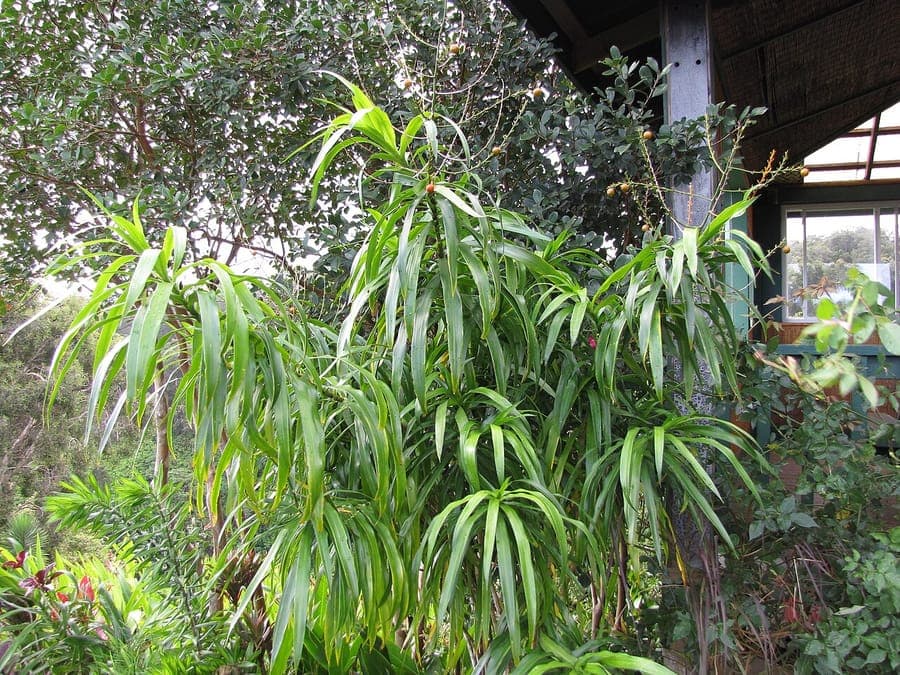
Forest and Kim Starr / CC BY 3.0 us, via Wikimedia Commons
Narrow-leaved dracaena: complete guide
Dracaena angustifolia
Want to see Narrow-leaved dracaena: complete guide in your garden?
1 minute, no credit card
Overview
The narrow-leaved dracaena (Dracaena angustifolia) is an elegant foliage plant in the family Asparagaceae, native to the tropical and subtropical regions of Asia and northern Australia. Its natural range is vast, stretching from the Andaman Islands and the eastern Himalayas through Myanmar, Thailand and Vietnam to Borneo, the Philippines, New Guinea and Queensland. This wide distribution has made Dracaena angustifolia an exceptionally adaptable plant that thrives both in tropical gardens and as an ornamental houseplant in European interiors.
In its native range the plant has long been used for traditional purposes. In Indonesia, the Philippines and across Southeast Asia, the leaves serve as a natural food colouring: a green dye is extracted to colour rice and other dishes. In Javanese cuisine the plant is known as suji or suji hijau and has been used for its colouring properties for centuries. This gives Dracaena angustifolia a cultural dimension that goes well beyond purely decorative value.
In European horticulture the narrow-leaved dracaena is less well known than its popular relative Dracaena marginata, but it deserves wider recognition. Its upright, narrow-leaved growth habit and ability to cope with lower-light interiors make it an excellent choice for anyone seeking a tropical feel indoors or on a shaded terrace. On gardenworld.app you can find ideas for incorporating this distinctive plant into a garden or patio design that stands out from the ordinary.
Appearance and bloom cycle
Dracaena angustifolia forms an upright, usually unbranched or lightly branched stem that can reach several metres tall in its natural habitat. In a houseplant setting it generally stays more compact, with stems of 50 cm to about 1.5 metres. The leaves are the most distinctive feature: long, narrow and lance-shaped, 15 to 40 cm in length and only 1 to 3 cm wide, bright or deep green, with a glossy surface.
The leaves are arranged in a spiralling rosette around the stem and give the plant its characteristic palm-like silhouette. Unlike some other dracaenas, Dracaena angustifolia has no coloured leaf margins; all of the ornamental value lies in the elegant, pure green leaf form and the graceful upright structure it creates.
Flowers appear in tropical climates but rarely under houseplant conditions in Europe. When they do occur they are small, white to pale pink and fragrant, arranged in clusters. Flowering is not the primary attraction of this plant; that is unquestionably the graceful foliage.
Ideal location
Indoors, a bright to lightly shaded position is ideal for Dracaena angustifolia. Direct sunlight through glass can scorch the leaf tips, while an excessively dark position slows growth considerably and makes the leaves pale. A spot near an east or west-facing window, or at some distance from a south-facing window, works very well.
Outdoors the plant can spend May to September on a sheltered, semi-shaded to lightly shaded terrace or balcony. Direct harsh midday sun should be avoided outdoors as well. The plant dislikes cold draughts and must be brought inside once night temperatures drop below 10 degrees Celsius. As a patio plant in a pot or large container, the narrow-leaved dracaena creates a tropical atmosphere that suits modern or Mediterranean garden designs beautifully.
Soil
Dracaena angustifolia grows best in a free-draining, airy growing medium. A quality houseplant or tropical plant compost works well, ideally enriched with 20 to 30 per cent perlite or coarse sand to improve drainage. Heavy, dense soil that holds water is unsuitable: the roots are susceptible to rot if kept wet for long periods.
A slightly acidic to neutral pH of around 6.0 to 7.0 is ideal. Avoid soils with a high lime content. When repotting, choose a pot only one size larger than the current one, with adequate drainage holes. Repotting is best done in spring when new growth begins.
Watering
One of the most common mistakes in dracaena care is overwatering. Dracaena angustifolia wants to dry out slightly between waterings. Check the top 2 to 3 cm of compost: only when they feel dry is it time to water. In summer this might be twice a week; in winter usually only once a week or even less.
Room-temperature water is preferable. Cold tap water with a high lime content can cause brown leaf tips. Rainwater or distilled water are better options in hard-water areas. Standing water in a saucer is not recommended: prolonged wet conditions in the drainage plate leads to root rot.
During the active growing season from March to September the compost can remain lightly moist. In winter, reduce watering noticeably, as the plant grows slowly and evaporation is much lower.
Free design
Want to see Narrow-leaved dracaena: complete guide in your garden? Make a free design now.
Pruning
Dracaena angustifolia generally needs very little pruning. Old or damaged leaves that turn brown can be cut off at the base where they meet the stem. If the plant has become too tall or lost its attractive silhouette, the stem can be cut back. Simply trim the stem at the desired height with a clean, sharp pair of secateurs or a pruning saw. The plant will then form new shoots just below the cut.
It is advisable to treat the cut surface with powdered charcoal or a plant wound sealant to prevent infection. The cut stem sections can themselves be used as cuttings: lay them horizontally on moist rooting medium and they will generally root well within a few weeks.
Any well-stocked garden centre in the UK or specialist houseplant retailer should have appropriate tools and wound sealants available.
Maintenance calendar
January to February: Plant is in light dormancy. Reduce watering to once a week or less. No feeding. Check regularly for spider mite or scale insects.
March to April: Growth resumes. Begin watering regularly again. Apply the first feed of the year with a balanced liquid fertiliser.
May to June: Active growth period. Feed every two weeks. Consider placing the plant outdoors in a sheltered, semi-shaded position. Monitor for aphids and spider mite.
July to August: Peak season. Ensure adequate moisture without waterlogging. Keep leaves clean by wiping them with a damp cloth occasionally.
September to October: Bring the plant indoors before night temperatures fall below 10 degrees Celsius. Gradually reduce watering.
November to December: Rest and winter period. Minimal watering. No feeding. Ensure adequate light; a cold windowsill is not ideal.
Winter hardiness
Dracaena angustifolia is a tropical plant and is not winter-hardy in the European climate. The plant tolerates temperatures down to a minimum of 10 degrees Celsius but prefers warmer conditions of 18 to 25 degrees Celsius. Below 10 degrees the leaf tips begin to discolour, and frost kills the above-ground plant entirely.
In USDA zone terms, the plant is suitable for zone 10 and above, meaning it can only be kept in western Europe as a houseplant or as a seasonal patio plant. In the far south of Spain, Portugal or on the Canary Islands it can overwinter outdoors in a sheltered garden, but in Britain, the Netherlands, Belgium and Germany it must always spend winter indoors.
A dry, well-lit room or conservatory with a minimum temperature of 12 degrees Celsius is the ideal overwintering spot. Avoid draughty hallways or positions near cold windows. On gardenworld.app you will find further guidance on overwintering tropical container plants through colder months.
Companion plants
In a houseplant grouping, Dracaena angustifolia combines well with other tropical foliage plants that share similar light and watering requirements. Good partners include Sansevieria (now reclassified within Dracaena), Spathiphyllum, Zamioculcas and Philodendron. These combinations also work well in terms of scale and silhouette: the narrow, vertical dracaena provides height and texture, while broad-leaved plants such as Spathiphyllum or Philodendron fill the horizontal space.
On a terrace or in the garden, the narrow-leaved dracaena sits beautifully alongside other Mediterranean or tropical container plants such as Phormium, Cordyline australis, Agapanthus and ornamental grasses. This kind of subtropical patio planting creates a modern, well-travelled feel to the outdoor space. Many of these companion plants are available at well-stocked garden centres during the warm season.
Closing
This species - Dracaena angustifolia - is an elegant, versatile tropical plant that looks wonderful as a houseplant or as a seasonal patio specimen. Its long, slender leaves bring a subtropical atmosphere to any interior, and its cultural significance as a food colouring plant in Asian cuisine gives it a depth of story that goes well beyond mere decoration. With the right care - sufficient light, restrained watering and warm winter conditions - this plant grows over the years into an impressive living sculpture that is sure to catch the eye of every visitor.
Want to see Narrow-leaved dracaena: complete guide in your garden? Make a free design now.
Upload a photo, pick a style, and get a photorealistic design with plant list in under a minute.
10,000+ gardens designed already
No credit card required


Similar plants
Chaparral yucca: complete guide to Hesperoyucca whipplei
Hesperoyucca whipplei
Hesperoyucca whipplei (Our Lord's candle) is a dramatic rosette-forming plant from California that produces a towering flower spike, ideal for dry and gravel gardens.
False lily-of-the-valley: complete guide
Maianthemum dilatatum
Everything about Maianthemum dilatatum, the false lily-of-the-valley. Care, shade location, propagation and garden combinations for this popular shade ground cover.
Creeping lilyturf: complete guide
Liriope spicata
Everything about Liriope spicata (creeping lilyturf): location, soil, watering, pruning, winter hardiness and the best companion plants.