
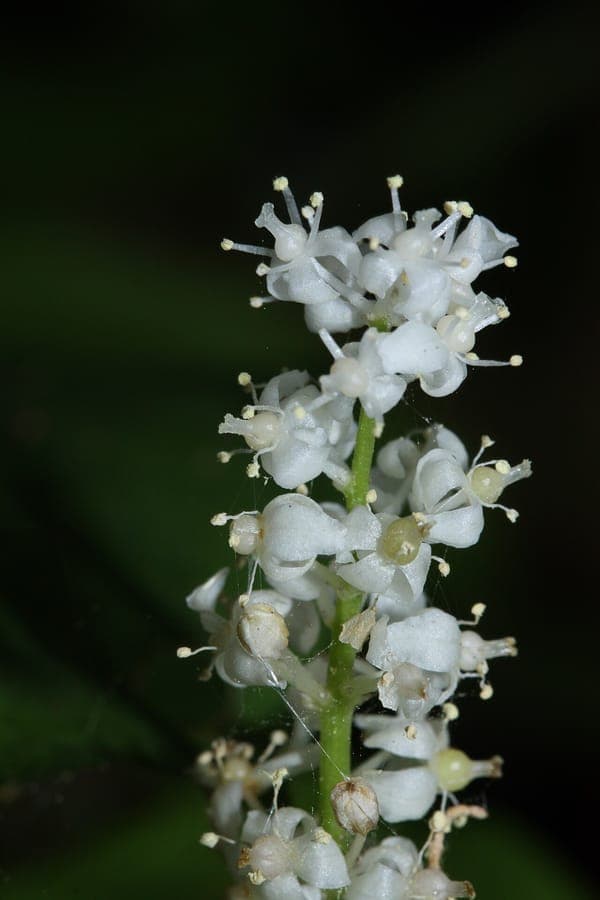
Walter Siegmund (talk) / CC BY-SA 3.0, via Wikimedia Commons
False lily-of-the-valley: complete guide
Maianthemum dilatatum
Want to see False lily-of-the-valley: complete guide in your garden?
1 minute, no credit card
Maianthemum dilatatum, commonly known as false lily-of-the-valley, pacific may lily, deerberry or two-leaved false Solomon's seal, is a charming shade-loving perennial belonging to the family Asparagaceae. In German it is called Kamtschatka-Schattenblumchen, in French maiantheme dilate or maiantheme de l'Ouest. The common name 'false lily-of-the-valley' refers to the superficial resemblance to the familiar Convallaria majalis, but Maianthemum dilatatum is a quite different plant - larger, bolder-leaved, more vigorous and far better adapted to the challenges of deep garden shade.
Overview
This species is native across a remarkably wide range: the Pacific coastal belt of North America from Alaska and Yukon through British Columbia, Washington, Oregon and into north-western California, and across a broad area of North-East Asia including Japan, Korea, Mongolia, Kamchatka, Sakhalin and the Kuril Islands. The German common name 'Kamtschatka-Schattenblumchen' reflects this East Asian origin. Its adaptation to cool, moist temperate forests across two continents makes it exceptionally well suited to North-Western European conditions.
As a mature perennial, Maianthemum dilatatum reaches 20 to 40 cm in height and spreads steadily by horizontal underground rhizomes to form a dense, fresh green carpet. This slow but persistent colonisation makes it one of the most effective and long-lived ground covers available for shady positions under trees and shrubs - places where little else will grow. Once established, it requires almost no maintenance and improves with age, becoming denser and more weed-suppressing every year.
Although the plant is sometimes described as 'two-leaved' because stems typically carry two broad leaves, stems with three leaves are also common. The leaves are large, glossy and heart-shaped, and they cover the ground so effectively that weeds rarely penetrate the mat. If you are planning a shady front garden or woodland-style planting, gardenworld.app provides design tools to help you incorporate ground-covering shade plants like this one into a coherent planting scheme.
Appearance and bloom cycle
The leaves are the plant's most striking feature: broadly heart-shaped, firm in texture, bright glossy green on the upper surface. They are considerably larger than those of the European relative Maianthemum bifolium - hence 'dilatatum', from the Latin for 'widened' or 'expanded'. A mature leaf can easily reach 10 to 15 cm in width and 15 to 20 cm in length. The glossy surface gives the plant a fresh, vibrant look throughout the growing season, even on dark days when many shade plants look dull.
Flowering takes place in April and May. Small white flowers appear in an upright, cylindrical spike or raceme at the top of each stem. Each individual flower has four white petals and is not particularly dramatic on its own, but a large colony in full bloom has real appeal, with a light, sweet fragrance that attracts bees and hoverflies. The flower spikes rise just above the canopy of leaves, giving the effect of white candles in the green.
After flowering, round berries develop that are initially green with brown speckles and ripen to bright red in late summer and autumn. They are ornamental and are eaten by some birds, but are considered mildly toxic to humans - they should not be consumed. The leaves turn yellow-brown in autumn before the plant withdraws completely below ground. Even as the top growth dies down, the rhizome network remains active, storing energy for the following spring.
Ideal location
Maianthemum dilatatum is an unambiguous shade plant. Its optimal site is full to deep shade - it also tolerates light dappled shade, but full sun is emphatically unsuitable. In direct sun the leaves scorch quickly and the plant declines.
Choose a site under deciduous or evergreen trees, against the north side of a building, or in any other sheltered shady corner. Think of the places where little else will grow: under a large beech, beneath a dense maple canopy, along a shaded path beside a fence. Precisely those difficult spots are where Maianthemum dilatatum excels.
The plant prefers moist to lightly dry conditions. It grows most luxuriantly in moist woodland settings but is surprisingly drought-tolerant once well established - a very valuable characteristic for dry shade locations where many other plants give up. It tolerates brief periods of significant dryness better than most other shade perennials, going semi-dormant during the worst heat and recovering quickly once moisture returns.
Soil
The plant prefers humus-rich, slightly acidic to neutral soil with a pH of 5.5 to 7.0. Typical woodland soil or leaf mould is ideal. It also grows well in moderately loamy soil that contains sufficient organic matter.
When establishing a new planting, incorporate generous amounts of garden compost, leaf mould or composted bark into the soil. An annual autumn top-dressing of leaf compost - mimicking the natural leaf litter layer in a real woodland - is the best combined fertiliser and soil protection. Ensure the soil has a light, open structure: compacted heavy clay without organic matter is unsuitable.
Sandy soil works if sufficient organic matter is present and regular mulching is carried out. Lime-rich or chalky soils are less suitable - on alkaline soils the plant grows more weakly and the foliage may become chlorotic. Incorporate sulphur-containing fertiliser or acidifying compost to lower the pH if needed.
Unlike some aggressive ground covers, Maianthemum dilatatum is not well equipped to compete in the densest root zones of dominant trees. Plant it in the surrounding area rather than directly at the base of a very large tree with heavy surface roots.
Free design
Want to see False lily-of-the-valley: complete guide in your garden? Make a free design now.
Watering
In its first growing season, Maianthemum dilatatum needs regular watering to allow the rhizome system to establish properly. Water thoroughly once a week during dry periods. After the first year the plant becomes considerably more self-sufficient.
An established colony handles dry spells better than its appearance might suggest - during a drought it may wilt slightly, but recovers quickly once rain returns. During very prolonged dry periods (more than 3 to 4 weeks without significant rain) supplementary watering is worthwhile to prevent permanent damage to the rhizomes.
A mulch layer of 5 to 8 cm of leaf compost or composted bark around and over the planting is the best way to retain moisture and keep the root zone cool - precisely the conditions the plant inhabits naturally. In shady gardens, evaporation is generally lower anyway, which reduces the need for irrigation compared to sunny sites. Visit gardenworld.app for help with designing a shady front garden that incorporates moisture-retaining planting strategies.
In winter the plant needs no water at all - it rests completely. Ensure the ground does not become bone dry before the plant goes dormant; a mulch layer helps with this as well.
Pruning
Maianthemum dilatatum requires virtually no pruning. In autumn the above-ground growth dies back. You can leave the dead foliage in place - it decomposes relatively quickly and adds organic matter to the soil, benefiting the next growth cycle. This is both the most natural approach and the least work.
If the dead material is aesthetically unwanted, cut the stems and leaves down in November or December. There is no risk to the plant from early or late cutting - the rhizome overwinters undisturbed and unbothered.
Propagation is easiest by dividing the rhizome in early spring (March). Carefully lift a section of the mat, cut the root mass into pieces using a sharp spade and replant immediately at the new location. Ensure each piece has at least one or two growing points (buds). Seed propagation is possible but takes many years; vegetative division is by far the faster method.
Spread of the mat is normal and desirable - let the plant go about its business and it will fill shady beds by itself. To restrict spread, cut back the edges of the colony once a year with a sharp spade.
Maintenance calendar
February-March: First signs of new green growth. Remove any remaining dead foliage from the previous year if it has not already decomposed. Apply a layer of leaf mould.
April-May: Flowering time. The white spikes appear. No pruning needed. Ensure sufficient moisture if the spring is dry.
June-August: Full leaf cover in place. Enjoy the fresh green, shade-filling groundwork. Water during prolonged drought. This is also a good time to plan any expansions of the planting.
September-October: Berries ripen red. Leaves begin to colour and die back. Reduce watering.
November: Foliage dies. Leave in place or remove. Apply mulch.
December-January: Dormancy. Rhizome overwinters actively. No maintenance required.
Winter hardiness
Maianthemum dilatatum is reliably hardy to USDA zone 4, tolerating minimum temperatures of -29 degrees Celsius. In the United Kingdom, the Netherlands, Belgium and across most of North-Western and Central Europe no winter protection is needed - the plant survives even the coldest winters in our region without difficulty.
In hard winters the rhizome may freeze lightly but recovers fully. A mulch layer of leaf compost or composted bark provides useful insulation as an added precaution, but is rarely necessary in the maritime climates of Western Europe. In the mildest coastal areas (USDA zone 9) the plant may remain partially evergreen through winter.
It is one of the most reliable shade perennials available: it returns each year on time and becomes denser and more impressive with every passing season, without ever becoming a problem or requiring significant intervention.
Companion plants
Maianthemum dilatatum combines superbly with other shade-loving plants. Some particularly effective combinations:
- Hosta: the large, architectural leaves of hostas and the finer carpet of false lily-of-the-valley are a classic shade pairing. Choose contrasting leaf colours - a blue or golden-yellow hosta alongside the bright green of Maianthemum creates strong visual interest.
- Ferns: the feathery, divided texture of ferns alongside the smooth, solid leaves of Maianthemum gives a lush woodland composition. Dryopteris and Athyrium species work particularly well.
- Epimedium: another outstanding ground cover for dry shade, with more delicate foliage; combined with Maianthemum dilatatum it creates a varied layered structure in difficult dry shady spots.
- Astilbe: the plumed flowers of astilbe in soft pink or white above a green Maianthemum carpet create a romantic woodland border effect.
- Trillium: the exotic three-petalled trilliums are magnificent neighbours in a woodland garden bed, with the Maianthemum mat as an elegant backdrop.
- Tiarella (foamflower): the subtle white-pink flower spikes of tiarella and the heart-leaved Maianthemum are a timeless combination for moist shady corners.
- Anemone nemorosa (wood anemone): the delicate white blooms of wood anemone in April to May emerging above the fresh young leaves of Maianthemum is one of the most beautiful early spring images possible in a shade border.
Closing
Maianthemum dilatatum is an undervalued but exceptionally reliable shade ground cover that solves long-term problems in the most difficult corners of any garden. Its broad, glossy leaves form a dense green carpet that suppresses weeds, protects the soil and gives any shaded area a fresh woodland character. The spring flowering adds seasonal charm and the red autumn berries are a further decorative bonus. A plant that asks for little and gives a great deal: for shade gardens across Northern Europe this is a highly recommended perennial. Browse gardenworld.app to explore how false lily-of-the-valley and other woodland ground covers could work in your own shady garden design.
Want to see False lily-of-the-valley: complete guide in your garden? Make a free design now.
Upload a photo, pick a style, and get a photorealistic design with plant list in under a minute.
10,000+ gardens designed already
No credit card required


Similar plants
Two-leaved Solomon's seal: complete guide
Maianthemum bifolium
Discover Maianthemum bifolium, a delicate woodland floor plant with tiny white flowers. Perfect for shade gardens, forest understory, and groundcover on gardenworld.app.
Canadian May-lily: complete guide
Maianthemum canadense
Discover the delicate Canadian May-lily, a shade-loving forest groundcover with white flowers and red berries. Perfect for woodland gardens and shaded corners.
Solomon's-plume: complete guide
Maianthemum racemosum
Solomon's-plume grows from North America to Mexico with feathery white-pink spring flowers. This shade-loving forest plant blooms in May and June. Perfect for woodland gardens and shaded borders.