
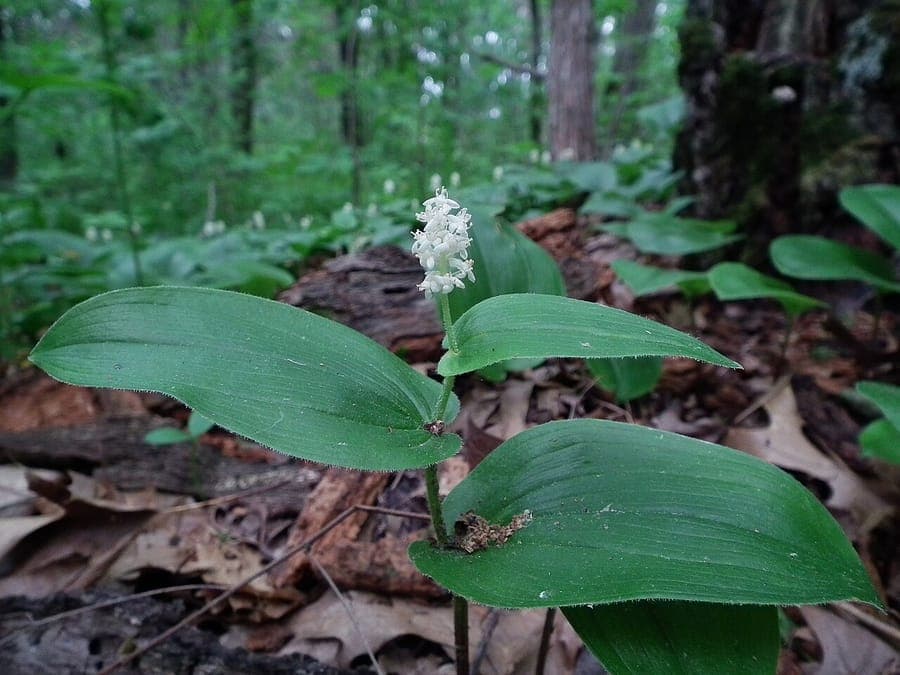
BlueCanoe / CC BY-SA 3.0, via Wikimedia Commons
Canadian May-lily: complete guide
Maianthemum canadense
Want to see Canadian May-lily: complete guide in your garden?
1 minute, no credit card
Overview
Maianthemum canadense, commonly known as Canadian May-lily or false lily-of-the-valley, is a low-growing forest plant native to northern North America. This charming perennial forms dense mats in moist shaded areas and blooms with delicate clusters of white flowers followed by red berries in late summer. It is an ideal choice for naturalistic gardens, woodland edges, and shaded corners where few other plants thrive.
Appearance and bloom
The plant reaches just 15 to 25 centimeters in height and spreads via underground rhizomes. The leaves are elongated, glossy green and typically two or three per plant, giving the species a delicate appearance. From May through June, small clusters of tiny white flowers emerge with a light pleasant fragrance. After flowering, green berries develop, turning red by late summer and often persisting until September.
Ideal location
This plant is a true shade lover and grows best in woodland-like settings beneath deciduous trees. It tolerates full shade but also accepts dappled light. Plant it beneath shrubs, at the base of trees, or in dark garden corners. The plant naturally forms dense groundcover and is perfect as an underplanting species. Avoid locations with direct afternoon light, especially in warm climates.
Soil
The soil must be humus-rich, moisture-retaining and well-draining. Mixing leaf mold, peat and sand provides ideal growing conditions. A pH level between 4.5 and 7.0 is tolerated. Replicating rich forest soil with plenty of organic matter is essential. The plant grows poorly in poor, dry soils. Compared to many garden plants, this species is not critical but significantly appreciates well-prepared soil.
Watering
Keep the soil moist but not waterlogged. During the growing season (April through September), water regularly, especially during dry periods. The shallow-rooted plant dries out quickly when the top soil layer becomes dry. In autumn and winter, water less but do not let it dry out completely. Remove dead wood and old leaves regularly to prevent rot. Drip irrigation works better than overhead watering.
Free design
Want to see Canadian May-lily: complete guide in your garden? Make a free design now.
Pruning
Canadian May-lily requires little pruning work. Remove dead leaves and flowers after the flowering period. The plant itself forms naturally attractive shapes. To counter aging, every three to four years some of the oldest shoots can be removed. Pruning right after flowering is the best time to encourage new growth. Avoid hard cutting back as this can disturb the plant.
Maintenance calendar
May-June: Follow flowering and remove spent flowers. July: Regular watering during dry spells. August-September: Apply feed and keep more moist. October-November: Allow leaf fall, mulch with dry leaves for insulation. December-March: Winter rest, minimal maintenance. April: Follow new growth and thin where needed.
Winter hardiness
This North American plant is fully hardy to zone 3 (temperatures down to -40 degrees Celsius). No protection needed in most of Northwest Europe. In extreme cold, organic mulch around the plant can help. The plant disappears completely above ground in autumn and does not return until April. This is completely normal. When seeds form, seed should be sown immediately after ripening outdoors or stratified in cold season.
Companion plants
Grew naturally with other woodland plants such as wood anemone, ferns and leaf mosses. In gardens combine with other shade plants such as hostas, ferns, Toadstools and small Impatiens. Low growth makes it ideal for edging along paths. Combination with flowering shrubs such as Viburnum and Sambucus gives structure in spring flowering. Avoid strong spreaders like ivy as it can be overwhelmed.
Closing
Canadian May-lily offers elegance for shaded gardens and provides bird food through berries. It is sustainable, environmentally friendly and an authentic way to create woodland-like gardens. At gardenworld.app you can design a front yard step by step with plant material that grows well in your region. At gardenworld.app you get advice for all garden types, from woodland to modern.
Want to see Canadian May-lily: complete guide in your garden? Make a free design now.
Upload a photo, pick a style, and get a photorealistic design with plant list in under a minute.
No credit card required


Similar plants
Narrow-leaved dracaena: complete guide
Dracaena angustifolia
Everything about Dracaena angustifolia - the narrow-leaved dracaena: location, care, overwintering and use as a houseplant or patio plant.
Chaparral yucca: complete guide to Hesperoyucca whipplei
Hesperoyucca whipplei
Hesperoyucca whipplei (Our Lord's candle) is a dramatic rosette-forming plant from California that produces a towering flower spike, ideal for dry and gravel gardens.
False lily-of-the-valley: complete guide
Maianthemum dilatatum
Everything about Maianthemum dilatatum, the false lily-of-the-valley. Care, shade location, propagation and garden combinations for this popular shade ground cover.