
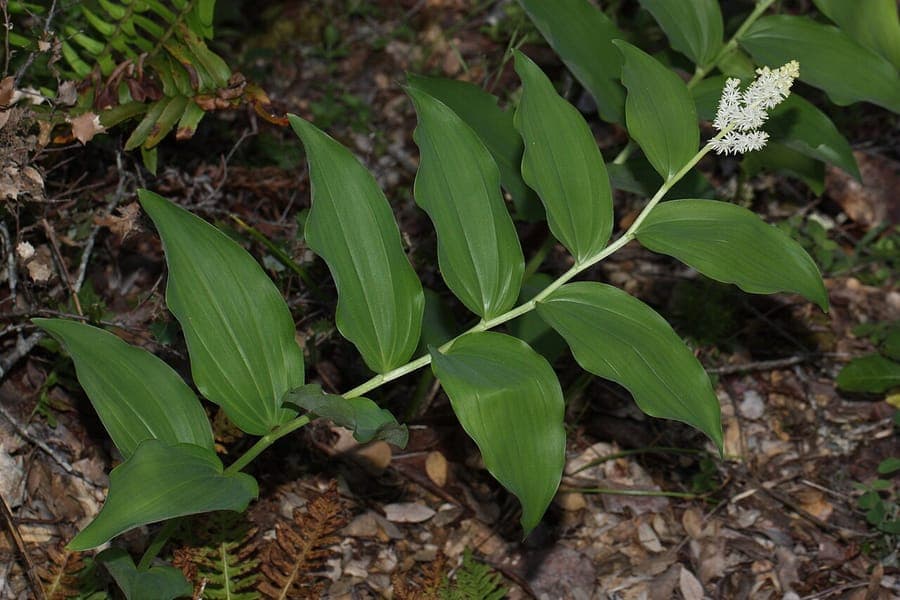
Walter Siegmund (talk) / CC BY-SA 3.0, via Wikimedia Commons
Solomon's-plume: complete guide
Maianthemum racemosum
Want to see Solomon's-plume: complete guide in your garden?
1 minute, no credit card
Solomon's-plume (Maianthemum racemosum), also called false spikenard, feathery false lily-of-the-valley, and treacle-berry, is an elegant and nutritious woodland plant from the Asparagaceae family. This graceful species ranges from Canada to Mexico, thriving in open woodlands and dense forest understory.
The plant forms frost-free colonies spreading from horizontal underground rhizomes in rich forest soil. Stems reach 30 to 60 centimeters tall and bear lance-shaped, slightly wavy pale green leaves arranged in two distinct rows along the stem. This two-row arrangement is characteristic of the genus Maianthemum.
Flowering and blooming: Solomon's-plume flowers in May and June with countless small white to pale pink flowers arranged in loosely branching racemes at stem tips. These feathery plumes are spectacular, sometimes reaching 15 to 30 centimeters long. Each individual flower is barely 5 millimeters across, but together they create an airy, fine-textured appearance.
Fruit development: After flowering come small berries that begin green and ripen to red-orange. These berries give the plant its common name treacle-berry. The berries are nutritious for birds and small mammals, which disperse the seeds.
Growth requirements: Solomon's-plume thrives in shade to part-shade, ideally beneath large trees where diffuse light penetrates. The plant prefers moisture-rich forest soil with abundant organic matter. Neutral to slightly acidic pH is optimal.
Watering needs: The plant prefers consistently moist soil during the growing season, especially May through September. In drier summers, water regularly. Once established, the plant tolerates short periods of drought thanks to deep roots.
Cultivation and propagation: Solomon's-plume is easily grown from seed. Seeds require stratification - a cold period during winter. Sow seeds in autumn in sand-peat mix to a depth of about 1 centimeter. Germination occurs in March or April as temperatures rise.
Division is also possible in March or April. Carefully divide to avoid damaging rhizomes, with each fragment containing at least two shoots.
Pests and diseases: Solomon's-plume is generally resistant to pests and diseases. Slugs may eat young foliage, but mature plants tolerate light damage.
Garden design: Ideal for woodland shade gardens, grotto gardens, or shade borders beneath large trees. Perfect massed with other shade-loving woodland companions like hellebores, epimediums, and wild ginger.
Winter hardiness: Solomon's-plume is hardy to USDA zone 3, making it suitable for nearly all temperate regions. Underground rhizomes survive harsh winters, with foliage returning each spring.
Companion plants: In natural habitat, Solomon's-plume grows with oak, maple, and hemlock trees. Other forest flora include royal fern, grasses, and wild onion.
Ethical collection: Solomon's-plume is considered threatened in many regions due to habitat loss. Never collect seeds or plants from wild populations without permission.
We recommend growing Solomon's-plume from seed or divided rhizomes. Each flowering plume brings elegance to shade gardens. Discover more plant guides at gardenworld.app.
Want to see Solomon's-plume: complete guide in your garden? Make a free design now.
Upload a photo, pick a style, and get a photorealistic design with plant list in under a minute.
No credit card required


Similar plants
Narrow-leaved dracaena: complete guide
Dracaena angustifolia
Everything about Dracaena angustifolia - the narrow-leaved dracaena: location, care, overwintering and use as a houseplant or patio plant.
Chaparral yucca: complete guide to Hesperoyucca whipplei
Hesperoyucca whipplei
Hesperoyucca whipplei (Our Lord's candle) is a dramatic rosette-forming plant from California that produces a towering flower spike, ideal for dry and gravel gardens.
False lily-of-the-valley: complete guide
Maianthemum dilatatum
Everything about Maianthemum dilatatum, the false lily-of-the-valley. Care, shade location, propagation and garden combinations for this popular shade ground cover.