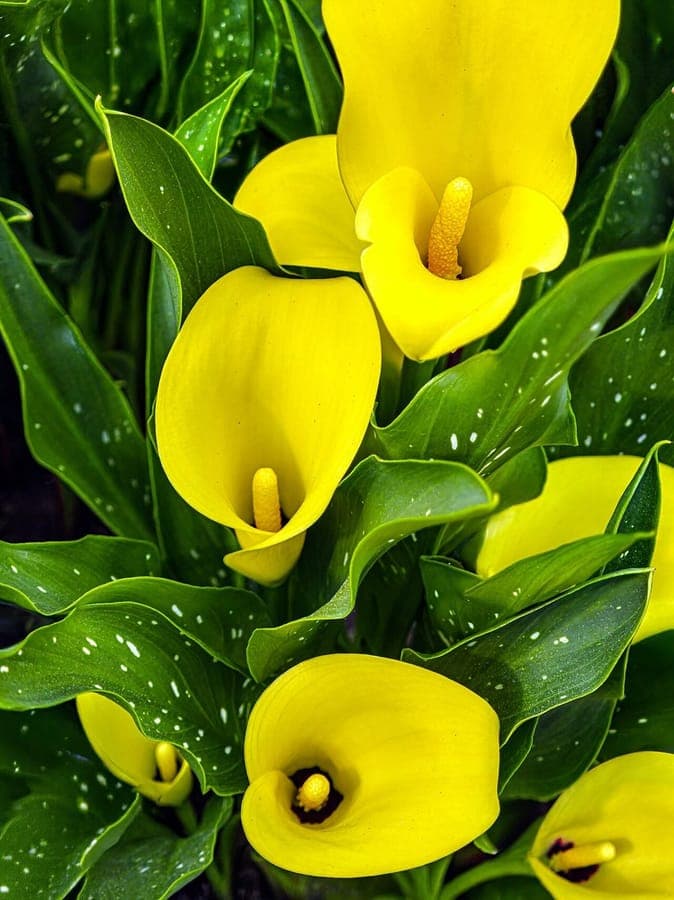
Didier Descouens / CC BY-SA 4.0, via Wikimedia Commons
Golden calla (Zantedeschia elliottiana): care and toxicity
Zantedeschia elliottiana
Want to see Golden calla (Zantedeschia elliottiana): care and toxicity in your garden?
Full design in HD: €7.99
Look after your Golden calla with the GardenWorld app
Identify plants with your camera and get a care calendar with reminders for this plant.


Overview
The golden calla (Zantedeschia elliottiana) is a summer-flowering tuber in the arum family, Araceae. Whereas the familiar white arum lily, Zantedeschia aethiopica, is a large bog plant, this species stays more compact and carries golden yellow flowers above leaves marked with white, translucent spots. It usually grows 50 to 80 cm tall and 30 to 40 cm wide.
Its origins are debated. The plant was described from cultivation at the end of the nineteenth century, and some sources say it comes from Mpumalanga province in South Africa. Other botanists suspect a garden hybrid, because it has never been found in the wild with any certainty. What is beyond doubt is that Zantedeschia elliottiana is one of the main parents of the coloured callas you see today in garden centres and florists, in shades from cream and yellow to orange, pink and almost black.
An important warning first: the golden calla is poisonous to people and pets. Every part contains needle-shaped crystals of calcium oxalate, and there is a separate section on this further down. If you are planting a border or patio where children or animals play, take that into account. At gardenworld.app you can have a garden design made in which you specify which plants you want to avoid or place well out of reach.
Appearance and bloom cycle
What we call the flower is really a modified leaf, the spathe, wrapped like a funnel around an upright spike called the spadix. The true flowers are tiny and sit on that spadix. In the golden calla the spathe is 10 to 15 cm long and a clear golden yellow, sometimes slightly deeper at the base inside. The spadix is yellow too. The photograph shows this well: smooth yellow funnels with a yellow spadix at the heart, surrounded by glossy leaves covered in white speckles.
The leaves are heart-shaped to arrow-shaped, 20 to 30 cm long, fresh green and dotted with small translucent white flecks, so the plant looks attractive even without flowers. Flowering starts roughly eight to ten weeks after planting the tuber, usually from July to September in our climate. Each tuber produces several flowers in succession. Faded spathes turn greenish and may set seed, but in the garden they are usually removed.
Golden calla is also a superb cut flower, lasting a good ten days in a vase. Cut the stems in the morning, just as the spathe has fully opened, and wear gloves, as the sap can irritate the skin.
Ideal location
Give golden calla a sunny or lightly shaded position. It flowers most freely in full sun, provided the soil does not dry out. In a very hot, dry spot the leaf edges scorch, so some afternoon shade helps there. A sheltered position out of the wind stops the long flower stems from snapping.
It works both in borders and in pots and containers on a patio. Pots have the advantage that you can bring the tuber indoors easily in autumn. Use a pot at least 20 cm across for one tuber, or a large container with three to five tubers spaced 25 to 30 cm apart.
Soil requirements
Unlike the white arum lily, golden calla is not a bog plant. It wants humus-rich soil that holds moisture yet drains well. In cold, waterlogged ground the tuber soon rots, often through bacterial soft rot. On heavy clay, work compost and some grit into the top layer, or plant in a raised bed. Slightly acidic to neutral soil is ideal.
Plant the tubers in April or May, 5 to 8 cm deep, with the growing points facing up. The top is usually rounder and shows small "eyes". For earlier flowers, start the tubers in pots from March in a light, frost-free spot indoors and move them outside from mid-May, once the risk of night frost has passed.
Free preview
Want to see Golden calla (Zantedeschia elliottiana): care and toxicity in your garden? Make a free preview of your design.
Watering
After planting, water sparingly until you see the first leaf tips. Too much water on a tuber without leaves leads to rot. Once the plant is growing, keep the soil evenly moist, especially while it is in flower. For pots that often means checking daily in summer. During growth, give a liquid feed for flowering plants every two weeks.
After flowering, from late August or September, gradually reduce watering. The leaves then start to yellow, and that is exactly what should happen: the tuber is going dormant. Stop feeding once the last flowers have faded.
Pruning
There is no real pruning to do. Cut faded flowers right at the base of the stem so the plant does not spend energy on seed. You can also remove damaged or yellow leaves. In autumn, leave the foliage in place for as long as possible, because it feeds the tuber for next year. Only cut it off once it has turned fully yellow and limp. Wear gloves for all of these jobs.
Maintenance calendar
March: Take the tubers out of winter storage and start them in pots indoors.
April and May: Plant tubers outdoors in the ground or in large pots. Move pre-started plants outside after mid-May.
June: Keep the soil moist and start feeding. Watch for aphids and slugs.
July to September: Flowering time. Remove faded flowers and cut stems for the vase.
October: Let the foliage die back and lift the tubers before the first frost.
November to February: Store the tubers dry and frost-free.
The planting calendar at gardenworld.app reminds you in good time when to plant in spring and when to lift in autumn.
Winter hardiness
Golden calla is not hardy. It will survive a touch of frost on the leaves, but a frozen or sodden tuber rots. In Britain and the Low Countries, lift the tubers in October before the first hard frost. Let them dry for a few days somewhere airy, brush off loose soil and old roots and store them in dry peat-free compost, sand or wood shavings at 10 to 15 °C. Check them now and then over winter and discard any that are soft or mouldy. Pots with tubers can simply be kept dry in a frost-free garage or cellar. Only in very mild coastal gardens, in sharply drained soil under a thick mulch, might tubers survive outdoors, and even there it is a gamble.
Toxicity
Zantedeschia elliottiana is poisonous to people and pets. All parts, particularly the leaves, stems and tuber, contain needle-shaped crystals of calcium oxalate. Anyone who bites into the plant feels an immediate burning pain. The mouth, lips and tongue swell, there is heavy drooling and swallowing becomes difficult. If material is swallowed, vomiting and diarrhoea may follow. Serious poisoning is rare, because the pain usually stops anyone eating more, but marked swelling in the throat is dangerous.
Cats, dogs, rabbits and other small pets are sensitive too. If an animal is drooling, pawing at its mouth or vomiting after contact with the plant, contact your vet. For people, rinse the mouth with water and phone your doctor or, in the UK, NHS 111. The sap can also irritate the skin, so wear gloves when cutting, lifting and dividing the tubers and wash your hands afterwards. Keep pots out of reach of small children and of pets that like to chew plants.
Companion plants
Golden calla looks good next to plants with large or colourful foliage that also enjoy moist, fertile soil. Indian shot (Canna indica) adds height and a tropical feel. A hosta such as Hosta plantaginea provides a calm green backdrop in light shade. Lady's mantle (Alchemilla mollis) forms a soft, lime-yellow edge that echoes the flower colour, while coral bells (Heuchera micrantha) with dark leaves set up a strong contrast with the gold. In a sunny border, the blues of African lily (Agapanthus africanus) are a perfect match.
Final thoughts
Golden calla is a rewarding tuber that brings bright yellow all summer long, in the border, in a pot or in a vase. Plant the tubers after the last frost, keep the soil moist while they grow and lift them in autumn. And never forget that the plant is poisonous: wear gloves and choose a spot where children and pets cannot reach it.
Frequently asked questions about Golden calla
Is Golden calla winter hardy?
Golden calla is not hardy. It will survive a touch of frost on the leaves, but a frozen or sodden tuber rots.
When and how do you prune Golden calla?
There is no real pruning to do. Cut faded flowers right at the base of the stem so the plant does not spend energy on seed.
How much water does Golden calla need?
After planting, water sparingly until you see the first leaf tips. Too much water on a tuber without leaves leads to rot.
Where does Golden calla grow best?
Give golden calla a sunny or lightly shaded position. It flowers most freely in full sun, provided the soil does not dry out.
What soil does Golden calla need?
Unlike the white arum lily, golden calla is not a bog plant. It wants humus-rich soil that holds moisture yet drains well.

See it in your garden
See Golden calla in your garden
One photo of your garden and a few questions. You see the result in about a minute.
Try it with a photoIdentify this plant in your own garden. Identify a plant
Similar plants
African arrowroot: complete guide
Canna indica
Everything you need to grow and care for Canna indica in your garden. Learn about sunlight, watering, winter care, and ideal planting partners.
August-lily: complete guide
Hosta plantaginea
Grow Hosta plantaginea with confidence: a fragrant, late-blooming perennial from China. Learn ideal conditions, care tips, and planting calendar for UK and US gardens.
Garden lady's-mantle: complete guide
Alchemilla mollis
Alchemilla mollis, or garden lady's-mantle, is a graceful perennial perfect for borders, shade gardens, and low-maintenance landscapes. Grows 15–30 cm tall, blooms June–August.
