
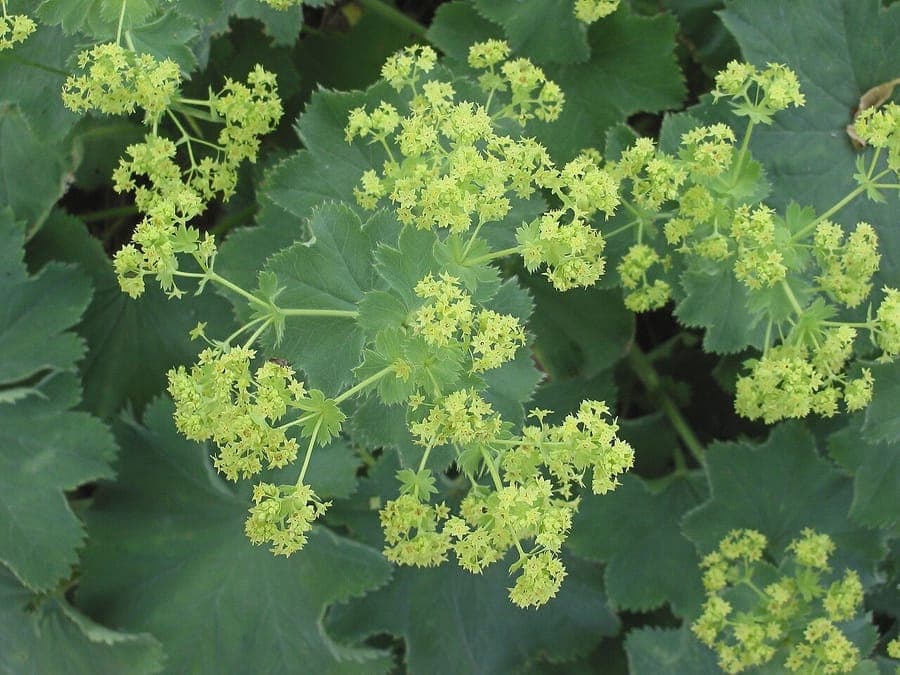
Rasbak 14:39, 19 June 2007 (UTC) / CC BY-SA 3.0, via Wikimedia Commons
Garden lady's-mantle: complete guide
Alchemilla mollis
Want to see Garden lady's-mantle: complete guide in your garden?
1 minute, no credit card
Overview
Alchemilla mollis, commonly known as garden lady's-mantle, is one of those quiet achievers in the garden – unassuming at first glance, but utterly indispensable once you get to know it. Native to Bulgaria, Romania, Sweden, and parts of Turkey and the Caucasus, this hardy perennial has adapted beautifully to temperate climates. It's a member of the Rosaceae family, though you won't find any thorns or roses here-just soft, rounded foliage and delicate chartreuse flowers that shimmer in dappled light.
Standing 15–30 cm tall and spreading 30–40 cm wide, it forms dense, cushion-like mounds that stay fresh from early spring to late autumn. It's perfect for softening edges, filling gaps between pavers, or underplanting shrubs. Unlike some aggressive ground covers, lady's-mantle spreads gently via shallow rhizomes, making it easy to manage.
One of its most magical traits? Rainwater beads up on the leaves like tiny pearls, a phenomenon known as the 'lotus effect'. It's not just pretty-it's practical, helping the plant resist fungal diseases. And did I mention it's a pollinator magnet? Bees and hoverflies love the nectar-rich blooms.
On gardenworld.app, you can design a planting scheme where Alchemilla mollis acts as a living mulch, suppressing weeds while adding light and texture to shaded borders.
Appearance & bloom cycle
The foliage is the star. The leaves are rounded, deeply lobed, and covered in fine hairs that repel water. They emerge in spring as a bright apple green, maturing to a richer olive tone by midsummer. Each leaf is held on a slender red-tinged stem, creating a layered, cloud-like effect.
Flowering begins in early June and can last through August, especially if you deadhead. The flowers themselves are tiny-no petals, just airy sprays of chartreuse bracts that rise 20–25 cm above the foliage. They're not loud, but they catch the light beautifully, especially in morning and late afternoon sun.
After blooming, the seed heads can be left for winter interest or snipped off to prevent light self-seeding. In fertile soils, you might get a few volunteer plants nearby-usually not a problem, and easy to pull if unwanted.
Ideal location
Lady's-mantle thrives in partial shade-think morning sun and afternoon shade, or dappled light under deciduous trees. It tolerates full shade, but growth will be looser and flowering reduced. In full sun, it demands more moisture and can scorch in hot, dry spells.
Avoid planting it directly under dense evergreens where the soil is dry and root competition is fierce. Instead, pair it with open-structured shrubs like Hydrangea or Cornus that allow light and rain to filter through.
Free design
Want to see Garden lady's-mantle: complete guide in your garden? Make a free design now.
Soil requirements
It's adaptable, but happiest in moist, well-drained soil rich in organic matter. Heavy clay? Amend with compost. Sandy soil? Add leaf mould or well-rotted manure to improve water retention. The ideal pH is slightly acidic to neutral (6.0–7.0), though it tolerates mildly alkaline conditions.
Avoid waterlogged soils-while it likes moisture, it won't survive in standing water. If your garden has poor drainage, consider raised beds or planting on a slight slope.
Watering
Keep the soil consistently moist during the first growing season. Once established, it's moderately drought-tolerant, but looks best with regular watering during dry spells. Aim for a deep soak every 7–10 days in summer if rainfall is under 25 mm per week.
Use rainwater when possible-this plant can be sensitive to chlorine and lime in tap water, especially in hard-water areas.
Pruning
No pruning is essential, but cutting back hard after flowering (late July) will trigger a flush of fresh foliage and sometimes a second, lighter bloom in September. Use clean shears to cut the entire plant down to 5–8 cm above ground level.
Leave late-season growth intact over winter-it protects the crown from frost and adds structure to the dormant garden.
Maintenance calendar
- March: Divide overcrowded clumps if needed.
- April–May: Plant or transplant. Top-dress with compost.
- June–July: Peak bloom. Monitor moisture.
- Late July: Cut back foliage for rejuvenation.
- August: Water during dry periods; check for slugs if young leaves emerge.
- September: Possible second bloom. No feeding.
- October–November: Leave foliage. Apply mulch only in very cold zones.
- December–February: Dormant. Avoid walking on frozen foliage.
Winter hardiness
Hardy in USDA zones 4–8 (down to -30°C). In most of the UK and US, it overwinters with no protection. The leaves may turn brown but regrow vigorously in spring. In zone 4, a light mulch of straw or leaf litter can help in exposed sites.
Companion plants
Lady's-mantle plays well with others. Try these combinations:
- Dicentra spectabilis – same conditions, contrasting form
- Geranium 'Johnson's Blue' – complementary color and height
- Allium flavum – for late spring contrast
- Euphorbia amygdaloides var. robbiae – bold texture, shared shade tolerance
- Lungwort (Pulmonaria) – early interest, shared moisture needs
On gardenworld.app, you can simulate a mixed border with Alchemilla mollis as a mid-layer textural anchor, adjusting for height, spread, and bloom time.
Closing
Garden lady's-mantle isn't flashy, but it's fundamental. It ties planting schemes together, fills awkward gaps, and adds a soft glow to shady corners. It asks for little-no feeding, no staking, no pampering-and gives back all season long.
You'll find Alchemilla mollis at most garden centres in the UK and US, often near the herbaceous perennials or ground cover section. Avoid wild harvesting-this plant is easy to propagate and widely available in cultivation.
Want to see Garden lady's-mantle: complete guide in your garden? Make a free design now.
Upload a photo, pick a style, and get a photorealistic design with plant list in under a minute.
No credit card required


Similar plants
Siberian crab apple: complete guide
Malus x robusta
Complete guide to the Siberian crab apple (Malus x robusta): location, soil, pruning, winter hardiness and the best companion plants for your garden.
Chinese flowering crabapple (Malus x spectabilis): complete guide
Malus x spectabilis
Meet the Chinese flowering crabapple (Malus x spectabilis): a classic spring bloomer with carmine buds and pink blossom.
Potentilla crassinervia: complete guide
Potentilla crassinervia
Potentilla crassinervia, the Corsican cinquefoil, grows wild on Corsica and Sardinia's peaks. Discover how to grow this hardy alpine rock garden gem.