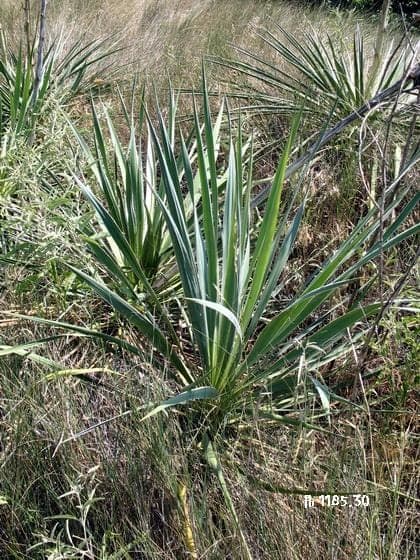
Rebou at German Wikipedia / CC BY-SA 3.0, via Wikimedia Commons
Yucca Arkansana: complete guide
Yucca arkansana
Want to see Yucca Arkansana: complete guide in your garden?
Full design in HD: €7.99
Look after your Yucca Arkansana with the GardenWorld app
Identify plants with your camera and get a care calendar with reminders for this plant.


Overview
Yucca arkansana, known as Arkansas yucca, is an imposing desert plant native from Kansas to Texas. This dramatic specimen is distinguished by its coarse-textured, blue-gray rosettes and spectacular flower spikes that tower above the foliage. For southern dry gardens seeking maximum impact, Arkansas yucca delivers unmatched architectural drama.
Appearance and Bloom
This striking semi-succulent forms large rosettes of stiff, blue-gray leaves reaching 18-48 inches long, often with wavy or ribbed edges. The plant grows massive - typically 3-6 feet tall and up to 6 feet wide. In April-July, impressive flower spikes emerge 10-13 feet tall, densely packed with large, bell-shaped white flowers with pink or yellow tinges. These blooms attract hummingbirds, moths, and day-flying insects.
Ideal Location
Yucca arkansana demands full sun - 8+ hours of direct daily light. Position prominently where the blue-gray foliage can sparkle in sunlight. Allow ample space - 10-13 feet clearance from structures and other plants to accommodate mature width.
Soil
Extremely well-draining soil is essential. Arkansas yucca thrives in sand, gravel, rocky soils, and chalky earth. Avoid heavy clay; amend with coarse sand, gravel, or pumice. This plant accepts broad pH (5.0-8.5) and is highly alkaline-tolerant.
Free preview
Want to see Yucca Arkansana: complete guide in your garden? Make a free preview of your design.
Watering
Once established, Yucca arkansana is extremely drought-tolerant. Water regularly during active growth, but sparingly thereafter. This plant tolerates extended periods without supplemental water. In wet winters, excellent drainage is critical to prevent root rot.
Pruning
Minimal pruning needed. Remove dead basal leaves and damaged foliage. After flowering, spent spikes may be cut when they begin to wither. Young pups may be carefully separated and planted independently.
Maintenance Calendar
- March-April: Resume watering
- April-July: Enjoy spectacular towering blooms
- August-October: Minimal care
- November-February: Winter dormancy
- Year-round: Remove dead basal leaves
Winter Hardiness
Yucca arkansana is hardy to USDA zone 4, tolerating temperatures to -30 deg F (-35 deg C). This makes it far colder-hardy than many yucca species, suitable for northern regions.
Companion Plants
Pair Yucca arkansana with:
- Large agave specimens for drama
- Prairie grasses: Panicum, Andropogon
- Desert shrubs: Artemisia, Salvia
- Large boulders for architectural landscape
This creates an authentically dramatic dry-climate landscape.
Closing
Yucca arkansana is for gardeners unafraid of drama and architectural extremes. Its blue-gray rosettes and towering flower columns provide unmistakable impact. This is not a delicate plant - it demands prominent placement and excellent drainage, but the visual rewards are spectacularly worth it. Discover how Arkansas yucca transforms dry garden designs at Gardenworld.app.
Frequently asked questions about Yucca Arkansana
Is Yucca Arkansana winter hardy?
Yucca arkansana is hardy to USDA zone 4, tolerating temperatures to -30 deg F (-35 deg C). This makes it far colder-hardy than many yucca species, suitable for northern regions.
When and how do you prune Yucca Arkansana?
Minimal pruning needed. Remove dead basal leaves and damaged foliage.
How much water does Yucca Arkansana need?
Once established, Yucca arkansana is extremely drought-tolerant. Water regularly during active growth, but sparingly thereafter.
Where does Yucca Arkansana grow best?
Yucca arkansana demands full sun - 8+ hours of direct daily light. Position prominently where the blue-gray foliage can sparkle in sunlight.
What soil does Yucca Arkansana need?
Extremely well-draining soil is essential. Arkansas yucca thrives in sand, gravel, rocky soils, and chalky earth.

See it in your garden
See Yucca Arkansana in your garden
One photo of your garden and a few questions. You see the result in about a minute.
Try it with a photoIdentify this plant in your own garden. Identify a plant
Similar plants
Great camas (Camassia leichtlinii): planting and care
Camassia leichtlinii
Everything about great camas (Camassia leichtlinii): planting the bulbs, heavy wet soil, naturalising in grass, hardiness and the best partners for a flowering meadow.
Pineapple lily (Eucomis bicolor): planting, care and overwintering
Eucomis bicolor
Everything about the pineapple lily (Eucomis bicolor): planting the bulbs, watering and feeding, overwintering in pots or the ground, and the best border partners.
Pineapple lily (Eucomis comosa): growing and overwintering
Eucomis comosa
Eucomis comosa is the tallest and best-known pineapple lily, with creamy spikes topped by a leafy tuft in late summer. Planting, overwintering and leaf cuttings.
