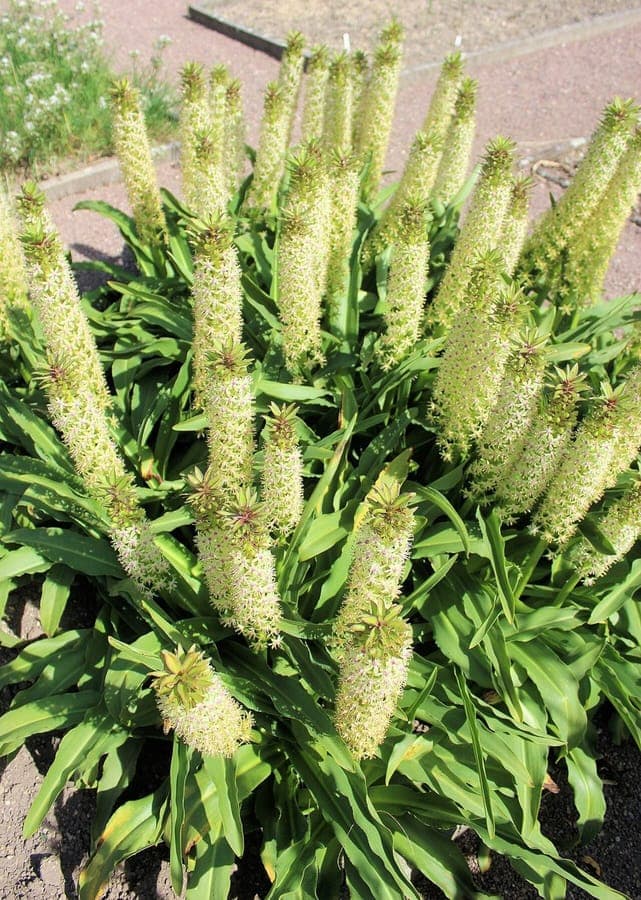
Dguendel / CC BY 3.0, via Wikimedia Commons
Pineapple lily (Eucomis comosa): growing and overwintering
Eucomis comosa
Want to see Pineapple lily (Eucomis comosa): growing and overwintering in your garden?
Full design in HD: €7.99
Look after your Pineapple lily with the GardenWorld app
Identify plants with your camera and get a care calendar with reminders for this plant.


Overview
Eucomis comosa is the tallest and most widely grown pineapple lily. In August sturdy stems rise from a broad rosette of leaves, each carrying a long, dense spike of small starry flowers topped by a tuft of green bracts. That tuft, which really does resemble the leafy crown of a pineapple, gives the plant its common name. A clump in full flower, like the one photographed in the botanic garden at Halle, looks like a bunch of creamy candles each wearing a little green crown.
The species comes from eastern South Africa, mainly the Eastern Cape and KwaZulu-Natal, where it grows in damp grassland and marshy hollows. Rain falls there in summer and winters are dry and cool. It belongs to the asparagus family, Asparagaceae, in the broad sense. Compared with the smaller Eucomis bicolor, whose greenish flowers are edged with purple, Eucomis comosa is taller, flowers for longer and has creamy-white to pale pink flowers with a dark purple ovary at the centre.
It is not known to be highly poisonous, but the bulb is not edible and is used in traditional medicine in South Africa. There is little information on its effect on pets, so keep bulbs away from dogs that like digging. If you are unsure where such an eye-catching plant would sit best, have a garden design made on gardenworld.app that takes your light and soil into account.
Appearance and bloom cycle
A mature bulb produces a rosette of broad, lance-shaped leaves 40 to 60 cm long with wavy margins. On many plants the undersides are spotted with purple, and the thick flower stem often carries purple speckles too. In the variety striata these streaks and spots on the leaves are especially strong.
The flower stem reaches 60 to 75 cm, sometimes more, most of it taken up by the spike. Each spike carries fifty to a hundred small flowers 1.5 to 2 cm across, opening from the bottom upwards. Colour varies from greenish white and cream to soft pink, depending on the form. Scent is faint; some plants smell lightly sweet, others hardly at all. Bees visit the flowers readily.
Flowering runs from late July into September, after which the green to purplish seed capsules swell, keeping the spike decorative into October. As a cut flower a stem lasts three weeks or more. Well-known cultivars include 'Sparkling Burgundy', with wine-red leaves and pink-tinged flowers, 'Oakhurst' with dark purple foliage, and 'Sparkling Rosy' with pink spikes.
Ideal location
Plant Eucomis comosa in full sun. The more light it gets, the sturdier the stems and the darker the foliage of the purple-leaved cultivars. It will grow in part shade, but the heavy spikes are then more likely to flop. A warm, sheltered spot against a wall or in a corner of the patio is ideal.
Its height suits the middle of a border, among lower perennials and grasses. Plant bulbs in groups of three to five, 30 to 40 cm apart. A pot at least 30 cm across holds three bulbs, and has the advantage that you can move the plant somewhere dry and frost-free in winter.
Soil requirements
The ideal soil is fertile, rich in organic matter and moist in summer, but free-draining in winter. Cold, wet ground in winter makes the bulb rot. On heavy clay work compost and coarse grit into the top 30 cm, or plant in a slightly raised bed. A neutral to slightly acidic pH is ideal.
Plant the bulbs in April or early May, once the soil warms, with the tip 10 to 15 cm below the surface. Planting deeper gives more stability and some extra frost protection. In pots, use a mix of multipurpose compost with a third grit or perlite. Shoots emerge late, often not until June, so be patient and mark the spot.
Free preview
Want to see Pineapple lily (Eucomis comosa): growing and overwintering in your garden? Make a free preview of your design.
Watering
In the wild the plant gets its rain in summer, so water regularly once the leaves appear, especially in July and August while the spikes are growing. Do not let the soil dry out, but make sure water never stands around the bulb. In a pot you will usually need to water every two or three days in summer.
From May to August give a liquid feed for flowering plants every fortnight. From September reduce watering, and once the leaves turn yellow in October stop altogether. From then on the bulb should stay dry.
Pruning
Real pruning is unnecessary. Leave the spike after flowering for as long as it looks good, because the seed capsules are attractive. If you want to build up the bulb, cut the spike off after flowering so no energy goes into seed. Leave the foliage until it yellows naturally, as it feeds the bulb for next year.
A special feature of pineapple lilies is that they can be propagated from leaf cuttings. In July cut off a healthy leaf, divide it into sections 5 to 8 cm long and push them, bottom end down, 2 cm deep into moist sand. After a few weeks tiny bulblets form along the lower edge. Let them grow undisturbed and pot them up the following spring; they flower after two or three years. Seed and offsets separated when lifting also work well.
Maintenance calendar
January-March: Dormant. Bulbs in pots stay dry and frost-free.
April-May: Plant new bulbs or move pots outside after the last frost. Start watering carefully.
June: Leaves emerge. Protect from slugs and water regularly.
July-August: Flowering. More water and a fortnightly feed. Take leaf cuttings in July.
September: Late flowers and seed capsules. Reduce watering.
October: Foliage changes colour. Stop watering. In cold areas lift the bulbs or bring pots under cover.
November-December: Cover bulbs left in the ground with a thick mulch.
Winter hardiness
Eucomis comosa is tougher than many people think. In dry, free-draining soil under a thick mulch the bulb survives frost down to about -10 °C, so in milder parts of Britain it can stay in the ground. The real danger is the combination of cold and wet soil.
On heavy clay, or in hard winters, lift the bulbs in October, let them dry for a few days and store them in dry sand or peat-free compost at 5 to 10 °C. Pots go into a cool, frost-free garage or shed and get no water at all through winter.
Companion plants
The cool colours and exotic shape of Eucomis comosa sit well beside other late summer flowers with a southern feel. African lily (Agapanthus praecox) flowers slightly earlier in blue and white and likes the same sunny, warm spot. The broad leaves of Canna indica add a tropical backdrop.
Regal lily (Lilium regale) flowers in July and brings scent and white trumpets at about the same height. Fountain grass (Pennisetum alopecuroides) gives a soft, feathery frame in late summer and hides the pineapple lily foliage as it starts to yellow in September. With purple-leaved cultivars, silver or lime-green foliage plants strengthen the contrast.
Final thoughts
Eucomis comosa is a rewarding bulb for anyone who wants something different in late summer: tall, long-flowering, excellent for cutting and with that irresistible green topknot. Full sun, fertile soil, water in summer and a dry winter are its only real demands. And with leaf cuttings you can soon have many more.
To remember when to plant in spring, when to feed and when to dry off in autumn, use the plant calendar on gardenworld.app. It shows you the right job for each point in the season.
Frequently asked questions about Pineapple lily
Is Pineapple lily winter hardy?
Eucomis comosa is tougher than many people think. In dry, free-draining soil under a thick mulch the bulb survives frost down to about -10 °C, so in milder parts of Britain it can stay in the ground.
When and how do you prune Pineapple lily?
Real pruning is unnecessary. Leave the spike after flowering for as long as it looks good, because the seed capsules are attractive.
How much water does Pineapple lily need?
In the wild the plant gets its rain in summer, so water regularly once the leaves appear, especially in July and August while the spikes are growing. Do not let the soil dry out, but make sure water never stands around the bulb.
Where does Pineapple lily grow best?
Plant Eucomis comosa in full sun. The more light it gets, the sturdier the stems and the darker the foliage of the purple-leaved cultivars.
What soil does Pineapple lily need?
The ideal soil is fertile, rich in organic matter and moist in summer, but free-draining in winter. Cold, wet ground in winter makes the bulb rot.

See it in your garden
See Pineapple lily in your garden
One photo of your garden and a few questions. You see the result in about a minute.
Try it with a photoIdentify this plant in your own garden. Identify a plant
Similar plants
Agapanthus praecox: complete guide
Agapanthus praecox
Agapanthus praecox or African lily is an elegant ornamental plant with striking purple-blue flower heads. Master cultivation, care and design tips here.
Lilium regale: complete guide
Lilium regale
The regal lily is the queen of lilies with pure white flowers and purple backs. Discover how to grow this classic lily in your garden.
African arrowroot: complete guide
Canna indica
Everything you need to grow and care for Canna indica in your garden. Learn about sunlight, watering, winter care, and ideal planting partners.
