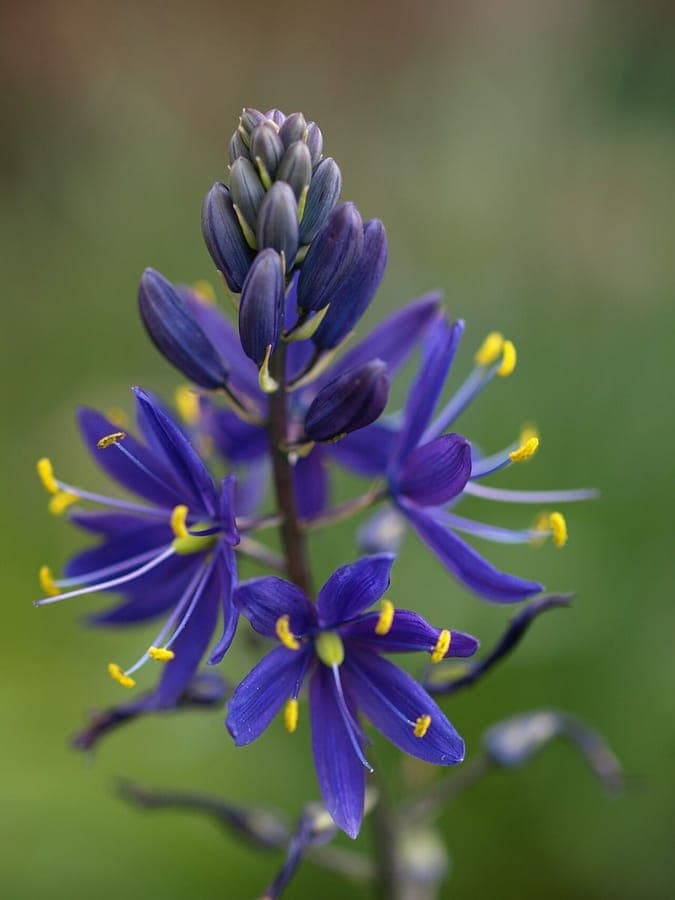
Flowersinmyyard / CC BY-SA 4.0, via Wikimedia Commons
Great camas (Camassia leichtlinii): planting and care
Camassia leichtlinii
Want to see Great camas (Camassia leichtlinii): planting and care in your garden?
Full design in HD: €7.99
Look after your Great camas with the GardenWorld app
Identify plants with your camera and get a care calendar with reminders for this plant.


Overview
Great camas (Camassia leichtlinii) is one of the few bulbs that performs best exactly where tulips and daffodils struggle. It copes with heavy clay, wet winters and damp springs, and in May it rewards you with tall spikes of starry flowers in deep blue-violet or creamy white. In a wildflower meadow, a naturalistic border or beside a pond it bridges the gap between spring and summer, just as the early bulbs fade and most perennials are only getting going.
The species comes from western North America, from southern British Columbia down to California, where it grows in damp meadows, along streams and in open woodland that is wet in winter and spring and dries out in summer. The name Camassia comes from camas, the word indigenous peoples used for the bulbs of these plants, which they ate after long, slow cooking. In the garden, however, it is purely ornamental: do not eat the bulbs.
Botanically, Camassia belongs to the asparagus family (Asparagaceae). Besides great camas, you will also see it called large camas or Leichtlin's camas. On gardenworld.app you can have a garden design drawn up in which camassias form a natural meadow with grasses and perennials that holds interest from April until autumn.
Appearance and flowering season
Each bulb produces a clump of long, strap-shaped leaves 30 to 60 cm long and about 2 cm wide, fresh green and slightly channelled. From this clump a sturdy, round flower stem rises in late spring to 60 to 120 cm, depending on the variety and the richness of the soil.
The top third of the stem is a dense, candle-like raceme of dozens of buds. These open from the bottom upwards into starry flowers 4 to 6 cm across, with six narrow tepals and prominent yellow anthers. Because new flowers keep opening while the lower ones fade, a single stem stays in flower for two to three weeks. One distinctive feature of this species is that the spent tepals twist together around the developing seed pod rather than dropping separately.
Flowering runs from late April into early June, peaking in May. The blue forms, often sold as Caerulea Group, are a rich blue-violet. 'Alba' and subspecies leichtlinii are creamy white, and 'Semiplena' carries double, cream flowers. Bees and bumblebees visit freely. After flowering, three-sided seed capsules form and the foliage dies down during June or July.
Ideal position
Camassia leichtlinii looks its best in full sun or partial shade. Stems are sturdiest in sun, but it also flowers well beneath deciduous trees that leaf up late, because it still gets plenty of light in spring.
It is ideal for places that stay damp in spring: a low-lying corner of lawn, the edge of a pond or ditch, or a wet patch that defeats other bulbs. It also naturalises well in grass that is mown late. Plant in groups or broad drifts of at least twenty bulbs; a few scattered bulbs disappear in a larger garden.
In a border, place camassias in the middle or towards the back, among perennials that grow up after flowering and hide the dying leaves. Their height also makes them a good vertical accent among low spring flowers.
Soil requirements
Where many bulbs rot in wet clay, camassia thrives. It grows in almost any fertile, moisture-retentive soil: clay, loam and humus-rich sand. It even tolerates soil that is temporarily waterlogged in winter and spring, provided it does not stay under water for months in summer.
The ideal pH is around neutral, from slightly acid to slightly alkaline. On poor, dry sandy soil, dig in some compost or well-rotted manure at planting time so the ground holds more moisture. A layer of compost each autumn keeps an established group vigorous.
Free preview
Want to see Great camas (Camassia leichtlinii): planting and care in your garden? Make a free preview of your design.
Planting the bulbs
Plant the bulbs from September to late November, as long as the ground is not frozen. They are fairly large, with a brown tunic, and put down a strong root system before winter. The earlier you plant, the better the first year's display.
Plant them 10 to 15 cm deep, measured from the base of the bulb, 15 to 20 cm apart and pointed end up. In grass, use a bulb planter or narrow spade to lift a plug, drop in the bulb and firm the turf back down. For a natural effect, scatter the bulbs across the lawn and plant them where they fall.
An established group slowly spreads by offsets and, in a spot it likes, by seedlings. After five or six years, congested clumps can be lifted and divided in summer once the foliage has died back.
On toxicity: Camassia leichtlinii is not known as a seriously poisonous plant for people or pets. Raw bulbs can cause stomach upset, though, and in the wild they resemble those of highly toxic relatives known as death camas. So do not eat the bulbs, and stop dogs from chewing them.
Watering
In open ground camassias rarely need watering. They draw on the moisture of a wet winter and spring. If April or May stays dry for a long spell, give each group a good can of water so the flower stems develop fully.
After flowering, once the leaves start to yellow, extra water is no longer needed. The bulb copes perfectly well with a dry summer. In containers, water regularly during growth and keep the pot fairly dry over summer.
Pruning
Cut off faded flower stems if you do not want seed or prefer a tidier look. If you leave them, the seed heads add structure for weeks and the plant may gently self-seed.
Always leave the foliage until it has turned yellow on its own. In naturalised grass that means no mowing before late June or early July. Mow too early and the bulbs weaken, and flowering declines after a few years.
Maintenance calendar
September–November: Plant new bulbs 10 to 15 cm deep. Spread compost over existing clumps.
December–February: Dormant period. No care needed, even in hard frost.
March–April: The leaves emerge. Protect young shoots from slugs.
May: Full flower. Cut a few stems for the vase when the lowest flowers have opened. Water during long dry spells.
June–July: Remove spent stems if you do not want seed. Let the foliage die back and only mow after that.
August: Lift and divide congested clumps and replant straight away.
Winter hardiness
Great camas is fully hardy in Britain and across western Europe. In its native range it experiences cold winters with hard frost, and in the garden it survives without any protection. Unlike many bulbs, it is not seriously troubled by wet winter soil either, as long as water does not lie on the surface for long periods.
Bulbs in containers are more vulnerable because frost reaches them from every side. Move pots against a wall in winter or wrap them in hessian or bubble wrap. A thick mulch is not needed in open ground, but on cold, exposed sites it can protect the first spring leaves from late night frosts.
Companion plants
Camassias combine beautifully with other plants of damp meadows and naturalistic borders. The pheasant's eye daffodil (Narcissus poeticus) flowers just before and partly overlaps, so white and blue together create a fresh meadow scene. The related Camassia quamash, shorter and earlier, extends the season.
Cow parsley (Anthriscus sylvestris), with its lacy white umbels, is a perfect match for the blue spikes in a relaxed, country-style garden. Meadow cranesbill (Geranium pratense) takes over after flowering and hides the fading leaves. Tufted hair grass (Deschampsia cespitosa) and other ornamental grasses add summer movement and keep the area green. Add hemp agrimony, purple loosestrife or great burnet if you want a moist border that flowers well into autumn.
Final thoughts
Camassia leichtlinii is a robust, long-lived bulb that saves you work: no lifting, little watering, hardly any disease and a display that gets richer every year. It also solves a problem many gardeners face, namely what to plant on heavy, wet ground. Plant a generous drift and let the foliage die down quietly after flowering.
Want to know when to plant the bulbs, when you can mow and when to divide clumps? The planting calendar on gardenworld.app sets it all out for your own garden, so you can enjoy these blue or white candles every May.
Frequently asked questions about Great camas
Is Great camas winter hardy?
Great camas is fully hardy in Britain and across western Europe. In its native range it experiences cold winters with hard frost, and in the garden it survives without any protection.
When and how do you prune Great camas?
Cut off faded flower stems if you do not want seed or prefer a tidier look. If you leave them, the seed heads add structure for weeks and the plant may gently self-seed.
How much water does Great camas need?
In open ground camassias rarely need watering. They draw on the moisture of a wet winter and spring.
What soil does Great camas need?
Where many bulbs rot in wet clay, camassia thrives. It grows in almost any fertile, moisture-retentive soil: clay, loam and humus-rich sand.

See it in your garden
See Great camas in your garden
One photo of your garden and a few questions. You see the result in about a minute.
Try it with a photoIdentify this plant in your own garden. Identify a plant
Similar plants
Camash (Camassia quamash): complete guide
Camassia quamash
Camassia quamash delivers stunning blue star-flower clusters in May-June. This North American bulb thrives effortlessly in moist soil. Ideal for borders, meadows, and wet corners.
Poet's narcissus: complete guide
Narcissus poeticus
All about Narcissus poeticus: full sun, pH 5.5-6.5, blooms in May, 30-40 cm tall. Ideal for cottage gardens, naturalised lawns, and borders. Hardy, fragrant, and low maintenance.
Cow-parsley: complete guide
Anthriscus sylvestris
Cow-parsley (Anthriscus sylvestris) is a versatile wildflower with fine, aromatic foliage and delicate white flowers. Perfect for naturalistic gardens and pollinator zones.
