
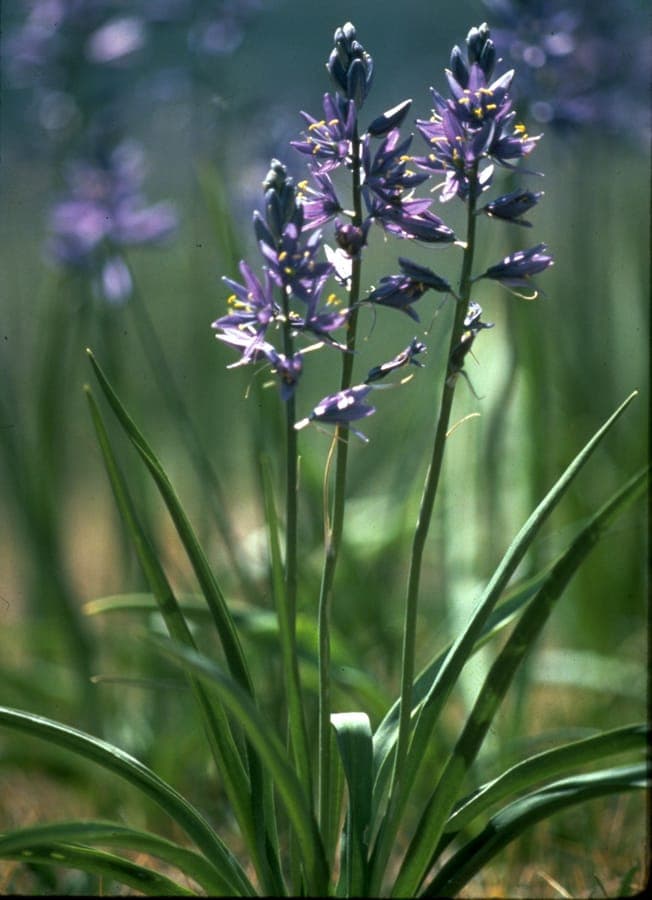
William & Wilma Follette @ USDA-NRCS PLANTS Database / USDA NRCS. 1992. Western wetland flora: Field office guide to plant species. West Region, Sacramento, California. / Public domain, via Wikimedia Commons
Camash (Camassia quamash): complete guide
Camassia quamash
Want to see Camash (Camassia quamash): complete guide in your garden?
1 minute, no credit card
Overview
Camash (Camassia quamash), also called quamash or blue camas, is a beautiful spring bulb from the Asparagaceae family, native to western North America. This robust spring bloomer delivers striking blue flower clusters that enliven gardens in May to June. Historically, native peoples in North America cultivated this plant for food; the bulbs were edible and nutritious. Today we grow them primarily for ornamental appeal.
Appearance and Bloom
Camassia quamash grows from an underground bulb approximately 2-3 cm in diameter. In early spring (March), long, narrow, dark green leaves emerge and grow upright. In May to June, a sturdy flower spike rises 50-80 cm tall bearing a magnificent parade of star-shaped small flowers in various shades of blue, from sky blue to deeper violet-blue. Each flower measures about 2-3 cm across and sits densely in a cylindrical raceme. After flowering, seed capsules form. Leaves gradually disappear after bloom and are mostly gone by early July.
Ideal Location
Camassia thrives in sunny to partially shaded positions. Full sun (6-8 hours daily) promotes best flowering, but partial shade works well too. In very hot, dry regions, afternoon shade is preferable. In borders, plant in groups of at least 5-7 bulbs for impact. Along ditches, in vegetable gardens, and in wet meadows they excel. They combine beautifully with other spring bloomers and early-summer plants.
Soil
Camassia loves growing in moist, well-draining soil. This is a plant for slightly moister soil types - not literally swampy, but certainly not dry. Ideal is border soil rich in organic matter (humus, compost). pH should be neutral to slightly acidic (pH 6.5-7.5). In very dry sandy soil, Camassia performs moderately; add plenty of compost. In clay soil it works well, provided waterlogged winters are prevented. Good drainage remains important: winter waterlogging causes bulb rot.
Free design
Want to see Camash (Camassia quamash): complete guide in your garden? Make a free design now.
Watering
During growth (March-May), the plant appreciates adequate moisture. If April and May are dry, water once weekly so soil stays consistently slightly moist. After blooming (June) and as leaves die back, allow drier conditions. From July through October it can stay dry; natural autumn rains usually suffice. In containers you must water more frequently; outdoor borders usually get sufficient rainwater. Avoid complete drying during the growing season, but also prevent waterlogging.
Pruning
Pruning isn't necessary. Dead flowers can be removed, but you may also leave them for seed production (wild charm). Once all leaves have disappeared (late June/early July), cut back everything. Just ensure you don't damage bulb parts still underground. The plant doesn't die; the bulb settles safely underground and prepares for next season.
Maintenance Calendar
March: First leaves appear. Optional light feeding. April-May: Water peak. Good watering. May-June: Bloom. Enjoy! June-July: Leaves wilt. Let them fade. July-October: Rest. Keep dry. October-November: Overwintering prep. October: Plant new bulbs.
Winter Hardiness
Camassia quamash is very winter hardy to USDA zone 3 (-35 degrees Celsius). In Europe no concerns; all frost zones through Scandinavia tolerate this plant. Winter protection is unnecessary. Bulbs can remain in the same spot for multiple years, slowly forming larger colonies. To prevent overcrowding, every 4-5 years after bloom you can lift bulbs, divide them, and replant elsewhere.
Companion Plants
Camassia pairs beautifully with other spring bloomers: tulips, daffodils, and hyacinths create lovely color schemes. Later-blooming plants like daylilies (Hemerocallis) and Salvia hide wilting Camassia foliage. In wild corners, pair well with grasses and other bulbs. In vegetable gardens among vegetables, they grow almost unnoticed yet decorate the space handsomely.
Closing
Camassia quamash is one of the most reliable and rewarding bulb plants for temperate climates. The blue spring bloom is unforgettable. Plant them en masse in borders, meadows, and wet corners. Zero maintenance, years of pleasure. Perfect for all garden types.
Want to see Camash (Camassia quamash): complete guide in your garden? Make a free design now.
Upload a photo, pick a style, and get a photorealistic design with plant list in under a minute.
No credit card required


Similar plants
Narrow-leaved dracaena: complete guide
Dracaena angustifolia
Everything about Dracaena angustifolia - the narrow-leaved dracaena: location, care, overwintering and use as a houseplant or patio plant.
Chaparral yucca: complete guide to Hesperoyucca whipplei
Hesperoyucca whipplei
Hesperoyucca whipplei (Our Lord's candle) is a dramatic rosette-forming plant from California that produces a towering flower spike, ideal for dry and gravel gardens.
False lily-of-the-valley: complete guide
Maianthemum dilatatum
Everything about Maianthemum dilatatum, the false lily-of-the-valley. Care, shade location, propagation and garden combinations for this popular shade ground cover.