
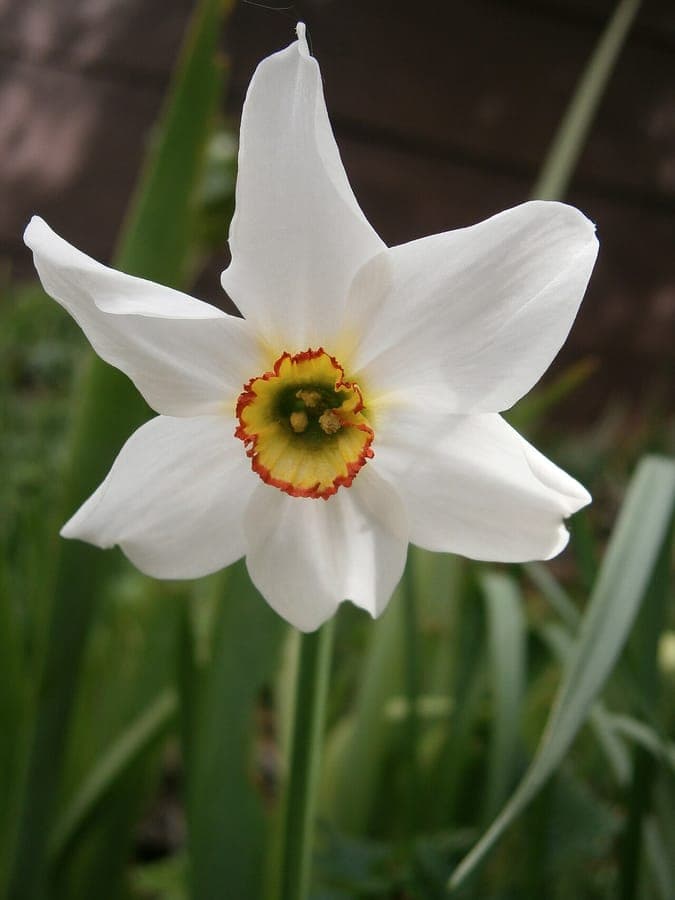
Meneerke bloem / CC BY-SA 3.0, via Wikimedia Commons
Poet's narcissus: complete guide
Narcissus poeticus
Want to see Poet's narcissus: complete guide in your garden?
1 minute, no credit card
Overview
Narcissus poeticus, commonly known as Poet's narcissus, is one of the most romantic and enduring daffodil species. Native to southern Europe-from the Pyrenees to the Balkans-this hardy bulb has graced gardens for centuries with its late spring blooms and intoxicating fragrance. Unlike modern hybrids, it grows wild in meadows and woodland edges, often naturalising beautifully over time. Standing 30 to 40 cm tall, it brings a wild, graceful presence to gardens, especially in cottage-style or informal landscapes.
On gardenworld.app, you can design a planting scheme that highlights the Poet's narcissus perfectly, whether in drifts through grass or as focal points in mixed borders.
Appearance & bloom cycle
The flowers of Narcissus poeticus appear in mid to late May, making it one of the last narcissi to bloom. Each stem carries a single bloom with pure white petals that flare outward and a small, flat, vividly orange-rimmed cup-giving it the French nickname 'Oeil de faisan' (pheasant's eye). The scent is powerful and sweet, reminiscent of jasmine or lilies of the valley, and strongest in the evening. This makes it ideal for near patios or pathways where its perfume can be appreciated after dusk.
The narrow, dark green leaves emerge in early spring and die back completely by early summer. The blooming period lasts about 10 to 14 days, depending on temperatures. Each bulb may produce one or two flowers in its first years, increasing over time as the clump matures.
Ideal location
This plant thrives in full sun (rated 8/10 for light), needing at least 6 to 8 hours of direct sunlight daily. A south- or west-facing border works best. It also tolerates light shade, especially in hotter climates, but flowering will be reduced. Avoid heavily shaded areas under dense trees or near large shrubs.
It performs well in borders, rock gardens, or naturalised in lawns. If planting in turf, wait at least six weeks after flowering before mowing to allow the foliage to photosynthesise and feed the bulb. It's also suitable for containers, provided they have good drainage.
Soil requirements
Well-drained soil is critical. Narcissus poeticus prefers a slightly acidic to neutral pH, ideally between 5.5 and 6.5. Heavy clay soils should be amended with grit, compost, or coarse sand to improve drainage. Poor drainage leads to bulb rot, especially during wet winters.
The ideal soil is loamy and rich in organic matter. Plant bulbs at a depth of 10 to 12 cm (roughly three times the bulb's height), spaced 10 to 15 cm apart. In containers, use a gritty, soil-based mix to prevent waterlogging.
Free design
Want to see Poet's narcissus: complete guide in your garden? Make a free design now.
Watering
Once established, Poet's narcissus is drought-tolerant. However, during active growth (February to June), consistent moisture is needed. In dry springs, water deeply once a week. Avoid overhead watering to prevent fungal issues like botrytis. In containers, check soil moisture weekly-don't let pots dry out completely, but never let them sit in water.
Reduce watering after flowering as the foliage begins to yellow. During dormancy (July to August), no watering is required.
Pruning
No pruning is necessary. After flowering, remove only the spent flower head to prevent seed set, which can drain bulb energy. Leave the foliage intact for at least six weeks-do not tie or braid it. The leaves must photosynthesise fully to store energy for next year's bloom. Cut back only when the foliage turns yellow and dies down naturally.
Maintenance calendar
- September–October: Plant bulbs 10–12 cm deep, 10–15 cm apart.
- February–March: Watch for emerging shoots. Protect from rodents if needed.
- May: Peak bloom time. Keep soil moist, avoid mowing if naturalised.
- June: Remove spent flowers. Let foliage die back naturally.
- July–August: Dormant period. No care needed.
With gardenworld.app, you can generate a custom maintenance calendar tailored to your garden's microclimate and planting schedule.
Winter hardiness
Narcissus poeticus is fully hardy in USDA zones 3 to 8. It withstands temperatures down to -20°C. Bulbs should remain in the ground over winter as long as the soil is well-drained. In containers, move pots to a sheltered spot or wrap them in horticultural fleece during prolonged freezes to prevent frost heave.
Companion plants
Its late bloom time makes it a great companion for alliums, poppies, and early summer perennials like Nepeta or Salvia. Pair it with early bloomers such as Muscari or Pulmonaria for a layered spring display. In wildflower meadows, it combines well with Camassia or native grasses.
Avoid planting near aggressive spreaders like mint or groundcovers that smother bulbs. Also, don't overcrowd with dense perennials that block light in early spring.
Closing
Poet's narcissus isn't flashy, but it's unforgettable. Its fragrance, simplicity, and resilience make it a standout in any garden. Plant it where you can enjoy its scent and late bloom. Buy bulbs in autumn from reputable garden centres-look for firm, plump bulbs without soft spots or mould. Plant them promptly or store in a cool, dry place.
With minimal care, this daffodil can return for decades, slowly forming naturalised clumps. It's not just a plant; it's a legacy. For inspiration, visit garden centres or browse planting ideas on gardenworld.app.
Want to see Poet's narcissus: complete guide in your garden? Make a free design now.
Upload a photo, pick a style, and get a photorealistic design with plant list in under a minute.
No credit card required


Similar plants
Douglas' Onion: complete guide
Allium douglasii
Douglas' onion is a compact ornamental allium with purple flowers, perfect for rock gardens and sunny borders. Learn care, siting and hardiness.
Oblique onion: complete guide
Allium obliquum
The oblique onion is a hardy ornamental allium with chartreuse flower heads and blue-green foliage. Location, soil and care explained.
False hooded garlic: complete guide
Allium pseudocalyptratum
Discover false hooded garlic (Allium pseudocalyptratum): a rare ornamental onion from Lebanon for rock gardens and alpine troughs.