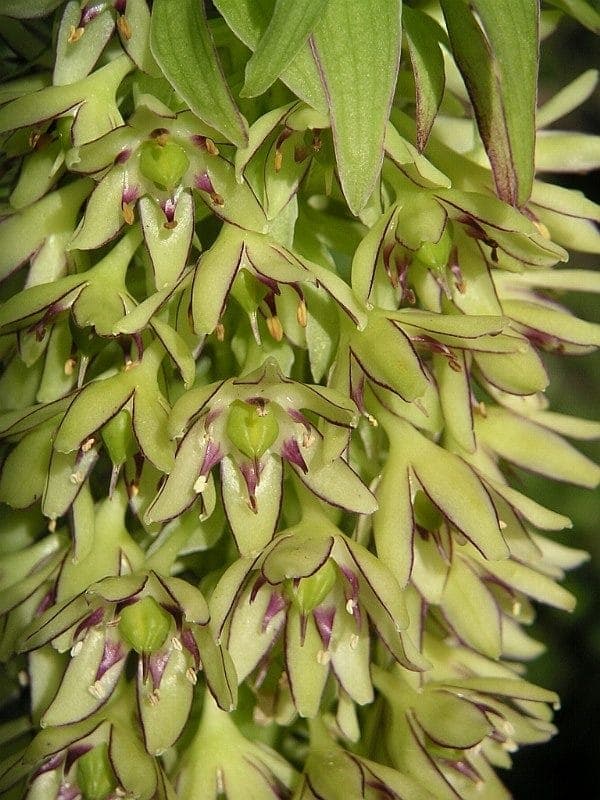
Jean-Jacques MILAN 18:07, 29 May 2005 (UTC) / CC BY-SA 3.0, via Wikimedia Commons
Pineapple lily (Eucomis bicolor): planting, care and overwintering
Eucomis bicolor
Want to see Pineapple lily (Eucomis bicolor): planting, care and overwintering in your garden?
Full design in HD: €7.99
Look after your Pineapple lily with the GardenWorld app
Identify plants with your camera and get a care calendar with reminders for this plant.


Overview
The pineapple lily (Eucomis bicolor) is a summer-flowering bulb from South Africa that never goes unnoticed in a border. Each flower spike ends in a tuft of green bracts that looks remarkably like the leafy crown of a pineapple, and beneath it sits a dense column of pale green, star-shaped flowers edged in purple. It looks exotic, yet it is surprisingly easy to grow, both in open ground and in a container on the patio.
In the wild, Eucomis bicolor grows in damp grassland and along streams in the Drakensberg and the eastern provinces of South Africa, where rain falls in summer and winters are cool and dry. That rhythm explains almost everything you need to do in the garden: plenty of water and food while it is growing, then a dry, cool rest in winter. The plant belongs to the Asparagaceae, in the same broad family as hyacinths and star-of-Bethlehem. It is not known to be seriously poisonous, but the bulb is not edible, so keep it away from children and from pets that like to dig.
A mature bulb produces a rosette of leaves 40 to 60 cm across and one or occasionally two flower stems 30 to 60 cm tall. If you would like to see where pineapple lilies would work best in your own plot, you can have a garden design made on gardenworld.app that takes account of sun, soil and the plants you already grow.
Appearance and flowering season
The leaves are broad, strap-shaped and fresh green with a distinctly wavy margin. They form a loose rosette and reach 30 to 50 cm in length. The flower stem is thick and fleshy, and is often speckled with purple-brown towards the base.
Flowering runs from late July into September. Each spike carries dozens of small starry flowers about 1.5 cm across, pale green to greenish white, with every petal neatly outlined in purple. The stamens and the ovary can also take on a purple flush. Above the flowers sits the characteristic crown of ten to twenty green bracts, again rimmed with purple.
Bring your nose close and you will soon notice that the flowers do not smell pleasant. That faintly rotten scent is no flaw: it attracts flies, which are the natural pollinators of this species. From a metre away you will not notice it at all. After flowering the green seed capsules swell and the spike stays attractive well into October. As a cut flower, a stem lasts two to three weeks in a vase.
Ideal position
Give the pineapple lily full sun or very light shade. The more sun it receives, the sturdier the stems and the stronger the purple markings on the flowers. In too much shade the stems stretch and flop. A sheltered spot against a south-facing wall or in a warm corner of the patio is ideal, particularly in cooler parts of Britain and northern Europe.
Because the plant is so striking, it is best placed at the front of a border, beside a path or in a large pot where the flowers can be admired at close range. A container also has the advantage that you can move the plant somewhere dry for the winter. In the ground, plant in groups of three or five bulbs for a bold effect.
Soil requirements
Eucomis bicolor wants fertile, humus-rich soil that stays moist in summer but drains freely in winter. Wet feet in the cold months are the bulb's worst enemy, as it will simply rot. On heavy clay, work a generous amount of coarse grit and garden compost into the top 30 cm, or plant in a slightly raised bed.
Slightly acidic to neutral soil is fine. For containers, use a mix of two parts good multipurpose or loam-based compost to one part grit or fine gravel, with a drainage layer of crocks or clay pebbles at the bottom. Choose a pot at least 20 cm across for a single bulb, or 30 to 35 cm for three.
Planting the bulbs
Plant the bulbs in April or early May, once the soil has warmed to around 10 °C. Planting earlier into cold, wet soil achieves nothing: the bulb either sits idle or starts to rot. In open ground, set each bulb pointed end up with 10 to 15 cm of soil above its tip, spacing them 20 to 30 cm apart.
In containers the bulbs can go shallower, with the tip just below the surface and roughly 3 to 5 cm of compost on top. Water once after planting, then wait until the first leaves appear before watering again. For earlier flowers, start bulbs indoors in pots in March in a bright, frost-free spot and move them outside after mid-May.
Free preview
Want to see Pineapple lily (Eucomis bicolor): planting, care and overwintering in your garden? Make a free preview of your design.
Watering
Once the leaves are growing strongly, the pineapple lily is a thirsty plant. From June to the end of August, keep the soil evenly moist without letting it become waterlogged. In a pot that can mean watering daily in hot weather. From June until flowering ends, feed every fortnight with a liquid fertiliser high in potassium, such as tomato feed.
From late September, water less. The leaves begin to yellow, which is the signal that the bulb is going into dormancy. Containers should be kept dry from October onwards. A dry winter matters just as much as a wet summer.
Pruning and tidying
There is no real pruning to do. You can leave the spent spikes in place, because the green seed capsules stay decorative into autumn. If you would rather the bulb put its energy into growth, cut the stem off just above the leaves once flowering is over. Leave the foliage itself until it has turned completely yellow so that the bulb can store the nutrients, and only then remove it.
Older clumps that flower less freely can be lifted and divided in spring. Small offsets form around the mother bulb and can be grown on separately; they usually reach flowering size in two to three years.
Maintenance calendar
March: Start bulbs indoors in pots, or resume watering pots that spent the winter dry.
April and May: Plant bulbs in open ground. Move pots outside after mid-May.
June: Feed every two weeks. Watch for slugs and snails on the young leaves.
July to September: Flowering. Water evenly and give light support to the stems if needed.
October: Stop watering, let the leaves die back, and move pots somewhere dry and frost-free.
November to February: Dormancy. Cover bulbs left in the ground with a thick mulch, and keep lifted bulbs cool and dry.
Winter hardiness
The RHS rates Eucomis bicolor H4, meaning the bulb tolerates brief frosts of around -5 to -10 °C. In practice, in dry, free-draining soil with a good winter blanket, it often survives in the ground for years in milder parts of the UK and the Low Countries. Frost combined with wet soil, however, is fatal.
Overwintering
For bulbs in the ground, spread a 10 to 15 cm layer of leaf mould, straw or bark over the planting spot in November. On heavy or wet soil, or in colder districts, it is safer to lift the bulbs. Let them dry for a few days, brush off loose soil and store them in dry peat-free compost or a paper bag at 5 to 10 °C.
Containers are the easiest option: once the foliage has died back, put them in a frost-free garage, shed or cellar and give no water at all through the winter. Bring them back out in March.
Companion plants
The green and purple tones of the pineapple lily look superb with dark or silvery foliage. Purple-leaved heucheras (Heuchera micrantha) planted at its feet pick up the purple edging of the flowers. Ornamental grasses such as fountain grass (Pennisetum alopecuroides) add movement and an airy backdrop.
In a border with an exotic feel, African lily (Agapanthus africanus), canna (Canna indica) and dahlias (Dahlia pinnata) are natural partners that share the same need for warmth and summer moisture. In a container, a pineapple lily also works well on its own, or with a low skirt of trailing silver foliage around its base.
Final thoughts
The pineapple lily is a characterful summer bulb that brings a tropical touch to the garden without demanding much effort. Remember three things: sun, water and food in summer, and a dry, cool rest in winter. Respect that, and you will enjoy this unusual plant, with its green crowns standing well into October, for many years.
To know exactly when to plant, feed or bring pots under cover, have a look at the planting calendar on gardenworld.app. That way you will not miss a single moment in the year of your Eucomis bicolor.
Frequently asked questions about Pineapple lily
Is Pineapple lily winter hardy?
The RHS rates Eucomis bicolor H4, meaning the bulb tolerates brief frosts of around -5 to -10 °C. In practice, in dry, free-draining soil with a good winter blanket, it often survives in the ground for years in milder parts of the UK and the Low Countries.
When and how do you prune Pineapple lily?
There is no real pruning to do. You can leave the spent spikes in place, because the green seed capsules stay decorative into autumn.
How much water does Pineapple lily need?
Once the leaves are growing strongly, the pineapple lily is a thirsty plant. From June to the end of August, keep the soil evenly moist without letting it become waterlogged.
What soil does Pineapple lily need?
Eucomis bicolor wants fertile, humus-rich soil that stays moist in summer but drains freely in winter. Wet feet in the cold months are the bulb's worst enemy, as it will simply rot.

See it in your garden
See Pineapple lily in your garden
One photo of your garden and a few questions. You see the result in about a minute.
Try it with a photoIdentify this plant in your own garden. Identify a plant
Similar plants
Lily-of-the-Nile: complete guide
Agapanthus africanus
Everything you need to grow Agapanthus africanus: ideal conditions, watering, winter care, and companion planting for UK and US gardens.
African arrowroot: complete guide
Canna indica
Everything you need to grow and care for Canna indica in your garden. Learn about sunlight, watering, winter care, and ideal planting partners.
Pennisetum alopecuroides: complete guide
Pennisetum alopecuroides (L.) Spreng.
Pennisetum alopecuroides, also called Chinese fountain grass, is a stunning ornamental grass with striking feathery plumes. Learn how to grow it successfully.
