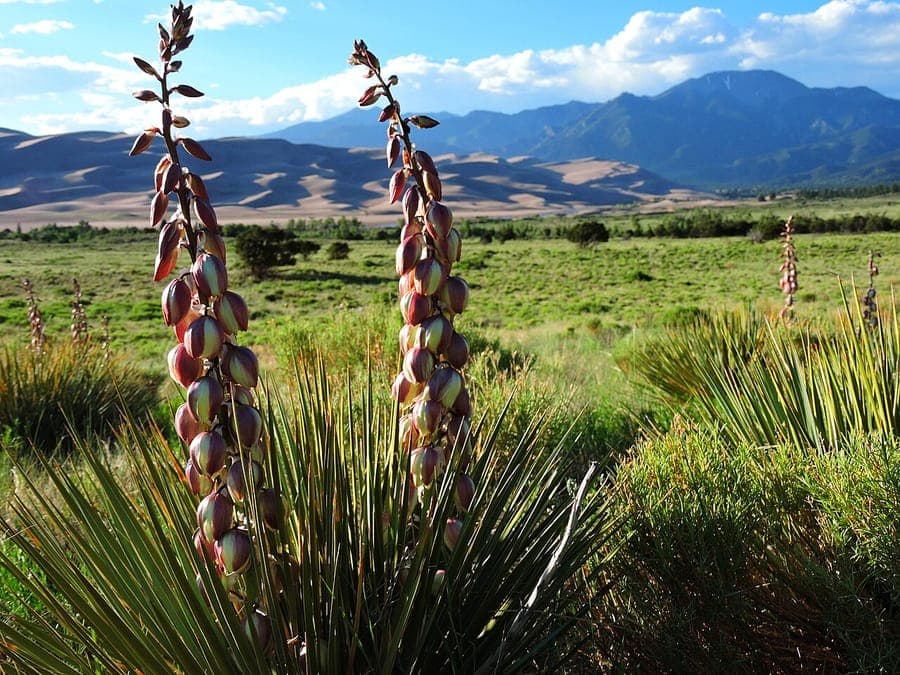
Great Sand Dunes National Park and Preserve / Public domain, via Wikimedia Commons
Yucca Angustissima: complete guide
Yucca angustissima
Want to see Yucca Angustissima: complete guide in your garden?
Full design in HD: €7.99
Look after your Yucca Angustissima with the GardenWorld app
Identify plants with your camera and get a care calendar with reminders for this plant.


Overview
Yucca angustissima, commonly known as narrow-leaf yucca, is a compact desert plant native to Utah, New Mexico, and Arizona. This distinctive plant brings remarkable structure to dry gardens with its elegant narrow foliage and spectacular tall flower spikes of creamy-white bells - ideal for xeriscape designs and Mediterranean gardens.
Appearance and Bloom
This semi-succulent forms tight rosettes of slender, gray-green leaves typically 12-24 inches long and only 0.5-1 inch wide. The plant grows slowly into a compact mound 24 inches tall and 1.5-3 feet wide. In late May and June, impressive flower spikes emerge to 3-5 feet tall, crowded with creamy-white, bell-shaped flowers that attract hummingbirds and night-blooming pollinators.
Ideal Location
Yucca angustissima demands full sun - 6-8 hours direct daily sunlight minimum. Position prominently to showcase the dramatic white flower spikes against blue sky. Protect from strong winds that might topple the flowering spike.
Soil
Extremely well-draining soil is essential. This plant thrives in sand, gravel, rocky soils, and chalky earth. Avoid heavy clay; amend with sand, gravel, or coarse compost. pH tolerance is broad (5.5-8.5); it's highly alkaline-tolerant.
Watering
Once established, Yucca angustissima is exceptionally drought-tolerant. Water regularly during active growth (spring-summer), but sparingly thereafter. Overwatering causes root rot - ensure soil dries between waterings. In wet winters, extra drainage is critical.
Free preview
Want to see Yucca Angustissima: complete guide in your garden? Make a free preview of your design.
Pruning
Minimal pruning needed. Remove dead basal leaves and damaged foliage. After flowering, cut spent flower spikes near the base. Young offsets may be carefully separated and propagated separately.
Maintenance Calendar
- April-May: Resume watering after winter
- May-June: Enjoy spectacular tall blooms
- July-September: Minimal care; water only during extreme drought
- October-March: Winter rest; water only in excessively wet periods
- Year-round: Remove dead basal leaves
Winter Hardiness
Yucca angustissima is winter-hardy to USDA zone 5, tolerating temperatures to -13 deg F (-25 deg C). In colder regions, winter protection (dry mulch, windbreak) helps against wet winters, which are more damaging than cold.
Companion Plants
Pair Yucca angustissima with:
- Other drought-tolerant specimens: Agave, Sempervivum
- Desert ornamental grasses: Bouteloua, Festuca
- Aromatic perennials: Salvia, Lavender
- Rocks and gravel for authentic backdrop
This creates an authentic dry-climate landscape.
Closing
Yucca angustissima excels in water-wise gardens and xeriscape designs. Its slender gray-green rosettes and tall white flowers provide striking architectural interest without demanding water. Perfect for the modern dry garden and Mediterranean patio. Explore Gardenworld.app for inspiration on incorporating this desert gem into your design.
Frequently asked questions about Yucca Angustissima
Is Yucca Angustissima winter hardy?
Yucca angustissima is winter-hardy to USDA zone 5, tolerating temperatures to -13 deg F (-25 deg C). In colder regions, winter protection (dry mulch, windbreak) helps against wet winters, which are more damaging than cold.
When and how do you prune Yucca Angustissima?
Minimal pruning needed. Remove dead basal leaves and damaged foliage.
How much water does Yucca Angustissima need?
Once established, Yucca angustissima is exceptionally drought-tolerant. Water regularly during active growth (spring-summer), but sparingly thereafter.
Where does Yucca Angustissima grow best?
Yucca angustissima demands full sun - 6-8 hours direct daily sunlight minimum. Position prominently to showcase the dramatic white flower spikes against blue sky.
What soil does Yucca Angustissima need?
Extremely well-draining soil is essential. This plant thrives in sand, gravel, rocky soils, and chalky earth.

See it in your garden
See Yucca Angustissima in your garden
One photo of your garden and a few questions. You see the result in about a minute.
Try it with a photoIdentify this plant in your own garden. Identify a plant
Similar plants
Great camas (Camassia leichtlinii): planting and care
Camassia leichtlinii
Everything about great camas (Camassia leichtlinii): planting the bulbs, heavy wet soil, naturalising in grass, hardiness and the best partners for a flowering meadow.
Pineapple lily (Eucomis bicolor): planting, care and overwintering
Eucomis bicolor
Everything about the pineapple lily (Eucomis bicolor): planting the bulbs, watering and feeding, overwintering in pots or the ground, and the best border partners.
Pineapple lily (Eucomis comosa): growing and overwintering
Eucomis comosa
Eucomis comosa is the tallest and best-known pineapple lily, with creamy spikes topped by a leafy tuft in late summer. Planting, overwintering and leaf cuttings.
