
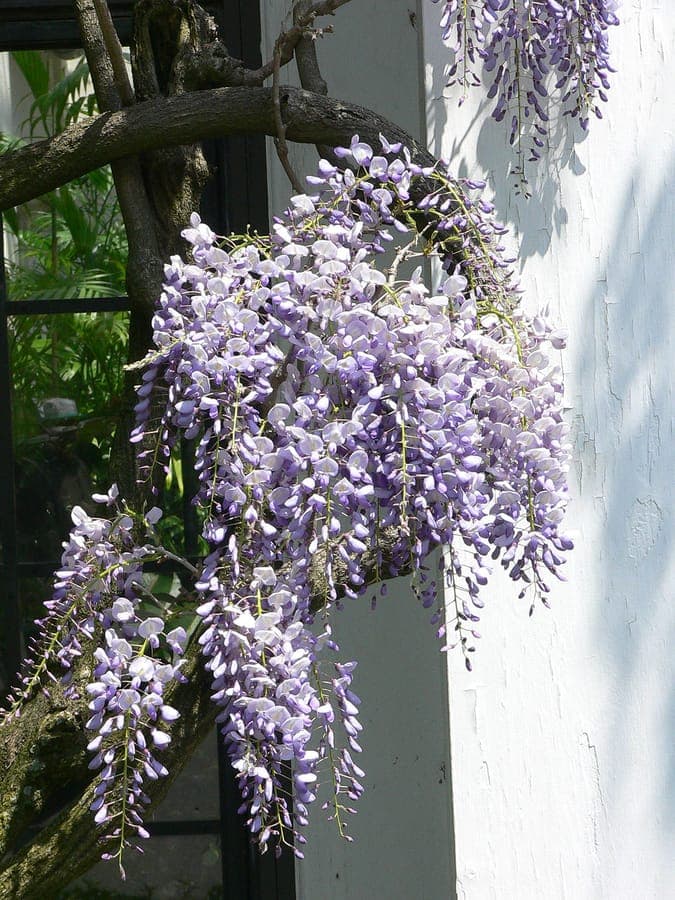
Raul654 / CC BY-SA 3.0, via Wikimedia Commons
Japanese Wisteria: complete guide
Wisteria floribunda
Want to see Japanese Wisteria: complete guide in your garden?
1 minute, no credit card
Overview
Japanese Wisteria (Wisteria floribunda) is one of the most breathtaking climbing plants in the world. When this deciduous twiner unfurls its spectacular flower racemes in May and June, every garden lover stops and stares in admiration. The racemes can reach 30 to 90 centimetres in length - with the legendary cultivar 'Multijuga' (also sold as 'Macrobotrys'), they can even exceed a full metre. No other climber in temperate gardens comes close to this floral spectacle that persists for weeks on end.
Wisteria floribunda originates from Japan, where it has been revered in gardens and temples for centuries. Across Europe and North America, Japanese Wisteria has steadily gained popularity, and rightly so. On gardenworld.app you can create a garden design in which a wisteria becomes the absolute showpiece - draping over a pergola, cascading down a facade, or trained as a free-standing standard tree. The plant can reach 10 to 15 metres in height and will readily cover an entire house front. A crucial distinction: Wisteria floribunda twines clockwise (when viewed from above), whereas Chinese Wisteria (Wisteria sinensis) twines anticlockwise.
Appearance and bloom period
Japanese Wisteria flowers in May and June, slightly later than its Chinese counterpart. A key difference is that the flowers of Wisteria floribunda appear simultaneously with the emerging foliage, while Wisteria sinensis blooms before the leaves unfold. The racemes of the Japanese species are longer and more elegant - they open gradually from top to bottom, which means the floral display can last for several weeks.
Individual flowers are 1.5 to 2 cm across, pea-shaped, and appear in shades from pale blue to deep violet depending on the cultivar. 'Multijuga' produces blue-violet racemes that can reach 100 cm or more. 'Rosea' has soft pink flowers with lavender undertones. 'Royal Purple' flaunts intensely dark purple racemes. After flowering, velvety seed pods of 10 to 15 cm develop and remain on the plant well into winter. The compound foliage is fresh green, comprising 13 to 19 leaflets, and turns golden yellow in autumn - an additional seasonal attraction that is often overlooked.
Ideal location
Give your wisteria the sunniest, warmest spot in your garden. At least six hours of direct sun per day is necessary for abundant flowering. A south- or southwest-facing wall, pergola, or arbour is the perfect location. The heat that a masonry wall stores during the day and releases at night creates a microclimate that wisteria thrives in. Without sufficient sun, the plant produces plenty of leaves but disappointingly few flowers.
Wisteria requires robust support. The plant becomes heavy - a mature specimen can weigh several hundred kilograms. A timber pergola, a steel wire system on a facade, or a purpose-built wisteria frame must be sturdy enough to bear decades of growth. Use stainless-steel wire tensioned 20 to 30 cm from the wall with heavy-duty wall anchors. Most good garden centres stock suitable climbing-support systems that are rated for the weight of a mature wisteria.
Soil requirements
Wisteria is surprisingly tolerant regarding soil, but performs best in fertile, well-drained ground with a slightly acidic to neutral pH of 6.0 to 7.0. Avoid extremely chalky soils and very heavy clay that becomes waterlogged in winter. On sandy soil it is wise to work a generous amount of compost into the planting hole to improve moisture retention.
Dig a generous planting hole of at least 60 by 60 by 60 cm. Mix the excavated soil with one-third compost and a handful of bone meal for a solid starter feed. Plant the root ball at the same depth as it sat in the pot - planting too deep can damage the stem. A critical point: never apply nitrogen-rich fertiliser to wisteria. Excess nitrogen drives leaf growth at the expense of flowers. In spring, use a potassium-rich feed (such as tomato fertiliser) to encourage flower-bud formation.
Watering
Young wisteria plants need regular watering during their first and second year to develop a strong root system. Supply 10 to 15 litres per week in dry weather, directly at the base of the plant. Keep the soil evenly moist but never waterlogged. A mulch layer of 5 to 8 cm of bark chips around the stem helps retain moisture and keeps roots cool.
Once established - after two to three years - wisteria is remarkably drought-tolerant. Its deep-reaching roots find moisture in layers inaccessible to many other plants. Supplementary water is then only necessary during prolonged heatwaves. Note that a period of summer drought stress can actually benefit next year's flowering, because the plant forms more flower buds instead of pushing vegetative growth.
Free design
Want to see Japanese Wisteria: complete guide in your garden? Make a free design now.
Pruning
Pruning is the single most important aspect of wisteria care and the key to abundant flowering. Without regular pruning, wisteria becomes an unruly wilderness of long whippy shoots that barely flower. The good news: the pruning regime is straightforward once you commit to doing it twice a year.
The summer prune takes place in July or August: shorten all new side shoots to 15 to 20 cm (five to six leaves) from the main framework branches. This concentrates the plant's energy into flower-bud formation instead of endless vegetative growth. The winter prune in January or February is the refinement: shorten those same side shoots further to two or three buds (approximately 8 to 10 cm). The fat, round buds are flower buds; the flatter, more pointed buds are leaf buds. Leave the flower buds in place and remove surplus leaf buds.
For the main framework branches that form the skeleton of the plant, train one or two strong shoots each year in the desired direction and tie them to the support structure. Remove all other shoots from the main trunk. A well-trained wisteria has a clear structure of horizontal framework branches with short flowering spurs - similar in concept to a fruit tree in espalier form.
Maintenance calendar
January-February: Winter prune - shorten the summer-pruned shoots further to two to three buds. Inspect and repair the support structure. Tie in any loose branches.
March-April: The plant begins to break bud. Remove any frost damage. Apply a potassium-rich fertiliser.
May-June: Flowering period. Enjoy the spectacle. Remove spent racemes if you do not want seed pods, as pods drain the plant's energy.
July-August: Summer prune - shorten all new side shoots to five to six leaves. This is the most important pruning session for promoting flowering.
September-October: The foliage turns golden yellow. Reduce watering. Re-tie any branches that have come loose.
November-December: Leaf fall. The graceful trunk and branch architecture becomes visible. Plan any modifications to the support structure.
Winter hardiness
Wisteria floribunda is hardy to approximately -20 to -25 degrees Celsius, corresponding to USDA zones 5 to 9. Across the UK, most of continental Europe, and much of North America, Japanese Wisteria overwinters outdoors without difficulty. Even the occasional severe winter poses no threat to an established plant.
Young plants of one or two years old are more vulnerable. Protect the trunk and base during the first and second winter with a layer of straw or fleece when temperatures drop below -10 degrees. Flower buds that are already visible in winter as plump buds on the short side shoots can be damaged by a late frost in April or May. This is the primary reason why a wisteria sometimes flowers poorly in certain years - not winter cold itself, but late spring frost that destroys the flower buds.
Common mistakes
The number-one complaint among wisteria owners is: my plant does not flower. The most frequent causes are insufficient pruning, excess nitrogen, too little sun, and a plant that is simply too young. Wisteria grown from seed can take eight to fifteen years to produce its first flowers. Therefore, always buy a grafted or cutting-grown plant from a reputable nursery - these typically flower within three to five years.
A second common mistake is failing to provide timely support. Wisteria grows at a blistering pace - up to two metres per year - and without guidance it can lift gutters, bend drainpipes, and even damage woodwork. Train the plant consistently along its support and remove any shoots that explore gaps and openings where they should not go.
Cultivars and variations
The most spectacular cultivar is undoubtedly 'Multijuga' (synonym 'Macrobotrys'), with flower racemes that can reach 60 to 120 cm in a mesmerising blue-violet hue. 'Alba' is the white variant of Multijuga with racemes up to 60 cm. 'Rosea' offers soft pink flowers with lavender tones, particularly elegant against a white pergola. 'Royal Purple' has the deepest flower colour - intense purple, ideal as a contrast against pale stone or white-rendered walls.
For smaller gardens, more compact selections exist that are suitable for a large container on a sunny terrace, though wisteria always performs best with unrestricted root space in open ground.
Companion plants
Wisteria is a solitary star that tolerates little competition at its feet, but beautiful combinations are possible. Let clematis (Clematis montana or Clematis armandii) grow through a wisteria for an extended flowering season - the clematis often blooms earlier or later. Underplant with shade-tolerant ground covers such as bigroot geranium (Geranium macrorrhizum) or barrenwort (Epimedium). Spring bulbs like narcissus and tulips provide colour at the base before the wisteria itself comes into flower.
For a Japanese-inspired garden, combine wisteria with Japanese Maple (Acer palmatum), azaleas, and ferns. The combination of cascading purple racemes with the finely dissected red foliage of a Japanese Maple is one of the most beautiful garden pictures you can create.
Final thoughts
Japanese Wisteria is not for the impatient gardener. It takes a few years for the plant to mature and reach its full potential. But those who exercise patience and prune consistently are rewarded with a floral spectacle that lasts for decades - wisteria plants can live for over a hundred years. It is an heirloom you quite literally pass on to the next generation.
Purchase your wisteria from a reputable garden centre and always choose a grafted specimen for faster flowering. On gardenworld.app you can create a garden design where wisteria takes centre stage - as an arch over a garden path, as a green facade, or as a free-standing tree that rains purple blossoms every May. Start planting your own wisteria this spring and give your garden a piece of timeless elegance.
Want to see Japanese Wisteria: complete guide in your garden? Make a free design now.
Upload a photo, pick a style, and get a photorealistic design with plant list in under a minute.
No credit card required


Similar plants
Chinese Wisteria: complete guide
Wisteria sinensis
Everything about Chinese Wisteria (Wisteria sinensis): planting, pruning, training and care. Expert tips for breathtaking cascading blooms.
Clematis: complete guide
Clematis
Everything about Clematis: pruning groups, planting, bloom time and care. Practical tips for abundant flowers on pergolas, walls and fences.
Star jasmine: complete guide
Trachelospermum jasminoides
Everything about Star Jasmine (Trachelospermum jasminoides): planting, care, pruning and winter protection. Expert tips for a fragrant evergreen climber.