
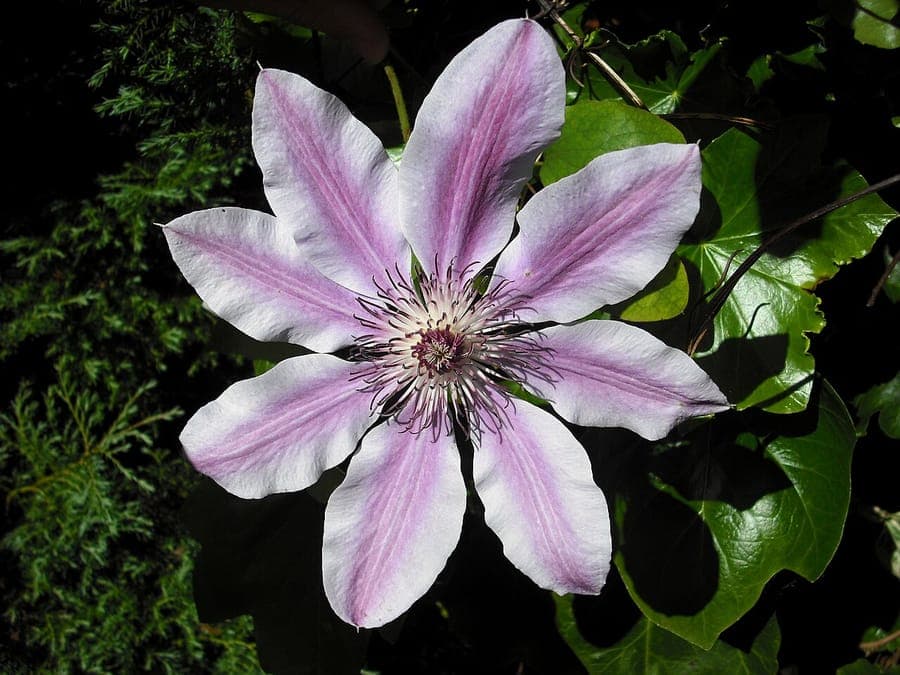
Jolly Janner / Public domain, via Wikimedia Commons
Clematis: complete guide
Clematis
Want to see Clematis: complete guide in your garden?
1 minute, no credit card
Overview
Clematis is the largest and most varied genus among flowering climbing plants. With more than 300 species and thousands of cultivars, the genus offers blooms in virtually every colour - from deepest purple to snow white, from soft pink to vivid blue - in sizes ranging from small nodding bells to saucer-shaped flowers 20 centimetres across. From early spring to late autumn, there is always a clematis in flower somewhere.
This diversity makes clematis suitable for every garden situation: a pergola, an obelisk, a wall, a fence, an old tree, or even scrambling across the ground as a flowering carpet. On gardenworld.app you can create a garden design where clematis takes centre stage or weaves subtly through shrubs as living decoration. Most species climb using twisting leaf stalks (petioles) that coil around wires, branches, and trellis work - they always need something to hold onto. Depending on the species, clematis reaches 2 to 12 metres in height. The single most important key to success is knowing your plant's pruning group, because incorrect pruning is the most common reason clematis fails to bloom.
Appearance and bloom
Clematis flowers are not true petals in the botanical sense but coloured sepals - modified leaves that surround the reproductive parts. This explains their often silky texture and the way they catch the light. Depending on the species, the flowers are star-shaped, bell-shaped, tulip-shaped, or fully open and flat. Some are single; others are doubled with dozens of sepals.
Group 1 species flower earliest. Clematis montana smothers itself in April and May with thousands of small pink or white flowers and is spectacular trained over a large wall or shed roof. Clematis armandii is evergreen and blooms in March with fragrant white flowers - a rarity among climbers. Clematis alpina and macropetala produce elegant nodding bells in blue, pink, or white from April to May.
Group 2 contains the large-flowered hybrids that most people picture when they hear the word clematis: 'Nelly Moser' (pink with a darker central bar), 'The President' (deep purple), 'Henryi' (pure white), and 'Multi Blue' (doubled, violet). These bloom in May and June on the previous year's wood and often again in August and September on new growth. Individual flowers can reach 15 to 20 cm across.
Group 3 flowers latest, from July to October, on the current season's growth. Clematis viticella hybrids ('Étoile Violette', 'Polish Spirit', 'Purpurea Plena Elegans') are particularly well-suited to cooler climates due to their resistance to clematis wilt. The workhorse of Group 3 is 'Jackmanii', with its profuse deep purple blooms from July to September.
Ideal location
The golden rule for clematis is: cool feet, warm head. The roots want coolness and moisture, while the shoots and flowers reach towards the light. Plant clematis preferably against a south-west or west-facing wall where the base sits in shade but the top growth can climb into sunlight. East- and north-facing positions also work, though flowering will be less prolific.
Shade the root zone by placing a low plant in front - a lavender bush, a clipped box ball, or even a couple of flat stones on the ground will keep the roots cool. Clematis grows superbly through shrubs and roses: the host plant shades the base while the clematis uses the branches as climbing support. On a fence or pergola, provide support with horizontal wires spaced 30 cm apart or trellis panels.
Avoid positions where water runs down the wall after rain - clematis dislikes sitting in wet soil through winter. Plant the clematis at least 30 cm away from the wall base to avoid the dry rain-shadow zone. In the United States, clematis thrives across USDA zones 4 to 9, though the evergreen Clematis armandii is only reliable in zone 7 and above. In Australia and South Africa, the viticella types perform best in warmer regions.
Soil requirements
Clematis prefers fertile, well-drained soil with ample organic matter. Unlike ivy or lavender, clematis genuinely benefits from a rich growing medium. Work a generous spadeful of garden compost or well-rotted manure into the planting hole. In heavy clay, improve drainage by adding coarse grit and compost; in light sandy soil, increase water retention with extra organic matter.
The ideal pH sits between 6.0 and 7.5 - most clematis favour slightly alkaline to neutral soil. Chalky ground is no problem; acidic soil is. On acidic soil, add garden lime at 200 g per square metre. Mulch the root zone annually in spring with a 5 to 8 cm layer of compost or well-rotted bark. This keeps the roots cool, conserves moisture, and slowly adds nutrients.
The single most important planting instruction: set the clematis 10 to 15 cm deeper than the level in the nursery pot. This encourages the formation of underground buds that serve as a backup system. If the plant dies back above ground - whether from clematis wilt, frost damage, or mechanical injury - it can regrow from these dormant subterranean buds.
Free design
Want to see Clematis: complete guide in your garden? Make a free design now.
Watering
Clematis needs more moisture than the average climbing plant. The shallow root system dries out quickly, particularly at the base of a wall or fence where rain does not reach. During the first year after planting, water twice a week with 10 litres. From the second year, watering once a week in dry weather is sufficient - roughly 10 to 15 litres each time.
Water at the base, never over the foliage. Wet leaves promote fungal diseases, particularly powdery mildew. A thick mulch layer around the root zone significantly reduces evaporation. During summer, when the plant is actively growing and flowering, regular watering is the key to a long bloom period. Clematis in containers needs daily watering in summer because the limited soil volume dries out rapidly.
Pruning
Pruning clematis is simpler than most gardening books suggest, provided you know which group your plant belongs to. The three pruning groups relate directly to the timing of bloom and whether the plant flowers on old or new wood.
Group 1 (spring-flowering on old wood): montana, armandii, alpina, macropetala. Prune immediately after flowering, in May or June. Remove dead wood and overly long stems. Do not prune in winter - you would be cutting off next year's flower buds.
Group 2 (large-flowered hybrids, blooming on old + new wood): 'Nelly Moser', 'The President', 'Henryi'. Prune lightly in February or March: remove dead and weak stems and cut remaining stems back to the uppermost pair of strong buds. After the first flush in June, you can cut back spent stems to encourage a second round of flowers.
Group 3 (summer-flowering on new wood): viticella, texensis, 'Jackmanii'. Prune hard in February or March, cutting back to 15 to 30 cm above ground level, just above a pair of healthy buds. This sounds severe, but Group 3 clematis produces entirely new growth each spring. Without hard pruning, the plant becomes a tangle of bare, woody stems with flowers only at the top.
Maintenance calendar
February–March: Prune Groups 2 and 3. Apply a 5 to 8 cm mulch layer around the root zone. Give the first feed of organic fertiliser.
April–May: Group 1 flowering (montana, alpina). Guide new shoots along supports - they do not always find their own way. Check for aphids.
May–June: Prune Group 1 immediately after flowering. First flush of Group 2. Begin regular watering in dry weather.
July–August: Group 3 in full bloom and second flush of Group 2. Apply liquid feed every two weeks until mid-August. Monitor for powdery mildew; improve air circulation by thinning overcrowded growth.
September–October: Final flowers of Group 3. Leave the fluffy seed heads in place - they are decorative through autumn and winter.
November–January: Dormancy. Plant new clematis if the ground is not frozen. Check supports for damage.
Winter hardiness
Most garden clematis are excellent in cold weather, tolerating temperatures down to -20°C to -25°C (USDA zones 4 to 9). Group 3 types such as viticella and 'Jackmanii' are the toughest, since they are cut to the ground each year and have no above-ground tissue to protect. Group 2 hybrids are slightly more vulnerable because they flower on old wood - protect the base with a layer of straw or leaves in severe frost.
Clematis armandii is the major exception: this evergreen species is only hardy to approximately -10°C and needs a sheltered, warm wall in most temperate climates. In milder coastal areas of the UK, the Pacific Northwest of the US, and parts of Australia and New Zealand, armandii performs reliably outdoors.
For all clematis: the root zone is the most vulnerable point. Mulch in autumn with 10 cm of leaf mould or straw. The deeper planting (10 to 15 cm below soil level) provides additional insurance for the dormant underground buds.
Companion plants
Clematis is the ideal partner for roses. The classic combination of a climbing rose and a clematis sharing the same support is hard to beat. Choose a Group 3 clematis that blooms at the same time as the rose, or one that starts after the main rose flush, giving the support two flowering seasons. 'Jackmanii' (purple) with a pale pink rose, or 'Étoile Violette' (deep purple) with a white rose are tried-and-tested pairings.
At the base of the clematis, plant low, shade-tolerant species: lavender (Lavandula angustifolia), box (Buxus sempervirens), hardy geranium (Geranium 'Rozanne'), or catmint (Nepeta faassenii). These shade the root zone and fill in the base where clematis is often bare. Growing clematis through a wisteria (Wisteria sinensis) produces a spectacular sequence: the wisteria in May, then the clematis through summer.
In a border, ground-cover clematis (Clematis x jouiniana 'Praecox') combines well with ornamental grasses and perennials. The non-climbing types scramble through the border, covering the ground with flowers from midsummer onward.
Closing
Clematis is the queen of climbing plants and deserves a place in every garden. The secret to success is threefold: choose the right species for your situation, plant 10 to 15 cm deeper than the pot, and prune according to the correct group. Follow these three rules and you will be rewarded with an ever-growing spectacle of flowers year after year.
Most garden centres stock a broad selection of clematis, usually clearly labelled with pruning group and flowering time. Pay attention to the pruning group on the label at the point of purchase - this prevents years of disappointment. On gardenworld.app you can create a garden design that combines clematis with the right partners for your specific garden. Start with one plant and you will discover what experienced gardeners already know: clematis is addictive.
Want to see Clematis: complete guide in your garden? Make a free design now.
Upload a photo, pick a style, and get a photorealistic design with plant list in under a minute.
No credit card required


Similar plants
Chinese Wisteria: complete guide
Wisteria sinensis
Everything about Chinese Wisteria (Wisteria sinensis): planting, pruning, training and care. Expert tips for breathtaking cascading blooms.
Rugosa Rose: complete guide
Rosa rugosa
Everything about the Rugosa Rose (Rosa rugosa): planting, pruning, care and winter hardiness. Practical tips for abundant blooms in your garden.
Bigleaf Hydrangea: complete guide
Hydrangea macrophylla
Everything about the Bigleaf Hydrangea (Hydrangea macrophylla): planting, pruning, flower colour control and winter protection. Practical tips for lush blooms.