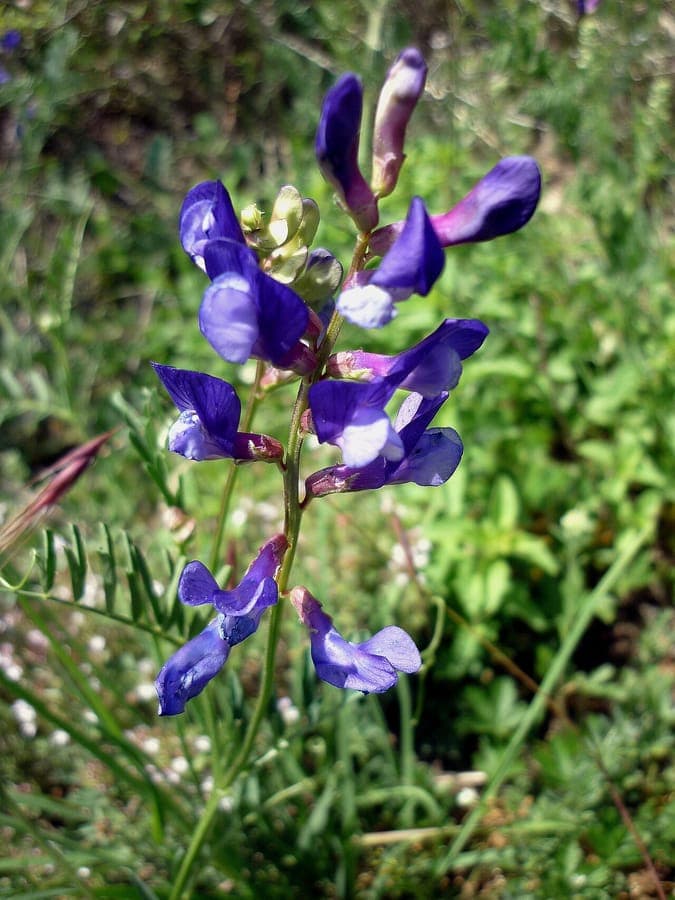
Isidre blanc / CC BY-SA 3.0, via Wikimedia Commons
Vicia onobrychioides: complete guide
Vicia onobrychioides
Want to see Vicia onobrychioides: complete guide in your garden?
Full design in HD: €7.99
Look after your Vicia onobrychioides with the GardenWorld app
Identify plants with your camera and get a care calendar with reminders for this plant.


Overview
Vicia onobrychioides, commonly known as Sainfoin vetch or False sainfoin, is an elegant, cold-hardy plant native to southern and central Europe and North Africa. This Fabaceae (pea family) member enchants with its delicate blue flower spikes that attract pollinators abundantly. It's a beautiful, underappreciated plant for dry soils and naturalistic gardens.
The plant grows as a slender, semi-climbing perennial with fine, compound foliage. It thrives in poor, dry soils where many plants struggle. Being a nitrogen-fixer, it enriches soil ecologically. The long blooming period appeals to butterflies and bees.
Appearance and bloom
Vicia onobrychioides grows as a slender, somewhat climbing plant reaching 40 to 60 centimeters tall. Stems are thin, angular, and lightly hairy. Leaves are compound, composed of small oval leaflets in opposite pairs, with fine spiral tendrils at the tip. This creates an airy, delicate appearance.
Flowers appear June through August in loose racemes containing 10 to 20 blooms. Color ranges from soft lavender-blue to deeper blue-purple. Each flower measures roughly 10-12 millimeters and displays the characteristic pea family shape. Bees and butterflies are highly attracted.
Following bloom, the plant produces long, thin seed pods containing several seeds. In warm years, plants self-seed readily.
Ideal location
Vicia onobrychioides thrives in full sun to dappled shade, preferring at least four hours direct sunlight daily. It's extremely tolerant of drought-prone, sunny locations where many plants would wilt.
The plant is frost-hardy to zone 6 (-23 degrees Celsius). Throughout the Netherlands, Belgium, and parts of Germany, it overwinters normally, though severe winters may cause damage. It's also wind and air-pollution tolerant.
Soil
Vicia onobrychioides prefers well-draining, lightly acidic to neutral soil with pH around 7.5 to 8.0. Crucially, the plant tolerates poor soils far better than rich, heavily fertilized ones. Excessive fertility promotes leafy growth at the expense of flowers. As a nitrogen-fixer, it creates its own nutrition.
The plant thrives in sandy, gravelly, and even rocky soils. Drainage is essential; waterlogged conditions cause root rot.
Free preview
Want to see Vicia onobrychioides: complete guide in your garden? Make a free preview of your design.
Watering
Once established, water requirements are minimal. The plant tolerates drought excellently thanks to its deep root system. Water regularly only during initial establishment (3-4 weeks) until well-rooted. Thereafter, supplemental water is rarely needed.
Overwatering is harmful and invites fungal infection. This plant genuinely prefers drier, Mediterranean-style conditions.
Pruning
Minimal pruning is necessary. In early spring, lightly cut back plants that haven't survived winter entirely. Avoid heavy pruning, which damages flowering. Deadheading spent flowers is optional but may slightly extend bloom.
Maintenance calendar
Spring (March-April): Check for winter damage, light pruning if needed.
Late spring (May): Plant begins growing. Minimal watering required.
Summer (June-August): Blooming period. No maintenance except in extreme drought.
Autumn (September-October): Blooming ends. Allow seed set for self-seeding.
Winter (November-February): Plant is hardy; minimal care required.
Winter hardiness
Vicia onobrychioides is moderately cold-hardy to zone 6 (-23 degrees Celsius). Throughout the Netherlands, it overwinters normally, though extreme cold can cause damage. In Belgium and southern Germany, it's generally frost-hardy. During extreme cold, mulch around the base provides insurance.
Companion plants
Vicia onobrychioides combines beautifully with other Mediterranean drought-tolerant plants. Plant alongside Lavender, Catmint, Stipa grasses, and other robust, underappreciated flowering plants for a dry, naturalistic garden scheme.
The plant also benefits wildflower meadow projects and ecological gardening. Nitrogen-fixing ability supports neighboring plants without extra fertilization.
Closing thoughts
Vicia onobrychioides is a charming, underrated plant for dry gardens. Its delicate blue flowers, soil tolerance, and ecological benefits deserve greater recognition. Add it to your garden and enjoy its graceful form and beautiful bloom.
For seed and plant material, check Mediterranean nurseries or online suppliers. Visit gardenworld.app for personalized garden planning. Happy growing!
Frequently asked questions about Vicia onobrychioides
Is Vicia onobrychioides winter hardy?
Vicia onobrychioides is moderately cold-hardy to zone 6 (-23 degrees Celsius). Throughout the Netherlands, it overwinters normally, though extreme cold can cause damage.
When and how do you prune Vicia onobrychioides?
Minimal pruning is necessary. In early spring, lightly cut back plants that haven't survived winter entirely.
How much water does Vicia onobrychioides need?
Once established, water requirements are minimal. The plant tolerates drought excellently thanks to its deep root system.
Where does Vicia onobrychioides grow best?
Vicia onobrychioides thrives in full sun to dappled shade, preferring at least four hours direct sunlight daily. It's extremely tolerant of drought-prone, sunny locations where many plants would wilt.
What soil does Vicia onobrychioides need?
Vicia onobrychioides prefers well-draining, lightly acidic to neutral soil with pH around 7.5 to 8.0. Crucially, the plant tolerates poor soils far better than rich, heavily fertilized ones.

See it in your garden
See Vicia onobrychioides in your garden
One photo of your garden and a few questions. You see the result in about a minute.
Try it with a photoIdentify this plant in your own garden. Identify a plant
Similar plants
Pineapple broom (Argyrocytisus battandieri): complete guide
Argyrocytisus battandieri
Everything about pineapple broom (Argyrocytisus battandieri), the Moroccan wall shrub with silver leaves and pineapple-scented flowers: site, pruning and hardiness.
Blue false indigo: complete guide
Baptisia australis
Everything about blue false indigo (Baptisia australis): position, soil, watering, cutting back, hardiness and toxicity. A long-lived prairie perennial with indigo flowers.
Warminster broom (Cytisus × praecox): complete guide
Cytisus × praecox
Everything about Warminster broom (Cytisus × praecox): position, poor soil, pruning after flowering, hardiness and what you need to know about its toxicity.
