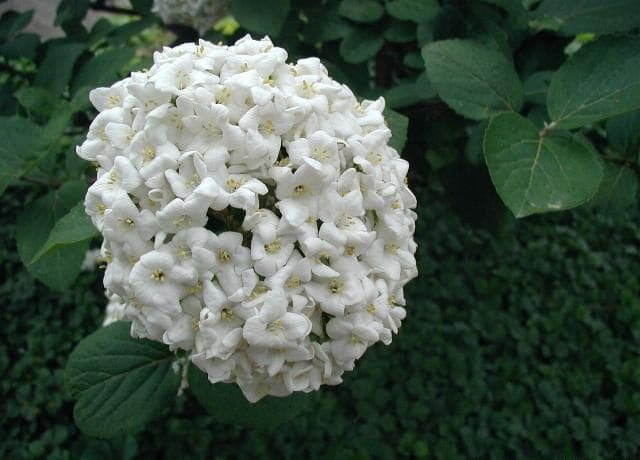
Sten at da.wikipedia / CC BY-SA 3.0, via Wikimedia Commons
Fragrant snowball (Viburnum × carlcephalum): growing guide
Viburnum × carlcephalum
Want to see Fragrant snowball (Viburnum × carlcephalum): growing guide in your garden?
Full design in HD: €7.99
Look after your Fragrant snowball with the GardenWorld app
Identify plants with your camera and get a care calendar with reminders for this plant.


Overview
Fragrant snowball (Viburnum × carlcephalum) is a deciduous shrub that carries large, rounded flower heads in April and May, with a sweet, spicy scent you can pick up several metres away. It is a hybrid between Viburnum carlesii, prized for its perfume, and Viburnum macrocephalum, the Chinese snowball with its enormous flower heads. It was raised in the 1930s at the Burkwood & Skipwith nursery in England, which also introduced several other fragrant viburnums. The result combines the best of both parents: bigger flower heads than carlesii and a far stronger scent than macrocephalum.
The shrub has a broad, loosely upright habit and usually reaches 2 to 3 metres in height and spread in gardens. It belongs to the Viburnaceae, the family that holds all the viburnums. A well-known selection is 'Cayuga', a backcross with Viburnum carlesii raised in the United States, which stays a little more compact and bears slightly smaller heads. You will also see the plant sold as fragrant viburnum.
On gardenworld.app you can have a garden design created that places this scented shrub close to a terrace, a path or the front door, where you will really notice it when it flowers.
Appearance and flowering season
The flower buds form in autumn and sit through winter as tight green knobs at the tips of the shoots. In April they turn pink, and from late April to mid-May they open into pure white flowers. Each flower is tubular with five spreading lobes and a small yellow centre of stamens, as you can see in the photograph. Together they form a dense, rounded head 10 to 13 cm across. Soon after opening, you often see pink buds and white flowers on the same shrub, which gives a soft two-tone effect.
The fragrance is the star attraction: sweet, spicy and reminiscent of cloves, strongest on warm, still days and in the evening. Bees and early butterflies visit the flowers.
The leaves are broadly oval, 5 to 10 cm long, dull to slightly glossy dark green and softly hairy underneath. In a sunny spot they often turn reddish to purple in autumn. Berries are rare: the hybrid sets little fruit, and when it does, the fruits ripen from red to black.
Ideal position
Viburnum × carlcephalum grows in sun or partial shade. Full sun gives the most flowers and the best autumn colour, but a few hours of afternoon shade does no harm in a dry summer. Deep shade beneath trees leads to a thin shrub with few flowers.
Choose a spot with some shelter from cold easterly winds, and ideally one where early morning sun does not fall straight onto frozen buds. A late frost in April can brown the pink buds, and rapid thawing in sunshine makes the damage worse. It also pays to plant it near somewhere you walk past often in spring, as that is the best way to enjoy the scent. Allow at least 2 metres between this and neighbouring shrubs.
Soil requirements
This viburnum is not fussy. It does well in any fertile, humus-rich garden soil that holds moisture but drains freely. Heavy clay is fine as long as water does not stand on it, and alkaline soils are tolerated well. On poor, sandy ground, dig in a generous amount of compost or well-rotted manure at planting time.
Plant in autumn or early spring, in a hole twice as wide as the root ball, setting the plant at the same depth it grew in its pot. A 5 cm mulch of leaf mould or wood chips keeps the soil cool and moist and feeds the soil life.
Watering
For the first two years after planting, water regularly in dry weather, allowing roughly 10 to 15 litres a week in a dry summer. After that, rainfall is usually enough, although it is worth watering during long dry spells in July and August, as this is when next year's flower buds are formed.
A very dry summer often means a thin display the following spring. Water thoroughly at the base, preferably a good soak once a week rather than a little every day, and keep the foliage as dry as possible.
Free preview
Want to see Fragrant snowball (Viburnum × carlcephalum): growing guide in your garden? Make a free preview of your design.
Pruning
Viburnum × carlcephalum needs very little pruning. It flowers on the previous year's wood, so if you do prune, do it straight after flowering in May or June. Remove dead and crossing branches and, on older shrubs, take out one or two of the oldest stems near ground level each year. This keeps the plant vigorous and open.
Pruning in autumn or winter removes the flower buds already waiting at the tips. According to the Royal Horticultural Society, an overgrown or leggy specimen also tolerates hard renovation pruning, though you should expect a year or two with few flowers.
Watch out with grafted plants: many are grafted onto the rootstock of another viburnum, often Viburnum lantana. Shoots that come up from below the graft, with different leaves, should be removed as low down as possible, or they will gradually take over.
Maintenance calendar
March: Scatter some compost or organic fertiliser around the base. Check for suckers from the rootstock.
April to May: Flowering. Cover a small plant with fleece if a night frost is forecast. Look out for aphids on young shoots.
May to June: Prune straight after flowering if needed. Top up the mulch.
July to August: Water during dry spells, as the flower buds are now forming. Check the leaves for viburnum beetle.
September to November: Enjoy the autumn colour. A good time to plant new shrubs.
December to February: Dormant season. Do not prune, as the flower buds are already in place.
Winter hardiness
Viburnum × carlcephalum is fully hardy throughout Britain and north-west Europe. The Royal Horticultural Society rates it H6, which covers temperatures down to about -20 °C, and in practice it survives harder frosts without lasting damage. No winter protection is needed.
The only real risk is a late frost once the buds have turned pink. The shrub itself is unharmed, but part of that year's flowers can be lost. A slightly sheltered position, away from frost pockets at the bottom of a slope, reduces the chance.
On toxicity: viburnum berries are considered mildly poisonous when eaten raw in quantity and can cause stomach and intestinal upsets, in pets as well as people. This hybrid rarely fruits, so the risk is small. Pests and diseases are limited to aphids in spring and, occasionally, viburnum beetle, whose larvae riddle the leaves with holes.
Companion plants
Under and around this viburnum, spring-flowering plants make the most of its season. The Lenten rose (Helleborus orientalis) flowers earlier and stays green beneath the shrub. Tulips (Tulipa gesneriana) in deep purple, burgundy or salmon pink contrast beautifully with the white heads, and Geranium macrorrhizum is a tough, aromatic ground cover for partial shade.
For taller partners, try snowy mespilus (Amelanchier lamarckii) or the saucer magnolia (Magnolia × soulangeana), which flowers at roughly the same time and creates a true spring corner together with the viburnum. The planting calendar on gardenworld.app helps you spread flowering times so the border carries on after the viburnum with peonies and summer perennials.
Final thoughts
Viburnum × carlcephalum is one of the most fragrant shrubs you can plant in a temperate garden. It is hardy, easy-going about soil and needs hardly any pruning. Give it a sunny or lightly shaded spot near a path or terrace, water it through its first summers and prune only after flowering. In return, every spring brings large white snowballs and a scent that fills the whole garden.
Frequently asked questions about Fragrant snowball
Is Fragrant snowball winter hardy?
Viburnum × carlcephalum is fully hardy throughout Britain and north-west Europe. The Royal Horticultural Society rates it H6, which covers temperatures down to about -20 °C, and in practice it survives harder frosts without lasting damage.
When and how do you prune Fragrant snowball?
Viburnum × carlcephalum needs very little pruning. It flowers on the previous year's wood, so if you do prune, do it straight after flowering in May or June.
How much water does Fragrant snowball need?
For the first two years after planting, water regularly in dry weather, allowing roughly 10 to 15 litres a week in a dry summer. After that, rainfall is usually enough, although it is worth watering during long dry spells in July and August, as this is when next year's flower buds are formed.
What soil does Fragrant snowball need?
This viburnum is not fussy. It does well in any fertile, humus-rich garden soil that holds moisture but drains freely.

See it in your garden
See Fragrant snowball in your garden
One photo of your garden and a few questions. You see the result in about a minute.
Try it with a photoIdentify this plant in your own garden. Identify a plant
Similar plants
Lenten-rose: complete guide
Helleborus orientalis
Learn how to grow and care for Helleborus orientalis. This early-blooming perennial thrives in shady spots and flowers from February to April, adding colour when little else is blooming.
Tulip: complete guide
Tulipa gesneriana
Everything about the tulip (Tulipa gesneriana): planting, care, the finest groups and cultivars. Practical tips for a colourful spring full of tulips.
Rock crane's-bill: complete guide
Geranium macrorrhizum
Rock crane's-bill (Geranium macrorrhizum) is a tough groundcover thriving in sun or partial shade. Great for rock gardens and dry spots. Grows 20-30 cm tall.
