
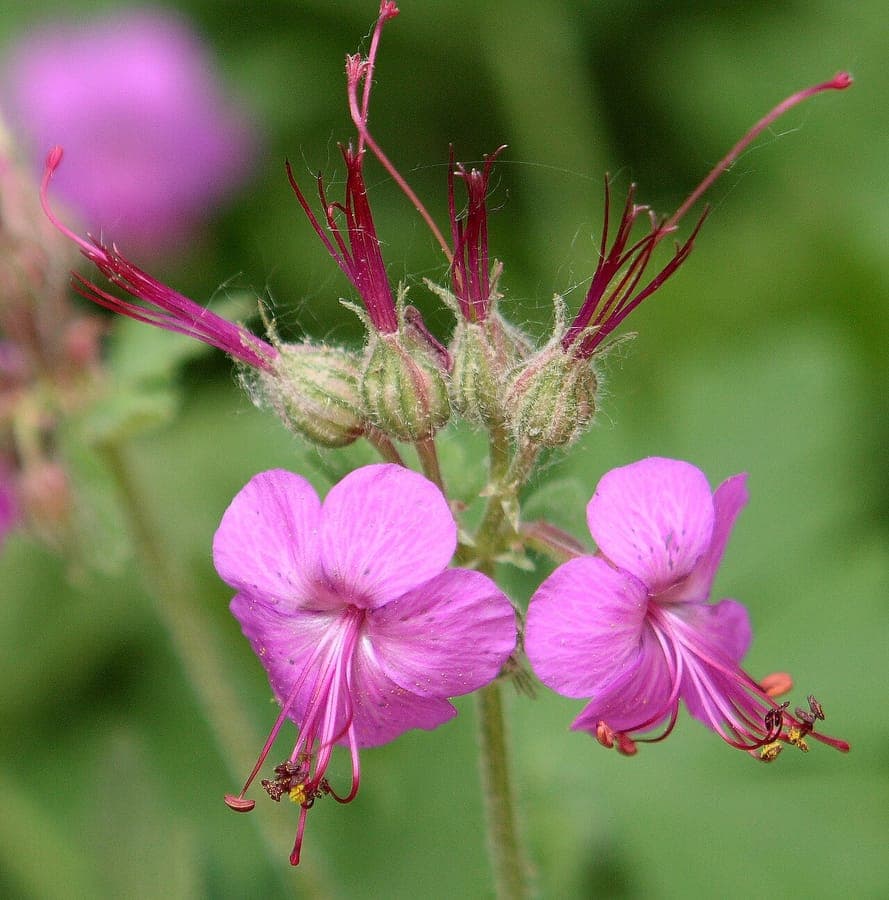
Hardyplants at English Wikipedia / Public domain, via Wikimedia Commons
Rock crane's-bill: complete guide
Geranium macrorrhizum
Want to see Rock crane's-bill: complete guide in your garden?
1 minute, no credit card
Overview
Rock crane's-bill, or Geranium macrorrhizum, is a no-nonsense perennial that's been quietly doing its job in gardens for decades. Native to southern Europe - think Albania, Greece, the Balkans - it's adapted to rocky slopes, dry woods and limestone soils. In the UK and US, it's hardy in USDA zones 5 to 8, meaning it handles cold winters down to -20°C without flinching. It grows 20–30 cm tall and spreads slowly via thick rhizomes, forming a dense mat over time. Not invasive, just persistent.
On gardenworld.app you can design a planting scheme that uses Rock crane's-bill as a backbone for low-maintenance borders, especially in spots where soil is thin or moisture scarce.
Appearance & bloom cycle
The foliage is deeply lobed, almost maple-like, in a rich green that turns warm bronze in autumn. Crush a leaf and you'll get a faint musky, resinous scent - not overpowering, but noticeable on a still day. From late May to early July, it produces clusters of five-petalled flowers in soft pink, sometimes white or deep rose. Each bloom lasts a week or more, and the whole show runs for about four weeks. After flowering, the plant doesn't look tired. It holds its form well, with neat, upright stems and healthy foliage.
For best flowering, give it full sun to partial shade. In full sun, blooms are more abundant. In shade, the leaves stay fresher in dry summers. It's not a major pollinator magnet - a few hoverflies and small bees visit - but it contributes to garden biodiversity without drawing pests.
Ideal location
This geranium thrives where others struggle. Use it in rock gardens, under shrubs, along pathways, or on banks where erosion is a concern. It handles dry shade under trees like beech or pine, though it grows slower there. Aim for at least 4 hours of sun daily for reliable flowering. In full shade, it survives but blooms sparsely.
Plant at 5 per m² for full coverage. They'll knit together in 2–3 years, especially if watered well in the first season. It's a slow starter, but a long-term performer.
Soil requirements
It's not fussy. It grows in sandy, loamy or clay soils as long as drainage is good. Avoid waterlogged spots - that's the one thing it can't handle. Ideal pH is between 5.5 and 7.5. If your soil is heavy clay, mix in grit or compost when planting to improve drainage. It doesn't need rich soil; in fact, too much fertility can make it floppy.
Feed lightly in spring with a thin layer of compost. No need for fertiliser - this plant does fine on neglect.
Free design
Want to see Rock crane's-bill: complete guide in your garden? Make a free design now.
Watering
Once established, it's drought-tolerant. But in the first year, keep it evenly moist - water weekly during dry spells. After that, it'll manage on its own, even through dry summers. In extreme drought, a deep soak every two weeks keeps it looking fresh.
Pruning
Cut it back hard in early July, right after flowering. Chop it down to about 10 cm. This removes tired growth and encourages a fresh flush of leaves. Sometimes you'll get a few bonus flowers in late summer. Leave it alone in autumn - the foliage provides winter interest and protects the crown. In early spring, tidy up any damaged leaves if needed.
Maintenance calendar
- January: Check for rot in wet areas. No other action.
- February: None, unless tidying up.
- March: Apply compost. Loosen soil gently.
- April: Watch for slugs on new shoots.
- May: First flowers appear. Keep young plants watered.
- June: Peak bloom. Monitor soil moisture.
- July: Cut back after flowering.
- August: New growth emerges. Little care needed.
- September: Let it be. No pruning.
- October: Leave foliage as mulch.
- November: Check drainage in heavy soils.
- December: Fully dormant. No care.
Winter hardiness
Hardy to USDA zone 5. In colder zones, a light mulch helps, but it's not required. The foliage often stays green or turns bronze, adding winter texture. Even if it dies back, the rhizomes survive and re-sprout in spring.
Companion plants
Pair it with shade-tolerant perennials like Epimedium, Tiarella, or ferns. Under deciduous shrubs, it fills space neatly. On sunny banks, combine with Sedum, Thymus, or Echinacea. Avoid aggressive spreaders like mint or bishop's weed - they'll outcompete it.
On gardenworld.app, you can visualise planting combos that balance texture and height, using Rock crane's-bill as a reliable filler in mixed borders.
Closing
Rock crane's-bill isn't flashy, but it's dependable. It doesn't need staking, dividing, or coddling. It just grows, year after year, covering ground and looking good doing it. Use it where you want low effort and high reward. Available at garden centres across the UK and US - including independents and larger chains.
Want to see Rock crane's-bill: complete guide in your garden? Make a free design now.
Upload a photo, pick a style, and get a photorealistic design with plant list in under a minute.
No credit card required


Similar plants
Pelargonium acetosum: complete guide
Pelargonium acetosum
Discover the Sorrel-leaf Geranium: a South African plant with aromatic foliage. Perfect for containers and warm locations. Learn cultivation and care.
Erodium foetidum: complete guide
Erodium foetidum
Rock stork's-bill is a delicate alpine plant with purple flowers and fine foliage. Learn how to grow this Mediterranean charmer in your front garden.
Pelargonium crithmifolium: complete guide
Pelargonium crithmifolium
Discover Samphire-leaf pelargonium: an exotic South African geranium with distinctive foliage. Growing tips, care advice and garden inspiration.