
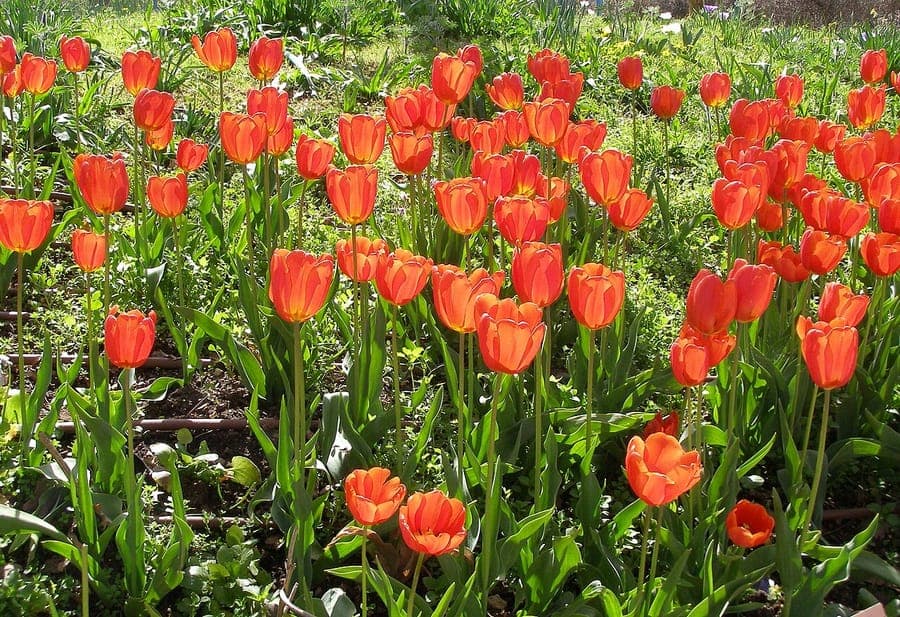
Dina L / CC0, via Wikimedia Commons
Tulip: complete guide
Tulipa gesneriana
Want to see Tulip: complete guide in your garden?
1 minute, no credit card
Overview
The tulip is one of the most iconic flowers in horticulture. From the legendary tulip mania of 17th-century Holland to the millions of blooms that greet visitors at Keukenhof each spring, no other bulb has captured the imagination of gardeners and artists quite like the tulip. Tulipa gesneriana, the garden tulip, is the ancestor of virtually all modern cultivars and represents one of the most diverse bulb genera on earth: more than 3,000 registered cultivars in every conceivable colour except true blue.
Tulips belong to the Liliaceae (lily family) and originate from Central Asia, where they grew on the steppes of present-day Turkey, Iran, and Kazakhstan. They reached Western Europe via the Ottoman Empire in the 16th century and quickly became the most sought-after garden plant of the era. On gardenworld.app you can create a garden design in which tulips take the starring role - in formal borders, naturalised beneath trees, or in stunning containers on your terrace. The bulbs are hardy (USDA zones 3 to 8) and flower reliably in April and May.
Appearance and bloom period
Tulips flower from March (the earliest species) to May (the latest cultivars), with the peak in April. The flower is iconic: a single, cup-shaped bloom on a sturdy, leafless stem 20 to 70 centimetres tall, depending on the group. The petals (tepals) are smooth, glossy and sometimes waxy in texture, and range from classically rounded to pointed, fringed, or spectacularly parrot-like.
The colour palette is staggering. Red, yellow, orange, pink, white, purple, lilac, near-black, bicoloured, striped, flamed - everything is possible except a true sky-blue. Flowers may be single or double, with smooth or fringed edges, and vary from 5 centimetres across (species tulips) to 12 centimetres (Darwin Hybrids).
The main groups are: Single Early (April, single-flowered, 25-40 cm), Triumph (mid-April, sturdy stems, the most widely planted), Darwin Hybrid (late April, large blooms, vivid colours), Parrot (May, ruffled, fringed petals), Fringed (May, serrated edges), and Species (botanical tulips, compact, naturalising). Species tulips such as Tulipa tarda, T. turkestanica, and T. sylvestris are smaller but naturalise superbly and return reliably year after year.
Ideal location
Tulips demand full sun - a minimum of six hours of direct sunlight per day. A south-facing bed, a sunny border along a wall, or an open lawn are ideal locations. In partial shade tulips will still flower, but the stems grow taller and weaker reaching for light, and the display is shorter and less intense.
More important even than sun is shelter from strong wind. The tall stems of Triumph and Darwin Hybrid tulips are vulnerable to wind damage, especially when the heavy flower heads are laden with rain. A sheltered position behind a hedge or wall prevents toppled stems. For natural planting in an orchard or under deciduous trees, the compact botanical tulips are the better choice - they are shorter and sturdier.
Soil requirements
Tulips demand well-drained soil. This is the number-one requirement: in ground that becomes waterlogged in winter, the bulbs will inevitably rot. In heavy clay, it is essential to work coarse grit or gravel into the planting hole - at least a spadeful per hole. In sandy soil, tulips feel instantly at home.
The ideal soil pH is 6.0 to 7.0 (neutral to slightly acidic), but tulips tolerate a range from 5.5 to 8.0. Add a handful of bone meal or specialist bulb feed at planting - this supplies the phosphorus and potassium the bulb needs for a strong flowering performance. Avoid fresh manure or nitrogen-rich fertilisers: they produce soft growth and increase the risk of bulb rot. Most garden centres carry specialist tulip bulb mixes and bulb feeds.
Planting
Plant tulip bulbs in autumn, from October to early December. Unlike most bulbs, tulip bulbs may be planted late - waiting until November or December actually reduces the risk of the dreaded tulip fire disease (Botrytis tulipae), because the fungal spores are less active in cold soil.
Plant the bulbs at a depth of three times their own height - for most tulip bulbs this means 12 to 15 centimetres deep. Spacing is 8 to 12 centimetres, depending on the desired effect. For a formal bed, plant at equal intervals in rows; for a more natural look, scatter the bulbs and plant them where they fall.
For an overwhelming colour impact, plant at least 30 to 50 bulbs per square metre. A mass of a single colour makes a greater impression than a mixture - think of Keukenhof, where blocks of thousands of bulbs in one colour dominate the landscape. For pots and containers, plant close together with just 2 to 3 centimetres between bulbs, and combine with other bulbs in layers (lasagne planting) for months of successive bloom.
Watering and feeding
Tulips in the open ground need virtually no supplementary watering after planting. Natural autumn and winter rainfall is normally more than adequate. Only in a very dry autumn might you water once after planting. In spring, during emergence and flowering, extra water is seldom needed - tulips actually prefer a relatively dry growing period.
Feeding occurs at two points: at planting in autumn (bone meal or specialist bulb feed) and immediately after flowering in spring. The post-bloom feed is critical: apply a potassium-rich fertiliser that helps the bulb build reserves for next year. Remove the spent flower head but leave the stem and foliage intact until they have turned completely yellow - the leaves feed the bulb through photosynthesis.
Free design
Want to see Tulip: complete guide in your garden? Make a free design now.
Perenniality and naturalising
Here lies the great difference from daffodils: most modern tulip cultivars are not reliably perennial. The spectacular Darwin Hybrids, Triumphs, and Parrots flower magnificently in their first year but weaken in subsequent seasons, producing smaller blooms or only foliage. This happens because the bulb splits into several smaller offsets, each individually too small to flower.
Two strategies exist. The first is the annual approach: plant fresh bulbs every autumn and treat tulips as a seasonal plant, much like bedding annuals. Many professional garden designers use this method for guaranteed spectacular results. The second is to choose naturalising species: botanical tulips such as Tulipa tarda, T. turkestanica, T. sylvestris, and T. praestans 'Fusilier' are reliably perennial and self-multiplying. They are smaller and more subtle than the large-flowered cultivars, but what they lack in drama they gain in charm and permanence.
Maintenance calendar
October-December: Planting season. Buy fresh bulbs and plant in well-drained soil. Add bulb feed.
January-March: The bulbs are forming roots and beginning to sprout. No action needed.
April-May: Flowering period. Enjoy the display. Remove spent flower heads (not the stems or foliage).
May-June: The foliage is dying back. Leave it undisturbed until completely yellow. Apply post-bloom feed.
July-September: The bulbs are dormant. You may leave them in the ground or lift, dry, and store them in a cool, airy place for replanting in autumn. Lifting is particularly worthwhile in heavy clay soils.
Winter hardiness
Tulips are excellent in terms of winter hardiness and tolerate temperatures down to -25 degrees Celsius or lower (USDA zones 3 to 8). They overwinter in the ground without difficulty across the UK and most of Europe and North America. Like daffodils, tulip bulbs require a vernalisation period - at least 12 to 14 weeks of exposure to temperatures below 10 degrees - in order to flower. This is why they are planted in autumn, not in spring.
In containers, tulips are slightly more vulnerable owing to reduced insulation. Move pots to a sheltered spot or wrap them in bubble wrap during prolonged frost below -10 degrees. Species tulips are generally hardier than the large-flowered hybrids.
Pests and diseases
Tulip fire (Botrytis tulipae) is the most feared disease: brown spots on leaves and flowers followed by grey mould growth. Prevention is the best strategy: plant in well-drained soil, avoid over-watering, and do not replant in the same spot as the previous year. Remove and destroy affected plants immediately.
Mice and rats relish tulip bulbs - unlike daffodil bulbs, which are toxic. If rodents are a problem, use purpose-made bulb baskets of fine wire mesh that go into the ground with the bulbs. A layer of fine gravel around the bulbs also deters diggers. Squirrels can be a nuisance too; a chicken-wire cover over newly planted beds usually solves the issue.
The tulip in horticultural history
No account of tulips is complete without the tulip mania of 1636-1637, when a single bulb of the cultivar 'Semper Augustus' was worth more than a canal house in Amsterdam. This speculative bubble was the first documented financial mania in history. Although the crash was dramatic, tulip mania laid the foundations for the Dutch bulb industry, which remains the world leader to this day.
Today the Netherlands exports over two billion tulip bulbs annually to every corner of the globe. The Bollenstreek between Leiden and Haarlem blazes each spring in stripes of red, yellow, and purple - a scene that from the air ranks among the most photographed landscapes in Europe.
Companion plants
Tulips are the kings of the spring combination. The classic partner is the daffodil - early daffodils that continue flowering as the tulips begin provide a seamless transition. Grape hyacinths (Muscari) offer a perfect colour contrast with red or yellow tulips. Violas and forget-me-nots (Myosotis) form a low carpet of colour above which the tulips rise.
For a modern, clean-lined effect, combine tulips with ornamental grasses such as Stipa tenuissima or Festuca glauca. In a cottage-garden style, pair them with forget-me-nots, hollyhocks, and daisies. Lavender and geraniums that take over later in the season elegantly conceal the dying tulip foliage.
Final thoughts
The tulip is the most democratic of spring flowers - affordable, spectacular, and available in every colour and form imaginable. Whether you want a sleek modern garden design or a romantic cottage border, there is always a tulip to match. The investment is minimal, the return is extraordinary: for a few pounds per dozen bulbs, you buy weeks of pure spring joy.
Purchase your tulip bulbs from a reputable garden centre - ideally in October when the selection is widest. On gardenworld.app you can create a garden design that combines tulips with the right partners for your specific garden, tailored to your soil type, sun exposure, and style preference. Plant a few hundred bulbs this autumn and give your garden the spring spectacle it deserves.
Want to see Tulip: complete guide in your garden? Make a free design now.
Upload a photo, pick a style, and get a photorealistic design with plant list in under a minute.
No credit card required


Similar plants
Daffodil: complete guide
Narcissus pseudonarcissus
Everything about the daffodil (Narcissus pseudonarcissus): planting, care, naturalising and the best cultivars. Practical tips for a radiant spring garden.
English Lavender: complete guide
Lavandula angustifolia
Everything about English Lavender (Lavandula angustifolia): planting, pruning, care and overwintering. Practical tips for lush purple blooms.
Rugosa Rose: complete guide
Rosa rugosa
Everything about the Rugosa Rose (Rosa rugosa): planting, pruning, care and winter hardiness. Practical tips for abundant blooms in your garden.