
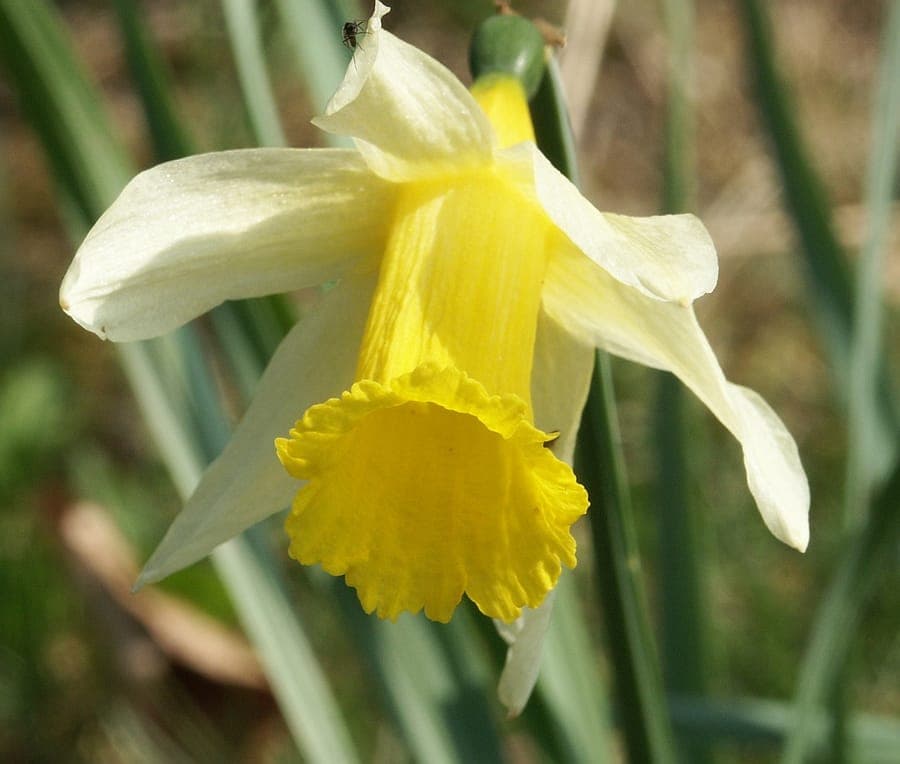
Wikimedia Commons / CC BY-SA 3.0, via Wikimedia Commons
Daffodil: complete guide
Narcissus pseudonarcissus
Want to see Daffodil: complete guide in your garden?
1 minute, no credit card
Overview
The daffodil is the ultimate symbol of spring. When the first yellow trumpets push through cold ground in March and April, everyone knows winter is truly over. Narcissus pseudonarcissus, the wild daffodil or trumpet daffodil, is the ancestral species from which thousands of cultivars have been bred - from miniatures of 15 centimetres to stately giants of 50 centimetres, in colours from pure white to deep yellow and orange.
Daffodils belong to the Amaryllidaceae (amaryllis family) and are native to Western Europe, including parts of the British Isles. Wild daffodils still grow in naturalised populations in woodlands, meadows, and along riverbanks across England, Wales, and Scotland. On gardenworld.app you can create a garden design in which daffodils form a cheerful spring layer - in borders, beneath deciduous trees, or naturalised in a lawn. The bulbs are completely hardy (USDA zones 3 to 8), perennial, and multiply on their own year after year once established.
Appearance and bloom period
Daffodils flower from February (the earliest varieties) to May (the latest cultivars), but the peak of bloom falls in March and April. The characteristic flower consists of a central trumpet or cup (corona) surrounded by six petals (perianth). In the trumpet daffodils, the corona is at least as long as the petals - the silhouette everyone recognises as 'the daffodil'.
The colour palette is richer than many realise. Beyond the classic yellow, there are pure-white daffodils, two-tone combinations of white with yellow or orange, salmon-pink cultivars, and even green-tinged cups. The flowers sit singly or in clusters (in the tazetta group) on sturdy, hollow stems 20 to 50 centimetres tall. The foliage is strap-shaped, grey-green, and emerges at the same time as or slightly before the flowers.
The principal divisions are: Trumpet (large central cup), Large-cupped (cup more than one-third the petal length), Small-cupped (cup less than one-third), Double (fully filled flowers), and Tazetta (multiple flowers per stem, fragrant). Famous cultivars include 'King Alfred' (the classic yellow trumpet), 'Ice Follies' (white with a pale yellow cup that fades to cream), and 'Tete-a-Tete' (a 15 cm miniature that is perfect for pots and window boxes).
Ideal location
Daffodils are exceptionally flexible regarding location. They grow in full sun to partial shade - the dappled shade beneath deciduous trees is actually ideal, because the bulbs complete their bloom cycle before the tree canopy closes. A spot that receives sun in early spring but is shaded later in the season works beautifully.
For naturalising in a lawn, choose a zone that you will not mow until late June, by which time the daffodil foliage will have died back completely. An orchard, a section of rough grass, or a wildflower meadow are perfect locations. In borders, plant daffodils among perennials that emerge later in the season and hide the fading daffodil foliage - hostas, ornamental grasses, and daylilies are ideal partners for this purpose.
Soil requirements
Daffodils make few demands on the soil, but good drainage is essential. In spots where water lingers through winter, the bulbs will rot. In heavy clay, work a spadeful of coarse grit or gravel into the planting hole to improve drainage. In sandy soil, daffodils thrive - add a handful of well-rotted compost at planting time for a modest nutrient boost.
The ideal soil pH is 6.0 to 7.0 (slightly acidic to neutral), but daffodils tolerate a wide range from 5.5 to 8.0. This makes them suitable for virtually every garden soil. Most garden centres stock specialist bulb feed that can be mixed into the soil at planting time - choose a product low in nitrogen and high in phosphorus and potassium.
Planting
Plant daffodil bulbs in autumn, from September to November, before the ground freezes. The general rule is that bulbs are planted at a depth of two to three times their own height - for most daffodil bulbs this means 10 to 15 centimetres deep. Plant with the pointed end facing up and the basal plate (where the roots emerge) facing down.
For a natural effect in a lawn or under trees, scatter the bulbs by the handful and plant them where they fall - this avoids the stiff rows that look artificial. Use a purpose-made bulb planter or a trowel to make holes quickly. The spacing is 10 to 15 centimetres from bulb to bulb. Always plant in groups of at least ten to fifteen - solitary daffodils have little impact, but a mass of yellow trumpets is breathtaking.
For pots and containers, plant the bulbs closer together - 3 to 5 centimetres apart - in a pot with good drainage. You can even plant in layers (lasagne planting): daffodils as the deepest layer, crocuses above, and snowdrops on top. This delivers months of consecutive bloom from a single pot.
Watering and feeding
Daffodils planted in the open ground need virtually no supplementary water after autumn planting - natural rainfall is usually sufficient. Only in an exceptionally dry autumn might you water once after planting to encourage root formation. In spring, during growth and flowering, additional water is likewise unnecessary unless conditions are bone-dry for weeks.
Feeding is straightforward: apply a potassium-rich bulb fertiliser immediately after flowering (not during). This supports the bulb in building reserves for next year's bloom. Avoid nitrogen-rich fertilisers that primarily stimulate leaf growth. A thin annual layer of well-rotted compost spread over the planting area in autumn serves as perfectly adequate base nutrition.
Free design
Want to see Daffodil: complete guide in your garden? Make a free design now.
Naturalising
The finest quality of daffodils is their ability to naturalise - to multiply and return in ever-greater numbers each year. Not all cultivars are equally suited to this. The best naturalisers are: the wild daffodil (Narcissus pseudonarcissus), 'February Gold' (early, yellow, indestructible), 'Tete-a-Tete' (miniature, slow to naturalise), 'Thalia' (white, elegant), and 'Pheasant's Eye' (poeticus type, late, fragrant).
For successful naturalising, it is crucial that the foliage is not cut or mown after flowering until it has turned completely yellow and limp - typically late June. The leaves photosynthesise to produce the sugars the bulb needs in order to flower again next year. Remove the foliage too early and you will get fewer flowers each year until eventually you have only leaves and no blooms at all.
Maintenance calendar
September-November: Planting season. Buy fresh bulbs and plant as soon as possible. Check existing planting areas and spread a thin layer of compost.
December-February: The bulbs are forming roots underground. No action needed. In exceptionally severe frost (below -15 degrees), you may cover container plantings with straw.
March-April: Flowering period. Enjoy the display. Remove spent flowers (not the foliage) to prevent seed formation.
May-June: The foliage is dying back. Do not mow or cut until it has gone completely yellow. Apply bulb feed after flowering.
July-August: The bulbs are dormant underground. Mark planting locations so you do not accidentally damage them while gardening. Plan new bulb purchases for autumn.
Winter hardiness
Daffodils are outstandingly hardy and tolerate temperatures down to -30 degrees Celsius or lower (USDA zones 3 to 8). They overwinter in the ground without difficulty across the entire UK and most of Europe and North America. Indeed, a period of cold is essential: daffodil bulbs require vernalisation - a spell below 10 degrees for at least 12 to 16 weeks - in order to flower. This is why daffodil bulbs are planted in autumn, not in spring.
In containers, daffodils are slightly more vulnerable than in the open ground because the bulbs have less insulation. Move pots into an unheated garage or shed during severe frost (below -10 degrees), or wrap the pot in bubble wrap. In the open ground, no winter protection whatsoever is needed.
Toxicity
An important point: all parts of the daffodil are toxic, including the bulb. The bulbs contain lycorine, an alkaloid that causes nausea, vomiting, and diarrhoea if ingested. This is the reason daffodil bulbs, unlike tulip bulbs, are left alone by mice, rats, and rabbits - a definite advantage for the gardener. Wear gloves when handling large numbers of bulbs, especially if you have sensitive skin, as the sap can cause skin irritation.
Daffodils in containers
Daffodils are superbly suited to pots, troughs, and windowsills. Choose compact cultivars such as 'Tete-a-Tete', 'Minnow', 'Jetfire', or 'Hawera' for the best results. Plant the bulbs in autumn in a container with good drainage, at a depth of twice the bulb's height. Use a free-draining compost - standard potting mix blended with a quarter perlite or coarse sand is ideal.
Place the pot outdoors in a sheltered, cool spot after planting. The bulbs need winter cold to trigger flowering. Once the shoots appear (usually February) you can move the pot to a more prominent position - by the front door, on the patio, or on a windowsill. Water sparingly: the compost should be moist but never wet. After flowering, you can transfer the bulbs from the pot into the garden to naturalise.
Companion plants
Daffodils pair beautifully with other spring bloomers. The classic combination is daffodils with grape hyacinths (Muscari) - the contrast of yellow and blue is stunning. Interplant them for the finest effect. Tulips are natural partners that extend the flowering period. Early daffodils together with late tulips provide months of bloom.
Beneath trees, combine daffodils with bluebells (Hyacinthoides), wood anemones (Anemone nemorosa), and celandines. In borders, perennials such as forget-me-nots (Myosotis), primroses, and violas make ideal companions. Lavender and ornamental grasses that emerge later in the season elegantly conceal the dying daffodil foliage.
Final thoughts
Few plants deliver so much joy for so little effort as daffodils. An hour of planting in autumn yields years of spring pleasure. The bulbs are inexpensive, virtually indestructible, and increase in number each year. It is the perfect plant for beginners and experienced gardeners alike - an investment in the future that pays annual interest in the form of yellow and white trumpets.
Purchase your daffodil bulbs from a reputable garden centre - ideally in September when the selection is greatest. On gardenworld.app you can create a garden design that combines daffodils with the right partners for your specific garden, taking into account your soil type and light conditions. Plant a few hundred bulbs this autumn and turn your garden into a spring festival that will make your neighbours envious.
Want to see Daffodil: complete guide in your garden? Make a free design now.
Upload a photo, pick a style, and get a photorealistic design with plant list in under a minute.
No credit card required


Similar plants
Tulip: complete guide
Tulipa gesneriana
Everything about the tulip (Tulipa gesneriana): planting, care, the finest groups and cultivars. Practical tips for a colourful spring full of tulips.
English Lavender: complete guide
Lavandula angustifolia
Everything about English Lavender (Lavandula angustifolia): planting, pruning, care and overwintering. Practical tips for lush purple blooms.
Purple coneflower: complete guide
Echinacea purpurea
Everything about Purple Coneflower (Echinacea purpurea): planting, care, pruning and combinations. Expert tips for a thriving prairie-style garden.