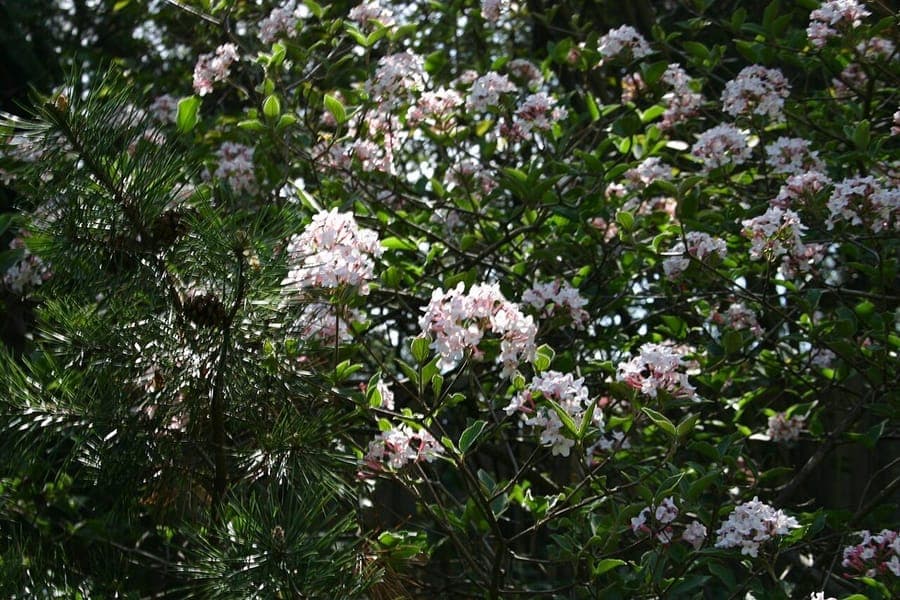
User:SB_Johnny / CC BY-SA 3.0, via Wikimedia Commons
Burkwood viburnum: complete guide
Viburnum × burkwoodii
Want to see Burkwood viburnum: complete guide in your garden?
Full design in HD: €7.99
Look after your Burkwood viburnum with the GardenWorld app
Identify plants with your camera and get a care calendar with reminders for this plant.


Overview
Viburnum × burkwoodii is a shrub you smell in April before you see it. On a mild spring day a sweet scent with a hint of clove drifts around the bush, and when you get closer you find rounded clusters of pink buds opening into white, star-shaped flowers. If you want a fragrant shrub that flowers reliably and asks for little care, this is one of the best choices in the whole viburnum family.
The plant is a garden hybrid. In the 1920s the British nurserymen Albert and Arthur Burkwood, at their nursery in Kingston upon Thames, crossed the strongly scented Viburnum carlesii from Korea with the evergreen Viburnum utile from China. The result combined the fragrance of one parent with the toughness and glossy foliage of the other. The × in the name marks that cross. In the trade it is known as Burkwood viburnum or simply Viburnum burkwoodii.
Viburnum × burkwoodii grows into a loose, upright to spreading shrub 2 to 3 metres tall and about as wide. It grows at a moderate pace, roughly 20 to 40 cm a year. The shrub is semi-evergreen: in mild winters it keeps some of its leaves, while in harsh winters most of them drop. On gardenworld.app you can have a garden design made that places a scented shrub like this right by the front door, terrace or a path, so you really get to enjoy the flowering.
Appearance and bloom cycle
Flowering usually begins in early April and runs into May; in mild springs it can start at the end of March. The flowers are held in domed clusters 6 to 9 cm across at the tips of the shoots. In bud they are pink, opening to white with a pink blush. Each tubular floret has five spreading lobes. While buds and open flowers sit side by side, the clusters have a lovely two-tone effect. The photo at the top shows exactly that: pink and white flower clusters among glossy green leaves, with a pine branch in the foreground.
The scent is sweet and spicy, with notes of vanilla and clove. Bees, bumblebees and early butterflies such as the brimstone visit the flowers readily, which makes the shrub valuable at a time of year when not everything is in flower yet.
The leaves are ovate, 4 to 10 cm long, glossy dark green above and paler and felted beneath. In autumn some of them turn red before they fall. After flowering a few berries sometimes form, ripening from red to black, but they are usually sparse. Several well-known cultivars exist: 'Anne Russell' stays more compact at around 1.5 to 2 metres, and 'Park Farm Hybrid' grows wider, with slightly larger flower clusters.
Ideal location
Viburnum × burkwoodii grows in full sun and partial shade. In sun it flowers most freely and its scent is strongest; in partial shade flowering is a little less generous but still attractive. Deep shade is best avoided.
Plant the shrub where you pass often in April: next to the front door, by a seat, along a path or beneath a window you can open in spring. A spot sheltered from cold wind lets the scent linger. It also works in a mixed hedge or a border with other spring-flowering plants. Allow 1.5 to 2 metres between it and neighbouring shrubs.
Soil requirements
This viburnum is not fussy. A fertile, humus-rich soil that holds moisture without staying waterlogged is ideal. It grows well on loam and clay, and also on chalky soil. On light, sandy soil, work plenty of compost into the planting area so the ground holds moisture better.
The pH can range from slightly acidic to slightly alkaline, roughly pH 6 to 8. An annual layer of compost or well-rotted manure in spring keeps the shrub vigorous.
Free preview
Want to see Burkwood viburnum: complete guide in your garden? Make a free preview of your design.
Watering
Water regularly in the first year after planting, especially during dry spells in spring and summer. A thorough soak once a week is better than a little every day. A mulch of compost or bark chips keeps the soil cool and moist.
Established plants usually manage on rainfall. During prolonged summer drought, particularly on sandy soil, an extra watering is welcome; drought stress in summer can reduce the following spring's flowering, because that is when the flower buds are being formed.
Pruning
Viburnum × burkwoodii flowers on the previous year's wood. So always prune straight after flowering, in May or June. If you prune in winter or early spring, you cut off the flower buds.
Annual pruning is not necessary. Limit yourself to removing dead or crossing branches and shortening the odd overlong shoot. To keep an older shrub young and free-flowering, cut one or two of the oldest stems down close to the ground every few years. That makes room for young shoots. A thoroughly neglected shrub can be renovated over three years by removing a third of the old stems each year.
In spring, watch out for aphids, which can make young shoots and leaves curl. Ladybirds and other natural predators usually clear them up on their own. Viburnum beetle, which can strip Viburnum opulus bare, largely leaves this hybrid alone.
Maintenance calendar
March: Spread a layer of compost or manure around the base. Check for dead wood.
April-May: Flowering season. Enjoy the scent. Check young shoots for aphids.
May-June: Prune straight after flowering: remove dead and crossing branches and, if needed, one or two old stems at the base.
July-August: Water during prolonged drought. Next year's flower buds are forming.
September-November: A good time to plant. Mulch around young plants. Some leaves turn red.
December-February: Rest period. Do not prune, or you will lose the flower buds.
Winter hardiness
Viburnum × burkwoodii is very hardy and tolerates temperatures down to around -20 °C and below. Across the UK and the Low Countries it grows without any winter protection. In severe winters more leaves drop, but that is normal for a semi-evergreen shrub and does not affect flowering. Late frosts during flowering can brown open flowers, but buds that are still closed will go on to flower normally.
A word of caution about the berries: as with many viburnums, raw berries and leaves can cause stomach upset if eaten, in people and in pets. The risk is small because the plant sets little fruit, but do not let young children or dogs eat them.
Companion plants
Viburnum × burkwoodii combines with other spring-flowering plants to make a fragrant, colourful corner. Star magnolia (Magnolia stellata) flowers just before it and makes an elegant white prelude. Beneath and in front of the shrub, early perennials such as the Lenten rose (Helleborus orientalis), Siberian bugloss (Brunnera macrophylla) and lungwort (Pulmonaria officinalis) fill the shady base.
In autumn, plant bulbs among them too: wild daffodils (Narcissus pseudonarcissus), grape hyacinths and tulips flower at the same time and complete the spring picture. For summer, when the shrub carries only foliage, place hydrangeas or hardy geraniums in front.
Want to know which plants need pruning or care in which month? On gardenworld.app you will find a plant calendar that helps you pick the right moment for every job in your garden.
Final thoughts
Viburnum × burkwoodii is a tough, hardy and easy shrub that flowers faithfully every spring with pink buds, white flowers and a wonderful scent. Give it a sunny or partly shaded spot in fertile soil, prune only straight after flowering and plant it where you can really breathe in the fragrance in April. That way this classic viburnum becomes a highlight of your spring garden year after year.
Frequently asked questions about Burkwood viburnum
Is Burkwood viburnum winter hardy?
Viburnum × burkwoodii is very hardy and tolerates temperatures down to around -20 °C and below. Across the UK and the Low Countries it grows without any winter protection.
When and how do you prune Burkwood viburnum?
Viburnum × burkwoodii flowers on the previous year's wood. So always prune straight after flowering, in May or June.
How much water does Burkwood viburnum need?
Water regularly in the first year after planting, especially during dry spells in spring and summer. A thorough soak once a week is better than a little every day.
Where does Burkwood viburnum grow best?
Viburnum × burkwoodii grows in full sun and partial shade. In sun it flowers most freely and its scent is strongest; in partial shade flowering is a little less generous but still attractive.
What soil does Burkwood viburnum need?
This viburnum is not fussy. A fertile, humus-rich soil that holds moisture without staying waterlogged is ideal.

See it in your garden
See Burkwood viburnum in your garden
One photo of your garden and a few questions. You see the result in about a minute.
Try it with a photoIdentify this plant in your own garden. Identify a plant
Similar plants
Star Magnolia: complete guide
Magnolia stellata
Everything about Star Magnolia (Magnolia stellata): planting, care, pruning and siting. Practical tips for spectacular star-shaped spring flowers.
Lenten-rose: complete guide
Helleborus orientalis
Learn how to grow and care for Helleborus orientalis. This early-blooming perennial thrives in shady spots and flowers from February to April, adding colour when little else is blooming.
Great forget-me-not: complete guide
Brunnera macrophylla
Brunnera macrophylla, also known as Great forget-me-not, is a shade-loving perennial with heart-shaped leaves and spring blue flowers. Learn care, soil and planting tips.
