
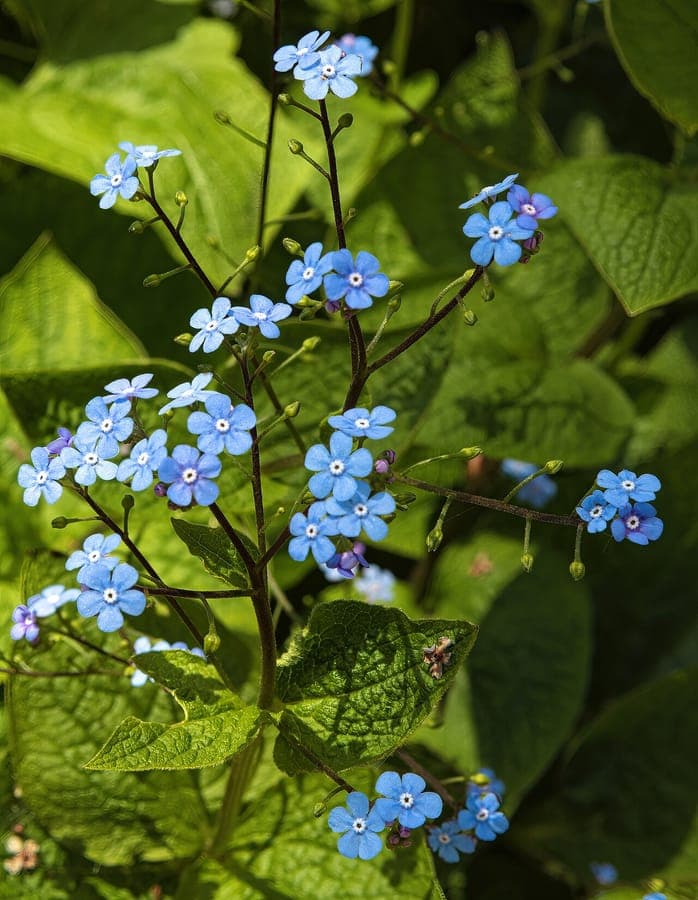
Didier Descouens / CC BY-SA 4.0, via Wikimedia Commons
Great forget-me-not: complete guide
Brunnera macrophylla
Want to see Great forget-me-not: complete guide in your garden?
1 minute, no credit card
Overview
Brunnera macrophylla, commonly called Great forget-me-not, is a tough yet delicate-looking perennial that brings life to shady corners where many plants struggle. Native to the forested slopes of the Caucasus, northern Turkey, and Transcaucasia, it thrives in cool, moist, humus-rich soils under open tree canopies. In temperate gardens across Europe and North America, it's earned a loyal following for its early spring bloom, long-lasting foliage, and resilience in low-light conditions.
This herbaceous forb in the borage family (Boraginaceae) forms neat clumps that slowly spread by rhizomes, creating lush ground cover over time. It's not aggressive, but persistent - filling gaps with elegance. What sets it apart is its ability to bloom reliably in full to partial shade, a rare trait among flowering perennials. On gardenworld.app, you can design a shade garden layout that highlights Brunnera's blue blossoms alongside complementary textures and forms.
Appearance & bloom cycle
Brunnera macrophylla has large, heart-shaped leaves that can reach up to 15 cm across. The foliage is typically medium green, but cultivars like 'Jack Frost' and 'Looking Glass' feature striking silver centres with dark green veining, adding ornamental value long before flowering begins.
In early spring - typically mid-March to early May, depending on your region - airy sprays of tiny, sky-blue flowers rise on slender stems 30–40 cm tall. Each flower is about 1 cm wide, with five petals and a yellow eye, resembling true forget-me-nots but with a more refined structure. The bloom period lasts 4–6 weeks, attracting early pollinators like hoverflies, bees, and small butterflies.
After flowering, the foliage remains attractive through summer if moisture is consistent. In hot, dry spells, leaves may scorch or wilt, but a trim can encourage fresh growth. The plant dies back gradually in late autumn, though some evergreen forms retain leaves through mild winters.
Ideal location
Great forget-me-not thrives in dappled to full shade. It's ideal under deciduous trees, on the north or east side of buildings, or in woodland gardens. Avoid hot afternoon sun, especially in southern zones (USDA 7+), as it leads to leaf scorch and reduced vigour.
It performs best in sheltered spots with high humidity and minimal wind exposure. While it tolerates root competition from trees, it won't survive in dry, compacted soils beneath dense canopies. Use it as a front- or mid-border plant, or in naturalistic groupings. On gardenworld.app, you can simulate how Brunnera interacts with tree shade and companion plants in your garden's microclimate.
Soil requirements
This plant demands consistently moist, well-drained, humus-rich soil. It prefers loamy or clay-loam textures with a pH between 5.5 and 7.0. Amend sandy soils with generous compost or leaf mould to improve water retention. For heavy clay, add grit or organic matter to prevent waterlogging.
Poor soils lead to stunted growth and sparse flowering. A 5 cm mulch of compost or shredded bark in spring helps retain moisture, suppress weeds, and feed the soil. Avoid lime-heavy soils - Brunnera can show chlorosis (yellowing leaves) if pH is too high.
Free design
Want to see Great forget-me-not: complete guide in your garden? Make a free design now.
Watering
Consistent moisture is key. Water deeply once a week during active growth (March–June) and in dry spells. In USDA zones 6–8, summer droughts may require watering twice weekly. Always water at the base to avoid fungal issues on leaves.
Never let the soil dry out completely, especially in containers or shallow soils. However, standing water is equally harmful - prolonged saturation causes root rot. Use rainwater when possible, as tap water with high calcium content can affect soil chemistry over time.
Pruning
Pruning is minimal but helpful. After flowering (late May to early June), cut back spent flower stalks to keep the plant tidy and prevent self-seeding (though it's rarely invasive). If foliage deteriorates in midsummer due to heat or drought, shear the entire plant back to 5–10 cm above the crown. New leaves often emerge within weeks, especially with supplemental watering.
Leave old foliage intact over winter - it protects the crown from freeze-thaw cycles. Remove it in late winter before new growth emerges.
Maintenance calendar
- February–March: Remove old leaves. Check for slugs or crown rot.
- March–May: Peak bloom. Maintain soil moisture. Apply mulch.
- June–July: Deadhead, cut back if needed. Watch for drought stress.
- August–September: No major tasks. Monitor for pests.
- October–November: Leave foliage. Light top-up of mulch.
- December–January: Dormant period. No action required.
Winter hardiness
Brunnera macrophylla is hardy in USDA zones 3–8 (-30°C to -12°C). It reliably survives winter with no protection. In colder zones, mulch lightly after the ground freezes to prevent heaving. In milder areas, foliage often stays evergreen or semi-evergreen, offering structure in winter gardens.
Avoid planting in frost-prone pockets or poorly drained areas, as wet winter soil is the biggest threat.
Companion plants
Pair Brunnera with other shade-tolerant perennials:
- Hosta – for bold foliage contrast
- Ferns (e.g., Dryopteris erythrosora) – for texture
- Helleborus orientalis – for overlapping bloom time
- Epimedium – for ground cover and drought tolerance
- Tiarella – for spreading habit and star-shaped flowers
It also looks beautiful with early bulbs like Crocus or Erythronium, which bloom beneath its emerging leaves.
Closing
Great forget-me-not is a quiet achiever in the shade garden. It asks for little but gives back with months of visual interest. With the right conditions - moist soil, cool roots, and filtered light - it thrives for years. You'll find it at garden centres like B&Q, Wyevale, or local independents, usually near hostas and ferns. Not sure how to place it in your space? On gardenworld.app, you can build a custom planting plan that integrates Brunnera seamlessly into your garden's layout.
Want to see Great forget-me-not: complete guide in your garden? Make a free design now.
Upload a photo, pick a style, and get a photorealistic design with plant list in under a minute.
No credit card required


Similar plants
Western waterleaf: complete guide
Hydrophyllum occidentale
Full growing guide for western waterleaf (Hydrophyllum occidentale): shade tolerance, soil needs, watering, winter hardiness and naturalistic garden use.
Limestone phacelia (Phacelia affinis): complete guide
Phacelia affinis
Full guide to Phacelia affinis, the limestone phacelia: sowing tips, purple-blue bee flowers, drought tolerance and uses in dry or wildlife gardens.
Pyrenean viper's bugloss: complete guide
Echium asperrimum
Echium asperrimum is a striking biennial from the western Mediterranean with rough bristly stems and vivid blue flowers. A magnet for bees and a bold border plant.