
Myrabella / CC BY-SA 3.0, via Wikimedia Commons
Star Magnolia: complete guide
Magnolia stellata
Want to see Star Magnolia: complete guide in your garden?
1 minute, no credit card
Overview
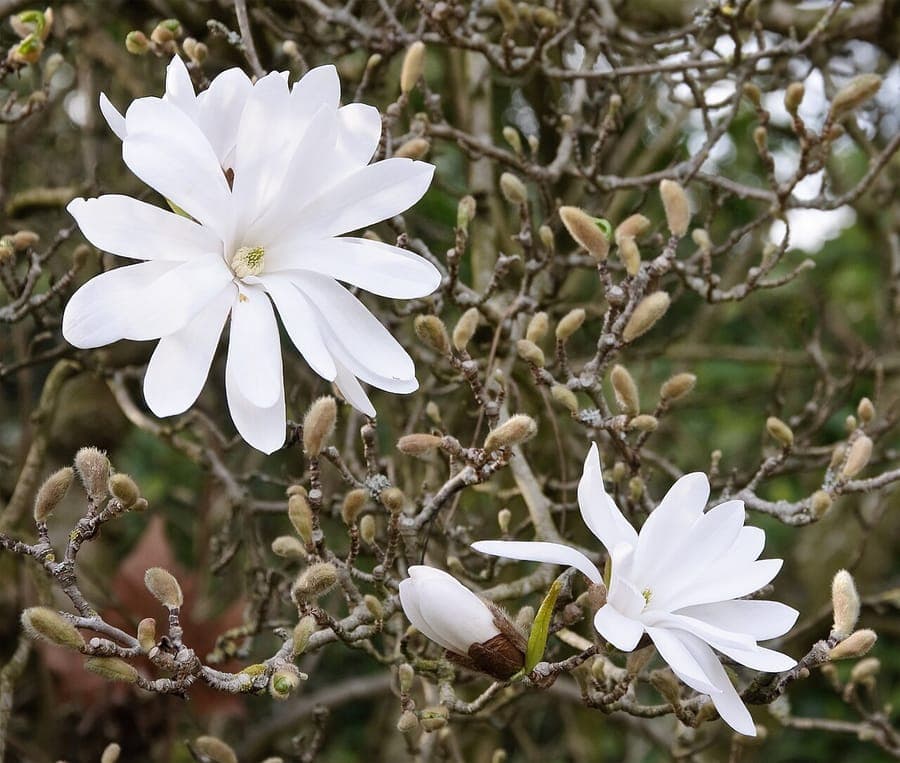
The Star Magnolia (Magnolia stellata) is one of the most enchanting spring-flowering shrubs you can grow in a garden. This deciduous plant from Japan belongs to one of the oldest flowering plant families on Earth - magnolias existed over 95 million years ago, long before bees evolved. What makes the star magnolia so special is that in March and April, before the first leaf unfurls, it becomes covered in dozens of star-shaped flowers 7 to 10 cm across. Those white or soft pink stars set against bare grey branches create one of the most breathtaking garden scenes of early spring.
With a mature height of just 2 to 3 metres and a spread of 2 to 3.5 metres, the star magnolia is a compact plant that thrives even in small gardens, front gardens, and large containers. On gardenworld.app you can create a garden design in which the star magnolia takes a prominent role as a specimen or as part of a mixed border with other early bloomers. The growth habit is broad and densely branched, with an elegant, often dome-shaped canopy that remains decorative in winter thanks to its silvery, furry flower buds.
Appearance and bloom period
The flowers are the crowning glory of Magnolia stellata. They appear from mid-March to mid-April, depending on the weather and location, and persist for two to three weeks. Each bloom carries 12 to 18 narrow, strap-like petals (tepals) that spread into a star shape - hence the common name. The fragrance is subtle yet delightful: a sweet, fruity note that you catch when standing close to the shrub.
Three cultivars deserve special mention. 'Royal Star' is the most popular selection: pure white, large flowers with up to 25 tepals that open later than the species itself, reducing the risk of frost damage. 'Rosea' offers soft, pale pink flowers that gradually fade to white as they open - a subtle colour play. 'Waterlily' has larger, more fully double flowers with extra tepals that indeed resemble water lilies. All three are widely available at garden centres.
After flowering, the foliage appears: oval leaves 5 to 10 cm long, dark green in summer, turning bronze-gold in autumn. Leaf drop is modest and clean-up minimal. In winter, the silvery furry flower buds catch the eye - they are formed in autumn, a promise of the spring to come.
Ideal location
Site selection is crucial for success with the star magnolia, primarily because of its early flowering. The ideal spot is sheltered and receives sun to light partial shade. Avoid an east-facing position at all costs: when frozen flower buds thaw rapidly in early morning sunshine, the tepals split and turn brown. A west or south-west-facing position, shielded by a wall, hedge, or building, is ideal.
Protection from cold, drying wind is equally important. A sheltered nook behind a house, fence, or planting prevents icy winter wind from desiccating the tender flower buds. Also avoid frost pockets where cold air collects - late night frost in March or April is the greatest threat to the display.
Magnolia stellata is hardy to approximately -25 degrees Celsius (USDA zones 4 to 8), so the plant itself survives severe winters without difficulty. It is the flowers that are vulnerable, not the plant. In a well-chosen position, the star magnolia blooms reliably year after year across the whole of temperate Europe and most of the United States.
Soil requirements
The star magnolia prefers moist but well-drained, humus-rich soil with a slightly acid to neutral pH (5.5 to 7.0). On limy, alkaline ground, chlorosis may occur - yellowing of the foliage due to iron deficiency. At planting time, work generous amounts of compost, leaf mould, or peat-free potting mix into the soil to raise the humus content.
On heavy clay, drainage improvement is essential: incorporate coarse sand or grit into the top 40 cm. On light sandy soil, add compost and leaf mould to increase moisture retention. The star magnolia has fleshy, brittle roots that are susceptible to damage - never dig in the root zone and avoid soil cultivation around established plants.
A mulch layer of 5 to 8 cm compost, leaf mould, or cocoa shells keeps the soil moist, suppresses weeds, and protects the shallow roots. Suitable mulch materials are available at most garden centres.
Planting
The best planting season is late autumn (October to November) or early spring (March), preferably before flowering. Avoid summer planting when heat and drought hinder establishment. Container-grown plants can be planted throughout the growing season, but spring and autumn remain optimal.
Dig a planting hole three times as wide and the same depth as the root ball. The fleshy, brittle roots of magnolias are particularly susceptible to damage - remove the plant from its pot carefully and disturb the root ball as little as possible. Mix the excavated soil with compost and leaf mould. Set the plant at the same depth as it stood in the pot, backfill, firm very gently (do not stamp), and water immediately with 15 to 20 litres.
Apply a mulch layer immediately but keep 10 cm clear around the stem. A low stake with a tie can be useful for specimens above 1 metre in windy gardens, but remove the support after two years to encourage self-supporting trunk development.
For a star magnolia in a pot, choose a container of at least 50 cm diameter with generous drainage holes. Use a mix of potting compost, garden compost, and perlite. Repot every two to three years into a larger container.
Free design
Want to see Star Magnolia: complete guide in your garden? Make a free design now.
Watering
The star magnolia needs a consistently moist but never waterlogged root zone. The fleshy roots rot quickly in saturated soil but dry out equally fast in excessively dry conditions. A balanced moisture regime is the key to success.
During the first and second year after planting, water weekly with 10 to 15 litres in dry spells, applied at the base. Soak the root zone - surface sprinkling is insufficient. From the third year onward, supplementary watering is only needed during prolonged drought exceeding two weeks.
During July to September, when flower buds for the following year are being formed, adequate moisture is especially important. Drought stress during this period can lead to fewer flowers the following spring. Container plants need regular watering throughout the growing season - allow the soil to dry slightly between waterings but never completely.
Feeding
The star magnolia is not a heavy feeder but benefits from an annual feed. In April, immediately after flowering, apply an organic fertiliser or a specialist magnolia/rhododendron feed. A second, lighter application in June supports the formation of flower buds.
Avoid lime-containing fertilisers and high nitrogen doses. Excess nitrogen drives leaf growth at the expense of flowers. Organic fertilisers such as compost, well-rotted leaf mould, and bone meal are sufficient for a healthy, free-flowering star magnolia. Never feed after August - late feeding encourages soft growth susceptible to frost.
Pruning
The star magnolia needs very little pruning - and that is fortunate, because magnolias respond poorly to heavy cutting. The natural growth form is dense, dome-shaped, and harmonious, and the best strategy is to respect this form and intervene as little as possible.
Prune only immediately after flowering in April to May. This is the only window in which you can prune without losing flower buds for the following year (those are formed in summer). Remove dead branches, crossing twigs, and any frost-damaged shoots. Over-long branches can be shortened to just above a side branch.
Avoid pruning in summer, autumn, or winter - the plant is vulnerable to fungal infections through pruning wounds during these periods, and you will lose the summer-formed flower buds. Drastic pruning (back to old wood) is not recommended - magnolias reshoot slowly and irregularly from hard wood. If a specimen has outgrown its space, reduce it gradually over three to four years.
Protection against late frost
Late spring frost is the star magnolia's only real vulnerability. The plant itself withstands severe cold, but the flowers and flower buds are sensitive once they begin to open. A single night at -3 to -5 degrees Celsius can transform a full display into brown mush.
Practical measures: cover the shrub on the evening before a frost forecast with a layer of horticultural fleece or an old bedsheet (never plastic - it freezes onto the flowers). Remove the covering during the day so that air and light reach the blooms. A sheltered position against a wall or beneath trees provides considerable frost protection in itself.
Preferably choose a late-flowering cultivar such as 'Royal Star' if you live in a frost-prone area. This cultivar flowers approximately two weeks later than the species, significantly reducing the risk of frost damage.
Pests and diseases
The star magnolia is generally a healthy, disease-resistant plant. The most common problems are fungal. Grey mould (Botrytis) can attack wilted flowers - remove spent blooms to prevent infection. Verticillium wilt can occasionally occur and causes individual branches to die back; remove affected branches to healthy wood.
Scale insects and mealybugs appear occasionally on the branches. Control is possible with biological insecticidal soap or by encouraging natural predators. Aphids on young shoots are rarely a serious problem.
The greatest risk is not biological but mechanical: damage to the brittle roots from digging, cultivation, or compaction. Prevent root damage by maintaining a permanent mulch layer and never digging in the root zone.
Companion plants
The star magnolia combines beautifully with other early spring bloomers and Japanese-inspired garden elements. Amelanchier (Amelanchier lamarckii) flowers almost simultaneously with white clusters and offers spectacular autumn colour - together they form an unforgettable spring duo. Japanese Dogwood (Cornus kousa) picks up the baton with June flowers and provides attractive fruits and autumn colour.
Japanese Maple (Acer palmatum) is the ultimate partner: its finely dissected foliage creates a contrasting backdrop for the magnolia blooms, and the maple's autumn colour compensates for the magnolia's modest autumn display. Underplant with spring bulbs: crocuses, snowdrops, and Scilla flower simultaneously and fill the base of the magnolia.
For a Japanese-inspired corner, combine the star magnolia with bamboo, ferns, and moss. Hellebores (Lenten roses) provide winter flowers that segue seamlessly into the magnolia season.
Final thoughts
The star magnolia is one of those rare plants that delivers maximum impact with minimum size. Its star-shaped flowers in early spring are an annual highlight that enchants garden owners and passers-by alike. With the right position - sheltered, out of morning sun, in moist but well-drained soil - this magnolia is a reliable, long-lived garden inhabitant that will serve you for decades. Choose a cultivar suited to your situation from a reputable garden centre and give it a place of honour.
On gardenworld.app you can create a garden design that pairs the star magnolia with the right companions for your specific garden, taking into account soil, light, and shelter. Plant a star magnolia this spring and watch its stars open the garden season afresh each year.
Want to see Star Magnolia: complete guide in your garden? Make a free design now.
Upload a photo, pick a style, and get a photorealistic design with plant list in under a minute.
No credit card required


Similar plants
Juneberry: complete guide
Amelanchier lamarckii
Everything about the Juneberry (Amelanchier lamarckii): spring blossom, autumn colour, edible berries and care. Expert tips for this versatile four-season tree.
Japanese dogwood: complete guide
Cornus kousa
Everything about the Japanese dogwood (Cornus kousa): spectacular bracts, autumn colour, edible fruits and care. Expert tips for this elegant ornamental tree.
Japanese Maple: complete guide
Acer palmatum
Everything about Japanese Maple (Acer palmatum): planting, pruning, cultivars and autumn colour. Expert tips for a spectacular ornamental tree in your garden.