
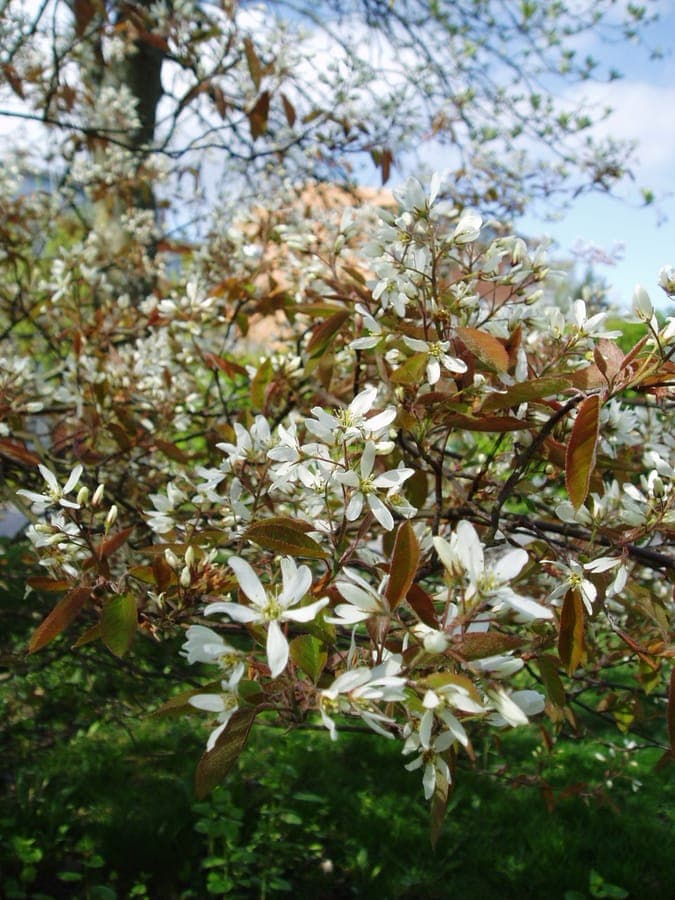
Udo Schröter / CC BY 3.0, via Wikimedia Commons
Juneberry: complete guide
Amelanchier lamarckii
Want to see Juneberry: complete guide in your garden?
1 minute, no credit card
Overview
The Juneberry (Amelanchier lamarckii), also known as snowy mespilus or shadbush, is one of the most versatile ornamental trees available to gardeners in temperate climates. This deciduous tree or large shrub performs the rare trick of offering genuine four-season interest: a spectacular cloud of white blossom in early spring, fresh green summer foliage, a breathtaking orange-red autumn display, and an elegant winter silhouette of fine grey-brown branches. To cap it all, it produces sweet, edible berries in June that taste remarkably like blueberries.
Native to coastal areas of North America and now thoroughly naturalised across northwestern Europe, the Amelanchier has become one of the most planted garden trees in the Netherlands and Belgium - and its popularity is spreading rapidly across the UK, the Pacific Northwest of the USA, and parts of Australia. On gardenworld.app you can create a garden design featuring the Juneberry as a multi-stemmed specimen or a light screen - its transparent canopy allows enough light for underplanting. Reaching 5 to 8 metres in height with a broad tolerance for different soils and positions, it is the ideal tree for those who want maximum impact with minimum fuss.
Appearance and bloom
The defining moment for Amelanchier lamarckii arrives in April, when the tree erupts into flower before the leaves have fully emerged. Abundant clusters of star-shaped, pure white flowers smother every branch, transforming the tree into a billowing cloud of white. The display lasts only ten to fourteen days, but those brief weeks deliver a beauty that catches the breath each year. The flowers are a magnet for bees, bumblebees, and hoverflies, making the Juneberry a valuable pollinator plant.
The emerging foliage is a distinctive coppery bronze that contrasts beautifully with the white flowers. As the season progresses, the leaves mature to a fresh mid-green. Come October and November, the tree ignites in shades of orange, scarlet, and deep crimson - an autumn performance that rivals any Japanese maple. In winter, the Juneberry reveals a finely branched, slightly irregular silhouette with smooth grey-brown bark that is remarkably decorative against a winter sky.
The fruits ripen in June and July: small, round berries that colour from red to dark purple. They taste sweet and are entirely edible - similar to blueberries but with their own distinctive flavour. You can eat them fresh, bake them into pies and muffins, cook them into jam, or leave them for blackbirds and thrushes, who devour them eagerly. The common name 'Juneberry' refers precisely to this fruiting season.
Ideal location
The Juneberry is remarkably flexible regarding position. It prefers a sunny to partially shaded spot, but performs admirably even in light shade. In full sun the blossom is richest, the fruit crop most abundant, and the autumn colour most intense. In partial shade the tree grows somewhat more open, but remains very attractive.
Its modest size and transparent canopy make the Juneberry particularly well suited to small gardens and urban plots. The root system is non-aggressive and poses no threat to paving or foundations, which has made the tree popular as a front-garden and street tree across the Low Countries. A multi-stemmed specimen used as a lawn focal point, beside a terrace, or as a light boundary screen is a classic application. The tree also tolerates the shelter of buildings and fences well and is reasonably wind-resistant - it thrives in exposed coastal gardens from Cornwall to Cape Cod.
Soil requirements
Where many ornamental trees are fussy about their soil, Amelanchier lamarckii is strikingly tolerant. The tree grows well on virtually any soil type: light sand, heavy clay, loam, and even chalky ground. It prefers a moderately moisture-retentive, humus-rich soil with a neutral to slightly acidic pH (5.5–7.5), but deviations are handled without complaint.
On very dry, poor sandy soil the tree grows more slowly and stays more compact. In that case, improve the planting hole with generous amounts of compost. On heavy clay, dig the planting hole slightly wider and add a drainage layer of coarse gravel at the base. The Amelanchier dislikes waterlogging: prolonged standing water around the roots can cause root rot. Moderately moist soil with good drainage is the golden formula.
When planting, dig a hole twice as wide and one-and-a-half times as deep as the rootball. Mix the excavated soil with compost and plant the tree at the same depth it sat in its pot. Multi-stemmed specimens that give an immediate graceful effect are available at garden centres and specialist nurseries throughout the UK, the USA, and Australia.
Free design
Want to see Juneberry: complete guide in your garden? Make a free design now.
Watering
Once established - after the first or second growing season - the Juneberry is remarkably drought-tolerant and requires little supplementary water in a normal temperate summer. The tree develops a deep and wide-spreading root system that draws moisture from the surrounding soil efficiently.
During the establishment year, regular watering is important: give a generous soaking (10–15 litres) once a week in dry weather during the first summer, so the roots can settle properly. In periods of prolonged drought - increasingly common with shifting weather patterns - even an established tree benefits from a thorough watering every two weeks. Water early in the morning, directly onto the root zone rather than over the foliage.
A mulch layer of 5 to 8 centimetres of composted bark or leaf mould around the base (keeping a ring of 10 centimetres clear around the trunk) retains soil moisture, protects roots from temperature swings, and suppresses weed growth. This is especially valuable in the first years after planting.
Pruning
The Juneberry is one of those gratifying trees that requires almost no pruning. The natural growth habit - open, slightly irregular, with a transparent crown - is precisely what makes the tree so elegant. Over-pruning disrupts this natural form and triggers unwanted water shoots (straight, vigorous suckers).
The only pruning needed: remove dead wood, crossing or rubbing branches, and any root suckers if you wish to maintain a multi-stemmed tree form. Do this preferably in winter (December–February), when the tree is dormant and the branch structure is clearly visible. Avoid pruning in spring, as the Amelanchier bleeds heavily from pruning wounds during the sap-rise period.
To form a multi-stemmed specimen from a shrubby plant, select 3 to 5 well-placed stems and gradually remove the rest over two to three years. This gives the tree time to adjust to the changed light distribution. A multi-stemmed Juneberry is one of the most sought-after tree forms in contemporary garden design - and for very good reason.
Maintenance calendar
March: Buds are swelling. Check for any winter frost damage. Apply a light feed with a balanced organic fertiliser.
April: Blossom bursts open. Enjoy the white flower display and the coppery emerging foliage. No specific care is needed at this time.
May–June: Berries begin to ripen. If you wish to harvest, fine-mesh netting is the only way to beat the birds. Begin supplementary watering in prolonged dry weather.
July–August: Berries are ripe and dropping. Provide extra water in hot weather, especially for young trees. Check for powdery mildew - the Amelanchier is somewhat susceptible, though damage is rarely serious.
September–October: Autumn colour develops, often spectacularly. Gradually reduce watering.
November–December: Leaf fall. Ideal pruning window. Apply an extra layer of mulch as winter root protection.
January–February: Dormancy. Plan any pruning work and enjoy the graceful winter silhouette.
Winter hardiness
Amelanchier lamarckii is exceptionally hardy and tolerates temperatures down to -25°C and below (USDA zones 4–8). In the UK, most of the USA, and the cooler regions of Australia and South Africa, winter cold is virtually never an issue. The tree is native to coastal North America and thoroughly adapted to changeable maritime climates with wet winters, late frosts, and fluctuating temperatures.
Late spring frost can occasionally damage the blossom, reducing the berry crop for that year. This is disappointing but not harmful to the tree itself. Newly planted trees benefit from a protective mulch layer around the base during their first winter. Beyond that, the Juneberry is one of the toughest ornamental trees you can plant - it withstands severe winters, dry summers, air pollution, and even de-icing salt without significant damage.
Companion plants
The Juneberry combines beautifully with a wide range of garden plants. Beneath a multi-stemmed specimen, shade-tolerant perennials look their best. Hostas with their broad foliage, ornamental grasses such as Hakonechloa macra or Carex oshimensis 'Evergold', and spring bulbs such as crocuses, snowdrops, and botanical tulips form an attractive underplanting.
For a naturalistic look, combine the Amelanchier with other native or naturalised shrubs such as hawthorn (Crataegus monogyna), guelder rose (Viburnum opulus), and dog rose (Rosa canina). In a more formal setting, box spheres or lavender borders at the base work beautifully. Hydrangeas (Hydrangea macrophylla) bloom after the Amelanchier blossom and take over the colour baton through summer.
Avoid aggressive ground covers such as ivy or greater periwinkle directly around the trunk - these compete too aggressively with the root system of young trees.
Closing
The Juneberry is one of those rare garden trees that offers something special in every season. The abundant white spring blossom, the fresh green foliage and edible berries in summer, the spectacular autumn colour, and the graceful winter silhouette make this tree a smart choice for any garden. Add the ease of maintenance, the broad soil tolerance, and the exceptional hardiness, and you understand why the Amelanchier has become a staple of contemporary garden design on both sides of the Atlantic.
Buy a multi-stemmed specimen from a reputable nursery and plant it preferably in autumn, so the roots can establish before spring. On gardenworld.app you can create a garden design where the Juneberry takes pride of place, complete with well-matched underplanting and the ideal position. Plant a Juneberry this autumn and enjoy that overwhelming cloud of white blossom next spring.
Want to see Juneberry: complete guide in your garden? Make a free design now.
Upload a photo, pick a style, and get a photorealistic design with plant list in under a minute.
No credit card required


Similar plants
Japanese Maple: complete guide
Acer palmatum
Everything about Japanese Maple (Acer palmatum): planting, pruning, cultivars and autumn colour. Expert tips for a spectacular ornamental tree in your garden.
Bigleaf Hydrangea: complete guide
Hydrangea macrophylla
Everything about the Bigleaf Hydrangea (Hydrangea macrophylla): planting, pruning, flower colour control and winter protection. Practical tips for lush blooms.
Japanese dogwood: complete guide
Cornus kousa
Everything about the Japanese dogwood (Cornus kousa): spectacular bracts, autumn colour, edible fruits and care. Expert tips for this elegant ornamental tree.