
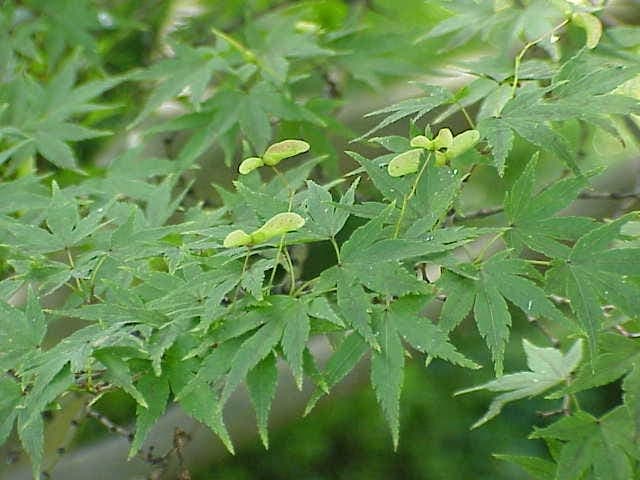
Kurt Stüber [1] / CC BY-SA 3.0, via Wikimedia Commons
Japanese Maple: complete guide
Acer palmatum
Want to see Japanese Maple: complete guide in your garden?
1 minute, no credit card
Overview
The Japanese Maple (Acer palmatum) is, without question, one of the most cherished ornamental trees in the world. This elegant deciduous tree or large shrub from Japan and Korea captivates gardeners with its palmate leaves, its graceful growth habit, and above all its unmatched autumn colour. From deep burgundy to blazing orange, from golden yellow to crimson pink - the autumn display of a Japanese maple is a spectacle that has no equal in the temperate garden.
With hundreds of cultivars ranging from dwarfs barely a metre tall to graceful trees of eight metres, there is a Japanese maple for every garden. On gardenworld.app you can create a garden design where the Japanese maple takes centre stage - as a lawn specimen, as a focal point beside a pond, in a large container on the terrace, or as the defining element of a Japanese-inspired garden. The plant combines beautifully with stone, water, moss, and bamboo screening, making it the cornerstone of Asian-influenced garden design from Kew to Kyoto.
Appearance and bloom
The foliage of Acer palmatum is its defining feature: palmate, with 5 to 9 finely toothed lobes that form an intricate, almost lace-like pattern. Leaf size varies from 4 to 12 centimetres depending on the cultivar. The Dissectum group (laceleaf maples) has even more finely divided foliage, giving the plant an almost feathery appearance.
In spring, the emerging leaves of many cultivars colour bronze-red to wine-red before transitioning to green or purple through summer. The true glory arrives in October and November, when the foliage explodes into shades ranging from bright yellow and orange to deep crimson and dark purple. The flowers are modest but charming: small red-purple blossoms in drooping clusters appear in April–May, followed by winged fruits (samaras) that helicopter down in the breeze.
Popular cultivars include 'Atropurpureum' (deep purple foliage all season), 'Dissectum' (finely cut leaves, weeping habit), 'Bloodgood' (dark red, colour-retaining), 'Sango-kaku' (coral-red winter bark), and 'Osakazuki' (widely regarded as having the most intense autumn colour of all cultivars - blazing scarlet-red).
Ideal location
The Japanese maple demands a sheltered position, protected from cold east winds and fierce afternoon sun. This is the single most important rule for success. Dappled shade is ideal: morning sun with shelter from the hottest afternoon hours. A spot beneath the light canopy of a larger tree, along the north side of a wall, or in the lee of a fence works beautifully.
The priority is to prevent the thin foliage from scorching in direct sun on hot summer days - burnt leaf margins are the most common complaint with Japanese maples. This applies doubly to the finely cut Dissectum forms. Conversely, too much shade produces lank growth and less vivid autumn colour. In urban gardens, the shelter of surrounding buildings often provides precisely the right conditions. The plant also excels in large containers (minimum 50 litres) on the patio or deck.
Soil requirements
The Japanese maple prefers a slightly acidic to neutral soil (pH 5.5–7.0) that is moisture-retentive but well-drained. A humus-rich, woodland-type soil is ideal. In heavy clay the plant may develop root rot unless drainage is improved with coarse grit and compost. In dry, poor sandy soil the rootball dries out too quickly, leading to scorched leaf edges.
When planting in the ground, work generous quantities of compost, leaf mould, or peat-free ericaceous compost into the planting hole. For container growing, use a mix of peat-free compost, perlite, and composted bark in a ratio of roughly 60/20/20. Avoid limey soil or hard tap water - the Japanese maple is lime-sensitive and may develop chlorosis (leaf yellowing) in overly alkaline conditions. Ericaceous compost suitable for Japanese maples is readily available at garden centres across the UK, the USA, and Australia.
Watering
Moisture is critical for the Japanese maple. The plant prefers a consistently moist but never waterlogged root zone. During dry periods in the growing season (April–September), water thoroughly two to three times per week. Do not allow the soil to dry out completely, but equally avoid water standing around the roots.
A mulch layer of 5 to 8 centimetres of composted bark or leaf mould around the trunk (but not touching it) is the single best investment you can make. Mulch retains soil moisture, cools the roots on hot days, and suppresses weeds. Japanese maples in containers are especially vulnerable to drought: check daily in warm weather and water as soon as the top few centimetres feel dry. Use rainwater where possible; hard tap water with a high lime content can gradually raise the soil pH.
Free design
Want to see Japanese Maple: complete guide in your garden? Make a free design now.
Pruning
The Japanese maple requires minimal pruning, and that is one of its charms. The natural growth habit - graceful, often slightly asymmetrical, with horizontal branch layers - is precisely what makes the plant so attractive. Prune only to remove dead wood, correct crossing branches, or lightly thin the canopy if it becomes too congested.
The best time to prune is late autumn to mid-winter (November–January), when the plant is dormant and the risk of bleeding is minimal. Never prune in spring (February–April): Japanese maples are under sap pressure at this time and bleed heavily from pruning wounds, which can seriously weaken the plant. Always use clean, sharp tools and make angled cuts just above a side branch or bud.
Dissectum forms (weeping laceleaf maples) may need some pruning to keep the crown open and preserve the characteristic cascading shape. Remove inward-growing branches and lightly thin the canopy so that light and air can penetrate.
Maintenance calendar
March–April: Foliage begins to emerge. Protect buds from late frost with horticultural fleece. Apply a light feed with an organic ericaceous fertiliser.
May–June: Foliage is fully developed. Begin regular watering in dry weather. Check for aphids, which sometimes attack the young shoots.
July–August: The hottest period. Ensure adequate watering and mulch. Watch for scorched leaf edges in heat and sun - move container plants to a more sheltered spot if necessary.
September–October: Autumn colour begins to develop. Gradually reduce watering. Enjoy the colour show.
November–December: Leaf fall. Ideal pruning window. Apply an extra layer of mulch as winter protection for the roots.
January–February: Dormancy. Prune dead wood and crossing branches. Check container plants for frost damage to the rootball - wrap large pots in bubble wrap or hessian if needed.
Winter hardiness
Acer palmatum is hardy to approximately -15°C to -20°C (USDA zones 5–8), depending on the cultivar. The species survives most winters across the UK, the eastern USA, the Pacific Northwest, and the cooler parts of Australia and South Africa without difficulty, but the details matter. Late spring frost (April–May) is the greatest enemy: if the freshly emerged leaves freeze, the plant can lose an entire season of growth.
Protect vulnerable specimens during frost with horticultural fleece or hessian draped over the crown. Young plants and container specimens are particularly frost-sensitive. In winter, place pots against a sheltered wall and insulate with bubble wrap or coconut matting. Container roots freeze faster than those of plants in the open ground. Dissectum cultivars are generally slightly more frost-sensitive than the upright types.
Companion plants
The Japanese maple combines most beautifully with plants that share its mood of tranquillity and refinement. Hydrangeas (Hydrangea macrophylla) are the perfect companion: their rounded flower heads in blue, pink, or white form a striking contrast with the finely cut maple foliage. Hostas with their large, ribbed leaves offer textural contrast at the foot of the tree.
Ferns (Dryopteris, Athyrium) create a woodland atmosphere that suits the maple perfectly. Ornamental grasses such as Hakonechloa macra (Japanese forest grass) form a natural carpet beneath the canopy. Box spheres (Buxus sempervirens) provide winter-green structure when the maple has shed its leaves. Patches of moss, stepping stones, and bamboo screening complete a Japanese garden picture. Avoid pairing with rampant ground-cover plants that could swamp the maple's shallow root system.
Closing
The Japanese maple is a plant for gardeners who relish subtlety and seasonal change. From the bronze spring foliage through the green or purple summer canopy to the blazing autumn glory and the sculptural winter branches - every season brings a new face. It is a plant that rewards patience: a Japanese maple only grows more beautiful with age.
Purchase your Japanese maple from a specialist tree nursery - check that the cultivar suits your garden situation in terms of ultimate size, colour, and sun requirements. On gardenworld.app you can create a garden design where the Japanese maple holds centre stage, with perfectly matched companion planting and the right location. Plant a Japanese maple this autumn and discover why this tree has captured the imagination of garden lovers for centuries.
Want to see Japanese Maple: complete guide in your garden? Make a free design now.
Upload a photo, pick a style, and get a photorealistic design with plant list in under a minute.
No credit card required


Similar plants
Bigleaf Hydrangea: complete guide
Hydrangea macrophylla
Everything about the Bigleaf Hydrangea (Hydrangea macrophylla): planting, pruning, flower colour control and winter protection. Practical tips for lush blooms.
Common Boxwood: complete guide
Buxus sempervirens
Everything about Common Boxwood (Buxus sempervirens): planting, pruning, topiary and box moth control. Practical tips for healthy, green hedges and shapes.
Rugosa Rose: complete guide
Rosa rugosa
Everything about the Rugosa Rose (Rosa rugosa): planting, pruning, care and winter hardiness. Practical tips for abundant blooms in your garden.