
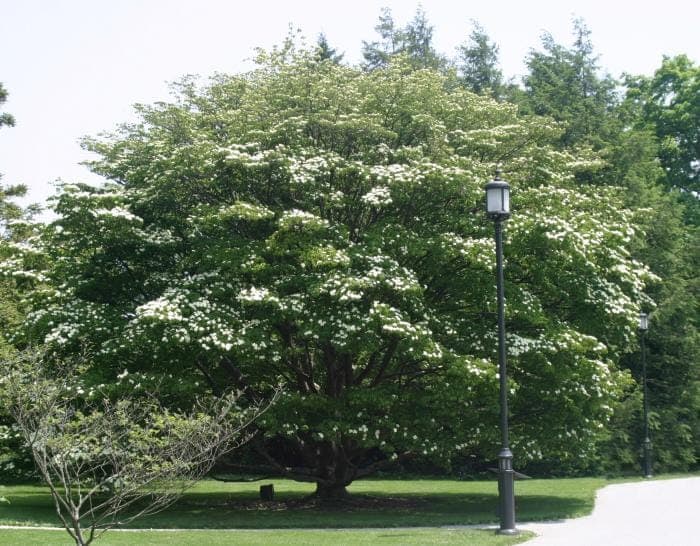
Henryhartley at English Wikipedia / CC BY-SA 3.0, via Wikimedia Commons
Japanese dogwood: complete guide
Cornus kousa
Want to see Japanese dogwood: complete guide in your garden?
1 minute, no credit card
Overview
The Japanese dogwood (Cornus kousa) is one of the most refined ornamental trees you can plant in a temperate garden. Where the related North American dogwood (Cornus florida) often struggles in cooler maritime climates, the Asian Cornus kousa thrives across the UK, the Pacific Northwest of the USA, and the temperate zones of Australia and New Zealand. The tree delivers a sequence of seasonal effects that few other trees can match: large, star-shaped white or pink bracts in June and July, raspberry-like edible fruits in autumn, a spectacular red-purple autumn colour display, and a picturesque exfoliating bark that comes into its own in winter.
Cornus kousa is native to Japan, Korea, and central China, where it grows in mountain forests and along woodland edges. In Western gardens it has built a devoted following among gardeners seeking something special - a tree that does not stand on every street corner but that performs reliably year after year. On gardenworld.app you can create a garden design featuring the Japanese dogwood as the centrepiece, whether as a multi-stemmed specimen in an Asian-inspired garden, a lawn focal point, or a companion tree beside a pond or terrace.
Appearance and bloom
Cornus kousa is a deciduous tree or large shrub reaching 4 to 8 metres in height, with a broad, slightly horizontally layered crown. The growth habit is strikingly elegant: horizontal branch tiers that broaden with age, giving the tree a layered, pagoda-like silhouette.
The great spectacle begins in June - later than most flowering trees, which is precisely what makes the Japanese dogwood so valuable. What appear to be large white flowers are actually four bracts (modified leaves) surrounding the inconspicuous, ball-shaped green flower clusters at their centre. These bracts are pointed, 4 to 8 centimetres long, and spread elegantly like four-pointed stars. The display lasts four to six weeks - remarkably long for a flowering tree. The cultivar 'Satomi' has pink bracts, creating a particularly romantic effect.
After the bracts fall, extraordinary fruits develop: raspberry-like, round, red globes 2 to 3 centimetres across that ripen in September and October. They are edible and taste sweet with a faintly tropical note - comparable to a cross between mango and banana. The autumn foliage turns a spectacular red-purple to burgundy. In winter, the tree reveals stunning exfoliating bark in shades of grey, brown, and olive green, reminiscent of camouflage fabric.
Ideal location
The Japanese dogwood prefers a lightly sheltered position in partial shade to full sun. The ideal spot provides morning sun with protection from the fiercest afternoon heat, though in a cool maritime climate the tree also performs well in a fully sunny position. Shelter from cold north and east winds is an advantage, particularly for young specimens.
The tree excels as a lawn specimen, where its broad, layered crown can develop fully. It also works beautifully in a woodland-edge setting, as an understorey tree in a light tree group, or as a companion tree beside a terrace or pond. In urban gardens, the shelter of walls and buildings often provides ideal conditions. The tree tolerates some competition from surrounding planting but performs best with sufficient space to develop its characteristic horizontal growth habit.
Soil requirements
Cornus kousa prefers an acidic to neutral soil (pH 5.0–7.0) that is moisture-retentive but well-drained. A humus-rich, loose woodland soil is ideal. The tree is less tolerant than, say, the Amelanchier: on heavy, compacted clay or strongly alkaline soil, growth may disappoint and chlorosis (leaf yellowing) can occur.
When planting, dig a hole twice as wide and one-and-a-half times as deep as the rootball. Mix the excavated soil with generous amounts of compost, leaf mould, or peat-free ericaceous compost. On alkaline clay, it is worth digging a large planting hole and replacing the soil almost entirely with an acidified mix. Working a handful of flowers of sulphur into the soil can help lower the pH. Good drainage is essential: in areas with a high water table, add a drainage layer of coarse gravel at the base of the planting hole.
Specialist tree nurseries offer the best selection, including named cultivars such as 'Satomi', 'China Girl', 'Milky Way', and 'Gold Star' (variegated). Larger specimens are occasionally available at well-stocked garden centres.
Free design
Want to see Japanese dogwood: complete guide in your garden? Make a free design now.
Watering
The Japanese dogwood prefers a consistently moist but never waterlogged root zone. Regular watering is crucial during the first and second growing seasons after planting: give 15 to 20 litres weekly in dry weather. The tree has a relatively shallow and wide-spreading root system that is sensitive to drying out.
Even once established, Cornus kousa benefits from adequate moisture during dry spells. Unlike the drought-tolerant Amelanchier, the Japanese dogwood is less forgiving of drought stress - prolonged water shortage leads to brown leaf edges, premature leaf drop, and reduced flowering the following season. Water thoroughly once a week on the root zone during prolonged dry weather.
A mulch layer of 8 to 10 centimetres of composted bark, leaf mould, or wood chips around the trunk (keeping a clear ring of 15 centimetres around the base) is the best measure for retaining moisture, maintaining a low soil pH, and protecting the root environment. Use rainwater where possible, as hard tap water can gradually raise the soil pH.
Pruning
Cornus kousa is a tree best left unpruned. The natural growth habit - those characteristic horizontal branch tiers that broaden with age - is precisely what makes the tree so special. Any heavy pruning disrupts this pattern and produces a less attractive result.
The only pruning required: remove dead wood, crossing or rubbing branches, and any water shoots (straight, strongly upward-growing stems that disrupt the silhouette). Do this preferably in late autumn or early winter (November–January), when the tree is dormant. Avoid pruning in spring, as the dogwood bleeds from pruning wounds during the sap-rise period.
If you wish to form a multi-stemmed specimen, select 3 to 5 well-placed stems and gradually remove the rest. This is best done on young trees within the first few years after planting.
Maintenance calendar
March–April: Foliage begins to emerge. Carefully remove any winter mulch that has accumulated too close to the trunk. Apply a light feed with an organic ericaceous fertiliser.
May: Foliage is fully developed. Flower buds become visible. Begin regular watering in dry weather.
June–July: The bracts are at their finest. Enjoy the display, which lasts four to six weeks. Ensure adequate watering.
August–September: Fruits begin to ripen. Harvest them when dark red and soft. Autumn colour begins to develop.
October–November: Spectacular red-purple autumn colour. Leaf fall. Apply an extra layer of mulch as winter protection.
December–February: Dormancy. Enjoy the exfoliating bark and graceful winter silhouette. Prune dead wood if needed.
Winter hardiness
Cornus kousa is hardy to approximately -20°C (USDA zones 5–8). Across most of the UK, the eastern USA, the Pacific Northwest, and the temperate zones of Australia, the tree survives winter without difficulty. It is considerably hardier than its North American relative Cornus florida, but less hardy than the European native Cornus mas.
Young, newly planted trees are the most vulnerable. Protect them for the first two to three winters with a thick mulch layer around the base and, if necessary, a hessian windbreak on the coldest side. Late spring frost can occasionally damage the young shoots, but the tree usually recovers well. The cultivar 'China Girl' is reputed to be one of the hardiest selections.
Companion plants
The Japanese dogwood combines most beautifully with plants that share its mood of Asian refinement. Hostas with their broad, ribbed leaves form a superb underplanting. Ferns (Dryopteris, Polystichum) create a woodland atmosphere that suits the dogwood perfectly. Japanese anemones (Anemone x hybrida) flower after the dogwood and extend the season.
The Japanese maple (Acer palmatum) is the ultimate companion: both trees share a love of partial shade, acidic soil, and an air of refined elegance. Plant them together for a miniature Japanese garden that captivates in every season. Hakonechloa macra (Japanese forest grass) as ground cover, combined with azaleas (Rhododendron) and Pieris japonica, completes the Asian garden picture.
Avoid pairings with aggressive root competitors or plants that demand alkaline soil - the Japanese dogwood needs its acidic, humus-rich environment.
Closing
The Japanese dogwood is a tree for gardeners seeking something that transcends the ordinary. The spectacular bracts in June, the unusual fruits, the blazing autumn colour, and the picturesque winter bark make Cornus kousa a tree with genuine four-season interest. It is not a tree for the impatient - it grows slowly and reaches its full glory only after ten to fifteen years - but the wait is richly rewarded.
Buy a well-branched tree from a specialist nursery and plant preferably in spring, so the roots have an entire growing season to establish before winter. On gardenworld.app you can create a garden design where the Japanese dogwood takes pride of place, with companion planting that reinforces the Asian character. Plant a Cornus kousa and give your garden a tree that surprises in every season.
Want to see Japanese dogwood: complete guide in your garden? Make a free design now.
Upload a photo, pick a style, and get a photorealistic design with plant list in under a minute.
No credit card required


Similar plants
Japanese Maple: complete guide
Acer palmatum
Everything about Japanese Maple (Acer palmatum): planting, pruning, cultivars and autumn colour. Expert tips for a spectacular ornamental tree in your garden.
Juneberry: complete guide
Amelanchier lamarckii
Everything about the Juneberry (Amelanchier lamarckii): spring blossom, autumn colour, edible berries and care. Expert tips for this versatile four-season tree.
Bigleaf Hydrangea: complete guide
Hydrangea macrophylla
Everything about the Bigleaf Hydrangea (Hydrangea macrophylla): planting, pruning, flower colour control and winter protection. Practical tips for lush blooms.