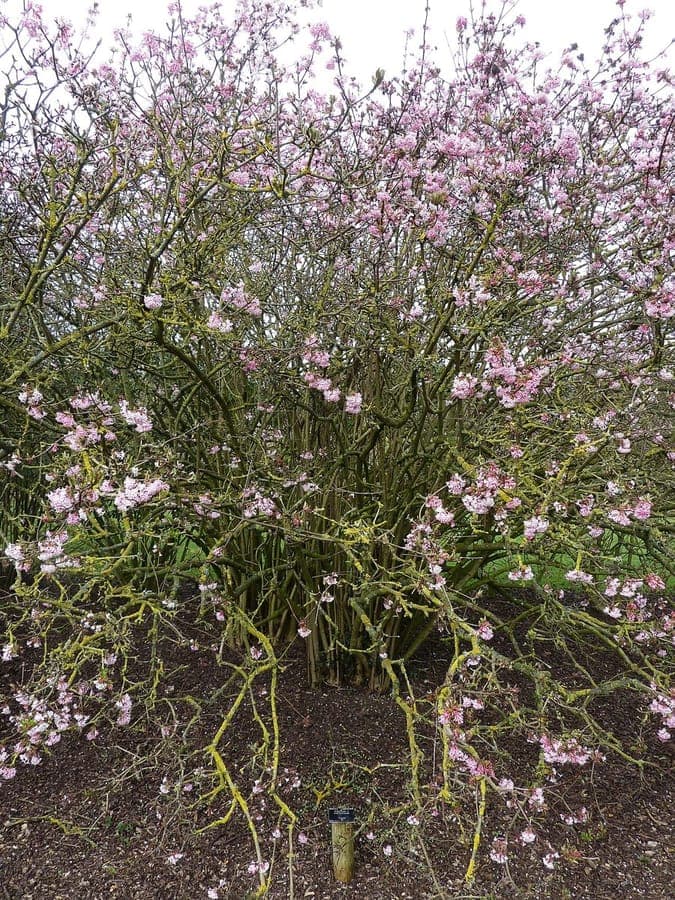
Magnus Manske / CC BY-SA 3.0, via Wikimedia Commons
Bodnant viburnum: complete guide
Viburnum × bodnantense
Want to see Bodnant viburnum: complete guide in your garden?
Full design in HD: €7.99
Look after your Bodnant viburnum with the GardenWorld app
Identify plants with your camera and get a care calendar with reminders for this plant.


Overview
Bodnant viburnum (Viburnum × bodnantense) is one of the finest shrubs for anyone who wants something to see and smell in the garden in winter. From November into March, dense clusters of pink flowers appear on the bare branches, with a sweet, almost honey-like scent. On a mild winter's day you can smell the shrub before you see it.
This viburnum is a hybrid between two Asian species, Viburnum farreri and Viburnum grandiflorum. It arose in the 1930s at Bodnant Garden in North Wales, which gave the plant its name. The best-known cultivar is 'Dawn', with deep pink buds opening to pale pink flowers. 'Charles Lamont' has brighter pink flowers, and 'Deben' is almost white with a pink flush.
The shrub grows upright and after ten years reaches about 2.5 to 3 m tall and 1.5 to 2 m wide. On gardenworld.app you can create a garden design that places this viburnum where you will really see and smell it in winter: by the front door, along a path or in view of the kitchen window. In summer it is a calm green shrub that blends well with perennials and other shrubs.
Appearance and bloom cycle
The flowers are carried in compact clusters 3 to 5 cm across at the tips of the twigs and along the branches. Each flower is small and tubular, but together they form pink posies that stand out from a distance. The buds are darker than the open flowers, so each cluster shows two shades of pink. The scent is sweet and slightly spicy.
Flowering often starts in October or November, sometimes while leaves are still on the shrub, and continues on and off until March. In hard frost the open flowers freeze and turn brown. As soon as the weather turns milder, new buds open, so you have flowers for most of the winter.
The leaves are oval, 5 to 10 cm long, toothed and strongly veined. Young leaves emerge bronze in spring, turn dark green in summer and take on red-purple tones in autumn. Berries are rarely produced. The branches are upright at first and arch a little with age, as in the photograph at the top of this page.
Ideal location
Viburnum × bodnantense grows in sun or partial shade, flowering most freely in sun. Choose a spot you pass often in winter, as that is where the fragrance is appreciated most. A sheltered corner also holds the scent, whereas a windy site disperses it quickly.
Avoid a position where early morning sun falls directly on the flowers after a frosty night. Rapid thawing damages the flowers more than the frost itself, so a west-facing spot or the partial shade of a wall or larger trees is ideal. Allow for the eventual size and plant at least 1 m from a wall or path. In an informal hedge, space plants about 1.5 m apart.
Soil requirements
This viburnum is not fussy. Any ordinary garden soil that is moist but not waterlogged will do, and heavy clay and chalky soils are no problem. It only struggles in very dry sand and in ground that stays wet for long periods.
When planting, dig a generous hole twice the width of the root ball. Mix the excavated soil with some compost and set the shrub at the same depth it was in the pot. Plant in autumn or early spring, or container-grown plants in any frost-free spell. A mulch of compost or bark chips keeps the soil moist and suppresses weeds.
Free preview
Want to see Bodnant viburnum: complete guide in your garden? Make a free preview of your design.
Watering
In the first year after planting, water regularly, giving a good 10-litre bucketful each week in dry weather. This encourages a deep root system. After that, an established viburnum copes on its own in most summers. Only in prolonged drought and heat should you water thoroughly now and then.
If the leaves droop in summer, the plant is thirsty. Give it one long soak rather than a little every day. A dry summer can also reduce the number of buds formed for winter flowering.
Pruning
Bodnant viburnum flowers on wood from previous years, so prune straight after flowering in March or April. Pruning in autumn removes the flower buds.
Annual shaping is not necessary. To keep the shrub young and free-flowering, cut one or two of the oldest, thickest stems down to near ground level every year or two. This makes room for young shoots from the base. Remove dead, weak and crossing branches too. A badly overgrown shrub can be fully renovated over two or three years by removing a third of the old stems each time.
Branches that touch the ground sometimes root, which makes propagation easy: sever the rooted branch in autumn and plant it elsewhere. The plant is considered to be of low toxicity, although the rare berries can cause mild stomach upsets in people and pets if eaten raw.
Maintenance calendar
March–April: Prune after flowering. Remove a few old stems at the base. Spread a layer of compost around the shrub.
May–June: The bronze young leaves unfold. Water young plants in dry spells. Check shoot tips for aphids; ladybirds usually deal with them.
July–August: The shrub sets its flower buds for winter. Water during prolonged drought.
September–October: Autumn colour. A good time to plant new shrubs.
November–February: Flowering. Cut a few stems for a vase if you like; indoors they are wonderfully fragrant. Do not prune now.
Winter hardiness
Viburnum × bodnantense is reliably hardy and tolerates frost down to about -20 °C. Across Britain and the Low Countries it needs no protection. Open flowers may brown in a sharp frost, but that is purely cosmetic; the plant itself is unharmed and new buds follow.
Young plants in containers are more vulnerable, because roots in a pot freeze more quickly. In a severe winter, move the pot against a wall and wrap it in hessian or bubble wrap.
Companion plants
Pair Bodnant viburnum with other plants that offer something in winter. Chinese witch hazel (Hamamelis mollis) flowers in January and February with fragrant yellow ribbons, and together with the pink viburnum it creates a winter corner full of colour and scent. The red stems of dogwood (Cornus alba) add extra colour in the bare months.
Shade-loving winter flowers suit the base of the shrub. Christmas rose (Helleborus niger) produces white saucers from December to March. Snowdrops (Galanthus nivalis) and Cyclamen coum naturalise happily beneath shrubs and form a white and pink carpet in February.
In summer, when the viburnum provides a green backdrop, perennials such as hardy geraniums, lady's mantle and Japanese anemones fit well at the front of the border.
Final thoughts
Bodnant viburnum brings fragrance and colour to the quietest months of the gardening year. It is tough, undemanding and grows in almost any soil. Give it a spot you pass every day in winter, prune only after flowering and renew the shrub now and then by removing old stems.
Want to know what to do and when? The plant calendar on gardenworld.app sets out monthly tasks for your shrubs, from pruning to planting. Plant a Viburnum × bodnantense 'Dawn' by your front door this autumn, and every winter you will be greeted by pink flowers and a sweet scent.
Frequently asked questions about Bodnant viburnum
Is Bodnant viburnum winter hardy?
Viburnum × bodnantense is reliably hardy and tolerates frost down to about -20 °C. Across Britain and the Low Countries it needs no protection.
When and how do you prune Bodnant viburnum?
Bodnant viburnum flowers on wood from previous years, so prune straight after flowering in March or April. Pruning in autumn removes the flower buds.
How much water does Bodnant viburnum need?
In the first year after planting, water regularly, giving a good 10-litre bucketful each week in dry weather. This encourages a deep root system.
Where does Bodnant viburnum grow best?
Viburnum × bodnantense grows in sun or partial shade, flowering most freely in sun. Choose a spot you pass often in winter, as that is where the fragrance is appreciated most.
What soil does Bodnant viburnum need?
This viburnum is not fussy. Any ordinary garden soil that is moist but not waterlogged will do, and heavy clay and chalky soils are no problem.

See it in your garden
See Bodnant viburnum in your garden
One photo of your garden and a few questions. You see the result in about a minute.
Try it with a photoIdentify this plant in your own garden. Identify a plant
Similar plants
Chinese Witch Hazel: complete guide
Hamamelis mollis
Chinese witch hazel blooms in January-February with fragrant yellow flowers even in deep winter. Master care, site selection, and pruning to enjoy 30+ years of winter color.
Christmas-rose: complete guide
Helleborus niger
The Christmas-rose (Helleborus niger) is an elegant winter-flowering perennial blooming from December to April. Perfect for shady borders and woodland gardens.
Siberian Dogwood: complete guide
Cornus alba
Learn how to grow and care for Cornus alba (Siberian Dogwood) in your garden. Ideal conditions, pruning, winter color and companion plants explained.
