
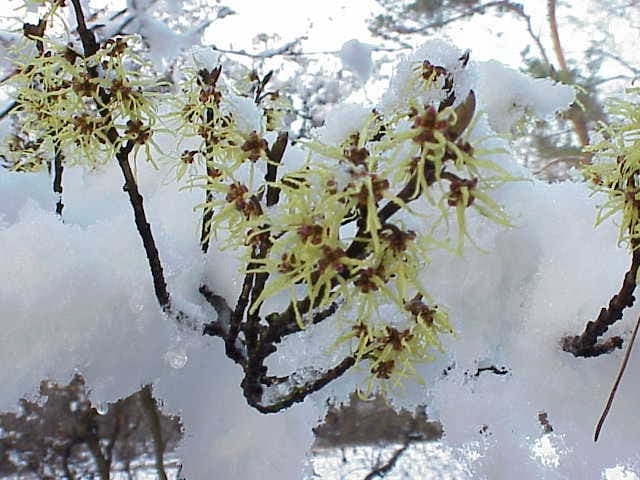
Kurt Stüber [1] / CC BY-SA 3.0, via Wikimedia Commons
Chinese Witch Hazel: complete guide
Hamamelis mollis
Want to see Chinese Witch Hazel: complete guide in your garden?
1 minute, no credit card
Overview
Chinese witch hazel (Hamamelis mollis) is a remarkable shrub that blooms reliably in the heart of winter. Starting in January and continuing through February, when most of the garden still sleeps, this vigorous Asian native covers itself with tightly packed clusters of strongly fragrant, bright yellow flowers often tinged with red at the base. It's a beacon of hope in the darkest season and one of the finest winter-flowering shrubs available. Originally from central China, it has become beloved worldwide for gardeners seeking winter color and scent.
Appearance & bloom
Witch hazel grows as an upright, sometimes open-branching shrub reaching 2 to 4 meters (6 to 13 feet) tall and wide. The leaves are broad, oval, dark green, and provide excellent golden to reddish fall color before dropping. But the true glory is the winter bloom: from January to March the branches become clothed in ribbon-like flowers roughly 15 mm long, typically golden yellow with red spots at the base. These flowers have a distinctive, sweet fragrance detectable from 20 meters away on calm winter days.
After flowering, small woody capsules form and explosively dehisce in October, flinging seeds several meters - a feature that earned the common name "witch hazel." This adds botanical interest beyond just winter beauty.
Ideal location
Witch hazel thrives with at least 4-6 hours of direct sunlight daily. In warmer climates it tolerates afternoon shade, but more sun means more flowers. Avoid extremely windy sites where flower clusters can be battered and growth is stunted. A sheltered spot, perhaps against a warm wall or among taller screening plants, is ideal.
This shrub pairs beautifully with other winter bloomers like Viburnum x bodnantense, Jasminum nudiflorum, and early anemones. Plant it as a specimen or in mixed shrub borders where its structure and blooms are visible during the bare season.
Soil
Witch hazel prefers acidic to neutral, humus-rich soil. Light sandy loam enriched with compost works best. Target pH 5.5-6.5; on alkaline soil it often shows chlorosis (yellowing of leaf tissue between green veins). Amend heavy clay with sand and organic matter before planting, or create a raised mound. Good drainage is essential - waterlogging damages roots. Incorporate 25-30% compost into the planting hole and apply 5-7 cm of leaf mold around the base after planting.
Watering
Young witch hazels and newly planted specimens need consistent moisture throughout the growing season (April-September). Water thoroughly when the top 5 cm of soil feels dry. Rather than frequent shallow watering, water deeply and less often to encourage deep rooting. In winter, reduce watering but don't allow the soil to dry completely.
Apply 5-7 cm of mulch (compost or shredded bark) around the base, keeping it 30 cm clear of the stem, to conserve moisture and insulate roots. This is especially crucial in the first two years as the root system establishes. In very dry summers, water every 7-10 days; in wet winters, monitor for waterlogging.
Free design
Want to see Chinese Witch Hazel: complete guide in your garden? Make a free design now.
Pruning
Witch hazel requires minimal pruning. It naturally develops a pleasing, open framework. Remove only dead, diseased, or obviously crossing branches in early spring (March) after flowering ends. Cut just above an outward-facing bud or side branch. Avoid heavy heading-back, which reduces next year's bloom.
For young plants, light pruning in May-June can encourage a fuller, bushier habit by pinching out some growing tips. Once mature, simply remove old wood from the base every few years to maintain vigor and shape. Never cut it back severely unless structural damage demands it.
Maintenance calendar
January-February: Enjoy the bloom. Inspect for frost or snow damage to flower clusters.
March: Prune out any dead wood. Apply fresh compost mulch around the base.
April-May: Begin regular watering as growth accelerates. Scout for spider mites and scale insects.
June-July: Continue watering throughout any dry spells. Check for powdery mildew on leaves in humid conditions; improve air circulation if needed.
August-September: Gradually reduce watering as growth slows. No feeding in late summer - it encourages frost-tender new growth.
October-November: Enjoy fall color. No maintenance required.
December: For young plants in very cold zones (below -15C), consider wrapping with burlap for frost protection.
Winter hardiness
Chinese witch hazel is hardy to USDA zone 5 (to approximately -28 degrees Celsius / -18 F). This means it thrives outdoors throughout the Low Countries and most of Central Europe without winter protection. Young trees in their first two winters benefit from mulch protection and shelter from drying winter winds. Place plants away from north-facing walls where temperature fluctuations are severe, as boom-and-bust cycles can damage flower buds.
Flower buds can be damaged by late freezes, but the plant itself is tough and will re-shoot the following year. In continental climates with late spring frosts, locate witch hazel where afternoon shade prevents too-early flower bud swelling.
Companion plants
Witch hazel partners wonderfully with:
- Viburnum x bodnantense (pink winter flowering viburnum)
- Jasminum nudiflorum (winter jasmine - yellow)
- Anemone blanda (winter windflower)
- Helleborus spp. (Christmas roses)
- Cornus alba (red-stemmed dogwood - winter skeleton contrast)
- Ilex verticillata (American holly - persistent red berries)
- Sarcococca (sweet box - fragrant, shade-tolerant)
Edge with dwarf evergreens and early spring bulbs like Crocus and Snowdrop (Galanthus) for continuous winter interest.
Closing
The Chinese witch hazel is an investment in winter joy that pays dividends for 30+ years. Its intensely fragrant yellow blooms in the deepest cold season offer proof that the garden is never truly asleep. With the right site, well-draining soil, and patience as it gradually fills out, you'll have a signature plant that draws admiration from January onward. Plant one this autumn and mark January on your calendar - your toughest winter days will suddenly feel much brighter. Better still, you can cut stems for indoor arrangements, filling your entire house with that unforgettable winter fragrance.
Want to see Chinese Witch Hazel: complete guide in your garden? Make a free design now.
Upload a photo, pick a style, and get a photorealistic design with plant list in under a minute.
No credit card required


Similar plants
Acer pycnanthum: complete guide
Acer pycnanthum
Acer pycnanthum, the Japanese swamp maple, is a fast-growing tree with early red flowers and brilliant autumn color, ideal for damp garden settings.
Freeman maple: complete guide
Acer × freemanii
Everything about the Freeman maple (Acer x freemanii): a fast-growing shade tree with spectacular autumn colour for large gardens.
Silver vine: complete guide
Actinidia polygama
Discover silver vine (Actinidia polygama): a hardy climbing plant with silvery foliage, loved by gardeners and cats alike.