Sgerbic / CC BY-SA 4.0, via Wikimedia Commons
Koreanspice viburnum: complete guide
Viburnum carlesii
Want to see Koreanspice viburnum: complete guide in your garden?
Full design in HD: €7.99
Look after your Koreanspice viburnum with the GardenWorld app
Identify plants with your camera and get a care calendar with reminders for this plant.


Overview
Koreanspice viburnum (Viburnum carlesii) is a deciduous shrub that most people plant for one reason: its scent. In April and early May it produces domed clusters of flowers with a fragrance so strong and sweet that you notice it several metres away. Anyone who has walked past one on a mild spring evening remembers that spicy perfume, somewhere between cloves and jasmine.
The species grows wild in Korea and on the Japanese island of Tsushima. It reached European gardens around 1900 and has been a nursery staple ever since. It is also a parent of several well-known hybrids, including Viburnum × burkwoodii and Viburnum × carlcephalum, yet for a smaller garden the original species is often the better choice.
Viburnum carlesii grows slowly to moderately and forms a rounded, slightly open shrub of about 1.5 to 2 m in height and spread. That makes it a good fit for an ordinary town garden, beside a patio or in a mixed border. On gardenworld.app you can have a garden design made that places this viburnum where you will actually enjoy the scent: by the front door, next to a seat, or under a window you open in spring. Popular cultivars include 'Aurora', with deep red buds, and 'Diana', which grows a little more vigorously and stays pink for longer. 'Compactum' stays at around 1 m and suits a large container.
Appearance and bloom cycle
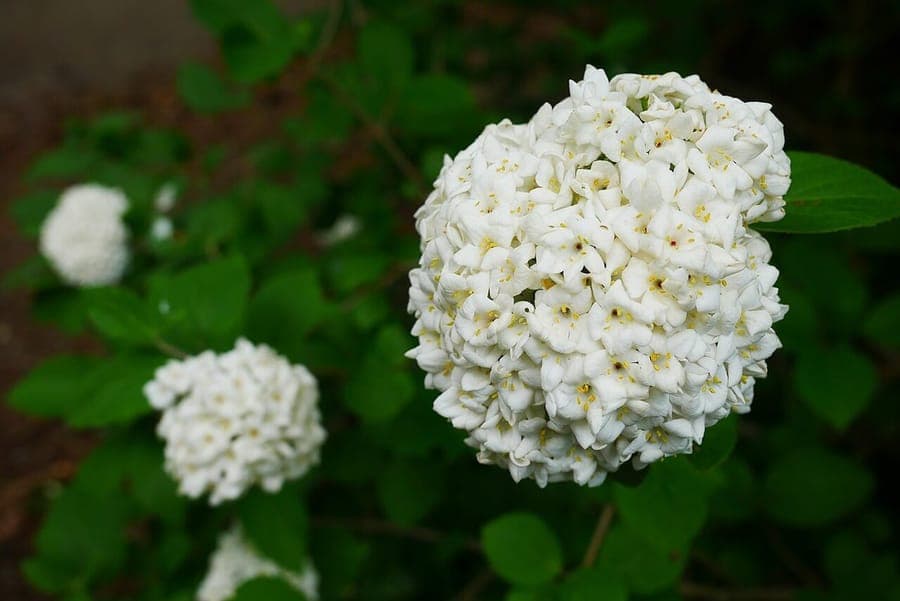
The show starts with the buds. From late March you will see round clusters of pink to reddish buds at the tips of the shoots. Around mid April they open into domed heads 5 to 8 cm across. Each flower is tubular with five spreading lobes and opens from pale pink to pure white. While buds and open flowers sit side by side, every cluster carries two colours, and that is when the shrub looks its best. Flowering lasts about three weeks, a little longer in cool weather.
The leaves appear with or just before the flowers. They are oval, 4 to 10 cm long, dull green and finely downy on both sides, which gives them a soft, slightly greyish feel. In many years the foliage turns deep red to purple in autumn, although this depends on the position and the season. In summer the shrub is a calm mass of green that asks for very little attention.
Oval berries that ripen from red to blue-black may follow the flowers. You see them fairly rarely in gardens, because a good crop needs a second, genetically different plant nearby. The berries are mildly toxic: eaten raw they can cause nausea or diarrhoea in people and pets. The risk is small, but it is sensible to teach young children not to eat them.
Ideal location
Koreanspice viburnum flowers best in full sun or partial shade. Four to six hours of sun a day is plenty for a good display. In deep shade it will survive but becomes thin and flowers poorly. In southern Europe a spot with afternoon shade is better, because the soft leaves can scorch in intense summer heat.
When choosing a position, think about the fragrance first. Plant it where you walk past regularly in April: along a path, by the back door or next to a bench. A sheltered corner against a hedge or wall also holds the scent in the air. On a windy site the perfume simply blows away, and the early buds are more likely to be damaged by night frost.
Give it room to grow. It starts small, but over the years it reaches 2 m across. A spacing of 1.5 to 2 m from other shrubs is sensible. A compact cultivar can live for years in a container of at least 50 litres, as long as the pot never dries out.
Soil requirements
Viburnum carlesii is not fussy, but it does best in humus-rich soil that holds moisture yet drains freely. Ordinary garden soil improved with some compost is ideal. The pH can range from slightly acidic to slightly chalky, roughly 5.5 to 7.5, so unlike rhododendrons it needs no special treatment.
On heavy clay that stays wet in winter, mix compost and some coarse grit into the planting hole to improve drainage. On poor, sandy soil, work plenty of compost or leaf mould into the top 30 cm so the ground holds more water. Dig the hole twice as wide as the root ball and plant at the same depth as the shrub sat in its pot.
Check the rootstock when buying. Many plants sold in garden centres are grafted, often onto Viburnum lantana. That rootstock can send up suckers with different leaves. Remove them as low down as possible, otherwise the rootstock will eventually take over. A 5 cm mulch of leaf mould or bark chippings keeps the soil cool and moist and suppresses weeds.
Free preview
Want to see Koreanspice viburnum: complete guide in your garden? Make a free preview of your design.
Watering
In the first year after planting the shrub needs regular watering. During dry spells give it a thorough soaking once or twice a week, about 10 litres each time, so the water reaches the deeper soil. A few small splashes do more harm than good, as they keep the roots near the surface.
Once established, Koreanspice viburnum copes with short dry periods. During a longer summer drought, especially in July and August, do give it extra water. Those are the months when next spring's flower buds form, and a shrub that is too dry will flower noticeably less the following year. Drooping or limp leaves are a clear signal that it needs a drink.
Pruning
Koreanspice viburnum needs very little pruning. It naturally forms a pleasing rounded shape, and pruning at the wrong time costs you flowers. The flower buds form in summer on the current season's wood and open the following spring, so cutting back in autumn or winter removes next year's display.
The right moment is straight after flowering, in May or early June. Cut only what is necessary: dead or damaged wood, crossing branches or stems growing inwards, and any wayward shoots that spoil the outline. On an older shrub that has become bare at the base, you can remove one or two of the oldest stems close to the ground each year. This renews the plant gradually without losing a season of flowers.
Maintenance calendar
March: Scatter a handful of organic shrub feed or a layer of compost around the plant. Check for suckers.
April: Flowering begins. Watch for aphids on young shoots and buds; a strong jet of water usually deals with them.
May: Flowering ends. Give a light prune straight afterwards if needed.
June to August: Water during dry spells, as next year's flower buds are forming now. Top up the mulch.
September to October: Autumn colour. A good time to plant new shrubs so they can root before winter.
November to February: Dormant period. Do not prune. Protect container plants during prolonged hard frost.
If you would rather not keep track of all this yourself, the plant calendar on gardenworld.app lists these tasks month by month, together with what the other plants in your garden need.
Winter hardiness
Viburnum carlesii is very hardy and tolerates temperatures down to about -25 °C. In Britain, Ireland and the Low Countries it never needs protection in open ground, and it also does well in colder parts of Germany and Central Europe.
Its only weak point is the early flowering. The buds are visible from March and can turn brown after a late night frost. The shrub itself is not harmed, but you lose part of the display. A sheltered spot, away from cold hollows where frost lingers, reduces that risk.
Companion plants
Koreanspice viburnum looks its best alongside plants that flower at the same time or that complement it in summer. Spring bulbs work well beneath and in front of it: daffodils, with the white pheasant's eye narcissus (Narcissus poeticus) as a fragrant partner, and blue grape hyacinths. Lenten roses (Helleborus orientalis) fill the base of the shrub early in the year.
For a scented corner, skimmia (Skimmia japonica) is a good neighbour, flowering at the same time and holding its leaves and buds through winter. In a sheltered garden a winter daphne such as Daphne odora can join them. To extend the fragrance season, plant a common lilac (Syringa vulgaris) a few metres away; it takes over in May.
Final thoughts
Koreanspice viburnum asks for little and gives a great deal every spring. A sunny or partly shaded spot, humus-rich soil, water in dry summers and restrained pruning straight after flowering are all it needs. In return you get three weeks of fragrance that fills the whole garden. Viburnum carlesii deserves a place close to the house, where you will smell it every day.
Frequently asked questions about Koreanspice viburnum
Is Koreanspice viburnum winter hardy?
Viburnum carlesii is very hardy and tolerates temperatures down to about -25 °C. In Britain, Ireland and the Low Countries it never needs protection in open ground, and it also does well in colder parts of Germany and Central Europe.
When and how do you prune Koreanspice viburnum?
Koreanspice viburnum needs very little pruning. It naturally forms a pleasing rounded shape, and pruning at the wrong time costs you flowers.
How much water does Koreanspice viburnum need?
In the first year after planting the shrub needs regular watering. During dry spells give it a thorough soaking once or twice a week, about 10 litres each time, so the water reaches the deeper soil.
Where does Koreanspice viburnum grow best?
Koreanspice viburnum flowers best in full sun or partial shade. Four to six hours of sun a day is plenty for a good display.
What soil does Koreanspice viburnum need?
Viburnum carlesii is not fussy, but it does best in humus-rich soil that holds moisture yet drains freely. Ordinary garden soil improved with some compost is ideal.

See it in your garden
See Koreanspice viburnum in your garden
One photo of your garden and a few questions. You see the result in about a minute.
Try it with a photoIdentify this plant in your own garden. Identify a plant
Similar plants
Common Lilac: complete guide
Syringa vulgaris
Everything about Common Lilac (Syringa vulgaris): planting, pruning, care and propagation. Practical tips for abundant, fragrant May blooms.
Winter daphne (Daphne odora): complete guide
Daphne odora
Learn how to grow fragrant winter daphne for year-round garden interest. This cold-hardy shrub blooms in winter and fills gardens with intoxicating perfume.
Lenten-rose: complete guide
Helleborus orientalis
Learn how to grow and care for Helleborus orientalis. This early-blooming perennial thrives in shady spots and flowers from February to April, adding colour when little else is blooming.
