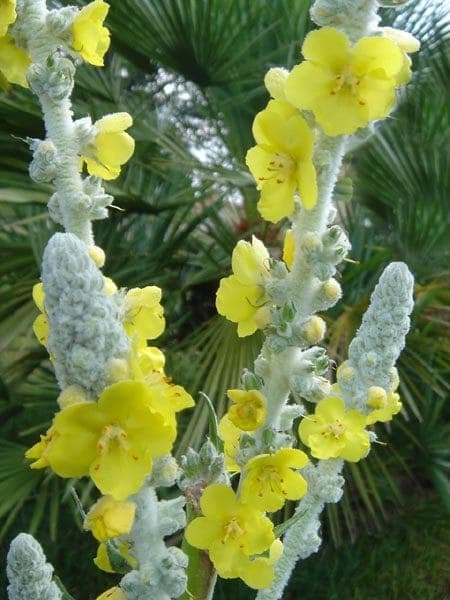
Ghislain118 http://www.fleurs-des-montagnes.net / CC BY-SA 3.0, via Wikimedia Commons
Giant Silver Mullein (Verbascum bombyciferum): complete guide
Verbascum bombyciferum
Want to see Giant Silver Mullein (Verbascum bombyciferum): complete guide in your garden?
Full design in HD: €7.99
Look after your Giant Silver Mullein with the GardenWorld app
Identify plants with your camera and get a care calendar with reminders for this plant.


Overview
Giant silver mullein (Verbascum bombyciferum) is impossible to miss. In its first year it makes a large, flat rosette of silvery white leaves so densely hairy that they feel like felt or soft wool. In its second year a thick, equally woolly flower spike rises from the centre to 1.5 to 1.8 m, studded with sulphur-yellow flowers. The species name bombyciferum means "silk-bearing", a nod to that silky coat of hairs.
The plant comes from north-western Turkey, from the mountains around Bursa, where it grows on dry, stony slopes. In gardens it is best known through the selection 'Polarsommer', also sold as 'Arctic Summer', which has even whiter foliage and spikes that can reach 2 m or more. Strictly speaking it is a biennial: once it has flowered and set seed, the parent plant dies. Thanks to its seedlings, though, it will stay in your garden for years.
This mullein is a dream for gravel gardens, dry borders and Mediterranean-style corners. It needs little water, no feeding and hardly any upkeep. Curious how such a silver showpiece would look in your own garden? On gardenworld.app you can have a garden design made that gives structural plants like Verbascum bombyciferum exactly the right spot.
Appearance and bloom cycle
The first-year rosette is ornamental in its own right. The oval leaves grow 30 to 50 cm long and the rosette can spread to about 60 cm. They persist through winter, so even in January you have a splash of silver in the border. After rain they can look a little bedraggled, but in dry weather they gleam.
In the second spring the flower spike grows from the heart of the rosette. It is usually unbranched or has a few side shoots near the base, and it is completely covered in white wool. From June into August the flowers open in succession. Each is about 3 cm across, sulphur yellow with a deeper orange-yellow centre and hairy stamens. Individual flowers last only a day, but new ones keep opening, so the spire stays yellow for weeks. Bees and bumblebees visit in large numbers, especially in the morning.
Verbascum bombyciferum is not known to be poisonous to people or pets. The hairs on leaves and stems can irritate sensitive skin, however, and the seeds contain saponins, so keep children from nibbling them.
Ideal location
This mullein wants full sun, as much as possible. At least six hours of direct sunlight a day is needed for a sturdy, upright spike. A south-facing bed, a gravel garden, the foot of a warm wall or a sloping bank are all ideal. In partial shade the stem becomes weak and leans, and the foliage stays greener and less woolly.
With its height and shape the plant acts as a vertical accent. Dot it among lower plants rather than setting it in a tight row. Allow 50 to 60 cm per plant for the rosette. On a very exposed site a mature spike may lean; a sheltered corner or an unobtrusive cane solves that.
Soil requirements
Poor, free-draining soil is the secret. Sand, gravel, chalk and stony ground are all fine, and the pH can be neutral to alkaline. Rich soil only produces weak, overly tall spikes that topple, and a shorter life.
On heavy clay, improve the ground generously with coarse grit and gravel, or plant on a raised bed. Water lying around the rosette in winter is fatal, because the woolly leaves rot. A layer of gravel around the plant keeps the rosette dry and stops soil splashing onto the leaves.
Free preview
Want to see Giant Silver Mullein (Verbascum bombyciferum): complete guide in your garden? Make a free preview of your design.
Watering
Water for a few weeks after planting to help the taproot get going. After that the plant is very drought tolerant. In an ordinary summer you will not need to water at all; only during long heatwaves in its flowering year can a drink help the spike.
Always water at the base and never over the rosette, as water lingers in the wool and can cause rot. In containers the plant needs a little more water, but let the compost dry out well between waterings.
Pruning
Hardly any pruning is needed. In spring, remove any dead or mouldy lower leaves from the rosette so air can circulate.
After flowering you have two options. Leave the spike standing and the plant will set seed and sow itself around; the parent then dies. Cut the spike off just above the rosette after the first flush, and it will sometimes produce new side shoots and live for an extra year. Many gardeners do both: one spike left for seed, the rest removed.
In May and June, keep an eye out for the caterpillars of the mullein moth (Cucullia verbasci). They are pale with yellow and black spots and can strip a plant in a few days. Pick them off by hand, or move them to a wild mullein further away.
Maintenance calendar
March–April: Clear dead leaves from around the rosette. Sow new plants in a tray of gritty compost if you like.
May–June: Flower spikes grow. Check for caterpillars. Plant seedlings out in their final positions.
June–August: Flowering. Water only during prolonged drought.
August–September: Decide whether to let seed ripen or cut the spike. Seedlings often appear around the old plant.
October–November: Thin out seedlings. Spread gravel around the rosettes to keep them dry.
December–February: Rest. Leave the rosettes alone.
To see what needs doing in the garden month by month, take a look at the plant calendar on gardenworld.app.
Winter hardiness
Verbascum bombyciferum is reliably hardy. The RHS gives it a rating of H6, meaning it tolerates temperatures down to roughly -20 °C. Across Britain the rosette comes through winter without protection.
As with many hairy-leaved plants, wet is the real problem. A rosette sitting in soggy soil for months, or smothered in rotting leaves from nearby trees, can rot away. So clear fallen leaves and make sure water drains away quickly. A pane of glass or a small cover is usually unnecessary, provided the soil is free-draining.
Companion plants
Silver leaves and yellow flowers suit other plants for dry, sunny places perfectly. Lamb's ears (Stachys byzantina) echoes the silver, woolly foliage at ground level. Lavender (Lavandula angustifolia) and Russian sage (Perovskia atriplicifolia) bring blue and purple that contrast beautifully with the yellow. Woodland sage (Salvia nemorosa) fills the gaps between rosettes with deep violet spikes.
For a wilder gravel garden, add Miss Willmott's ghost (Eryngium giganteum), which self-seeds just like the mullein. Grasses such as Stipa and a few sedums complete the picture. Avoid moisture-loving partners such as hostas or astilbes.
Final thoughts
Verbascum bombyciferum is a plant with real character: a silver rosette in year one, a woolly yellow candle in year two, and then a new generation of seedlings that pick their own spots. With full sun, lean soil and dry feet it needs almost no work. Let it seed freely, thin where necessary, and your gravel garden will gain fresh silver showpieces every year.
Frequently asked questions about Giant Silver Mullein
Is Giant Silver Mullein winter hardy?
Verbascum bombyciferum is reliably hardy. The RHS gives it a rating of H6, meaning it tolerates temperatures down to roughly -20 °C.
When and how do you prune Giant Silver Mullein?
Hardly any pruning is needed. In spring, remove any dead or mouldy lower leaves from the rosette so air can circulate.
How much water does Giant Silver Mullein need?
Water for a few weeks after planting to help the taproot get going. After that the plant is very drought tolerant.
Where does Giant Silver Mullein grow best?
This mullein wants full sun, as much as possible. At least six hours of direct sunlight a day is needed for a sturdy, upright spike.
What soil does Giant Silver Mullein need?
Poor, free-draining soil is the secret. Sand, gravel, chalk and stony ground are all fine, and the pH can be neutral to alkaline.

See it in your garden
See Giant Silver Mullein in your garden
One photo of your garden and a few questions. You see the result in about a minute.
Try it with a photoIdentify this plant in your own garden. Identify a plant
Similar plants
Lamb's-ear: complete guide
Stachys byzantina
Stachys byzantina, known as lamb's-ear or lamb's-tongue, is a hardy perennial from the mint family. This popular plant is especially valued for its soft, silvery-white hairy foliage and purple flowers.
English Lavender: complete guide
Lavandula angustifolia
Everything about English Lavender (Lavandula angustifolia): planting, pruning, care and overwintering. Practical tips for lush purple blooms.
Perovskia atriplicifolia: complete guide
Perovskia atriplicifolia
Russian sage is a semi-shrub with purple-blue flowers and grey-green foliage that blooms from July to October. Perfect for dry gardens and landscape design.
