
Rationalobserver / CC BY-SA 4.0, via Wikimedia Commons
Perovskia atriplicifolia: complete guide
Perovskia atriplicifolia
Want to see Perovskia atriplicifolia: complete guide in your garden?
1 minute, no credit card
Overview
Perovskia atriplicifolia, commonly called Russian sage, is an elegant semi-shrub that has been treasured by gardeners across Europe for decades. This plant originates from the dry mountain regions of Afghanistan and surrounding areas, where it has adapted to lean growing conditions. In contemporary gardens, it offers an ethereal quality with delicately branched foliage and long-lasting purple-blue flowers that bloom from July through October.
Beyond its aesthetic appeal, Russian sage is remarkably practical. It attracts bees, butterflies and beneficial insects, shows no invasive tendencies, and becomes extremely drought-tolerant once established. With heights of 90 to 150 cm and a fine, grey-green texture, it fits seamlessly into virtually any garden style from cottage to modern minimalist.
Appearance and Bloom
Russian sage develops a vase-shaped form with finely textured, grey-green leaves that are strongly aromatic. The foliage is narrow and lance-shaped, sometimes with a slightly woolly feel. When brushed, the leaves release a characteristic fragrance reminiscent of lavender.
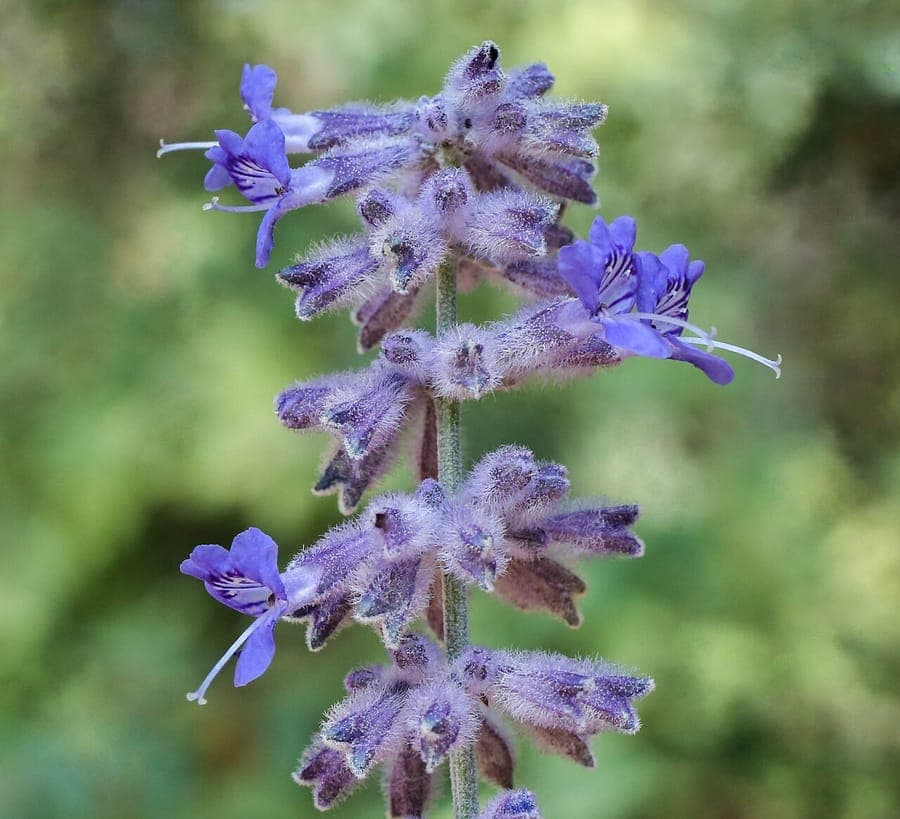
Flowers emerge in densely packed plumes displaying purple-blue to violet hues. The tubular blooms are highly attractive to pollen and nectar-seeking insects. A mature plant in full flower can carry eighty to one hundred flower spikes simultaneously, creating a misty, cloud-like effect that transforms gardens with its ethereal lightness.
Ideal Location
Russian sage is a sun lover that thrives with at least six hours of direct sunlight daily - ideally seven to eight hours. In heavier shade, plants become less compact and flower less profusely.
Ensure good air circulation. The plant dislikes being crowded against other dense shrubs, as this promotes moisture buildup. A location on a gently sloped terrace or raised bed is ideal. Summer and autumn breezes help keep plants dry and sturdy.
Soil Requirements
The key to success with Russian sage is well-draining soil. It thrives best on moderately lean, free-draining ground. Adding sand, gravel or pumice to standard garden soil helps roots avoid waterlogging. A pH between 6.0 and 7.5 is optimal, though the plant is not fussy.
Avoid heavy clay, waterlogged soils. Heavy ground can be lightened with shells, coarse sand and organic matter. For container culture, use a cactus mix or gritty universal compost, adding roughly 30 percent extra gravel for optimal drainage.
Watering
Once established (after the first growing season), Russian sage is exceptionally drought-tolerant. During the first year after planting, water regularly to keep soil slightly moist but never waterlogged. Two thorough waterings weekly in dry weather typically suffice.
Mature plants in normal years need virtually no supplementary water. Only during severe dry spells (three weeks or more without rain) should you water. Roots of Russian sage are deep and can access moisture from lower soil layers. Excess water is very harmful and causes root rot.
Free design
Want to see Perovskia atriplicifolia: complete guide in your garden? Make a free design now.
Pruning
Russian sage requires annual pruning to remain compact and full. The best time is early spring, around March, before new growth begins. Cut plants back by approximately one-third, or even to 20-30 cm height if severely leggy.
From this base, plants quickly regenerate with abundant branching and even richer flowering. Deadhead spent flowers throughout the season to encourage continued bloom. Leave dried stems standing through autumn and winter; they provide structural interest and protect new spring growth from frost.
Maintenance Calendar
March: Prune back to about one-third. April-May: Monitor growth, add loose gravel mulch in heavy soils. June-July: Water regularly during dry spells, first flowers appear. August-September: Peak bloom, pinch back spent flower heads. October-November: Flowering wanes, light tidying. December-February: Dormancy, no maintenance needed.
Winter Hardiness
Russian sage is extremely hardy in temperate climates, tolerating temperatures down to -20 degrees Celsius without damage. In severe winters, above-ground parts may die back, but roots typically regenerate in spring. Protection is only necessary in very cold regions or for young plants.
Good drainage during winter matters more than heat. Wet feet are far more damaging than cold. Plant in raised beds or use containers in very wet regions.
Companion Plants
Russian sage combines beautifully with other drought-tolerant plants: lavender, salvias, sedums, santolina and dwarf conifers. Ornamental grasses like festuca and artemisia create striking contrasts against Perovskia's fine texture. For color combinations, it works excellently with yellow flowers (Achillea 'Moonshine'), pink (Echinacea) or white blooms (Gaura).
Underplanting with groundcover sedums or silver-foliaged perennials is also highly effective.
Closing
Russian sage deserves a place in virtually every mixed border. Its elegant form, extended flowering period and low-maintenance nature make it one of the most valuable semi-shrubs for contemporary gardens. Once established, it requires minimal care yet delivers years of visual pleasure. Plant nursery-grown specimens in spring or early autumn for fastest results.
Procure plants from reputable nurseries and garden centers. In the UK and Europe, Russian sage is widely available. Experience the transformation Russian sage can bring to your garden - an almost cloud-like effect with shrubs full of life and color throughout the season!
Want to see Perovskia atriplicifolia: complete guide in your garden? Make a free design now.
Upload a photo, pick a style, and get a photorealistic design with plant list in under a minute.
No credit card required


Similar plants
Apple mint (Mentha x villosa): complete guide
Mentha x villosa
Meet apple mint (Mentha x villosa): a fruity-scented kitchen herb with woolly leaves, perfect for tea and mojitos.
Salvia peyronii: complete guide
Salvia peyronii
Discover Salvia peyronii, a rare Lebanese mountain sage. Growing tips, hardiness, and companion planting for a Mediterranean gravel garden.
Bigleaf mint (Mentha x rotundifolia): complete guide
Mentha x rotundifolia
Discover bigleaf mint: cultivation, care tips, and garden uses. Learn how to grow this aromatic herb with soft, hairy leaves.