
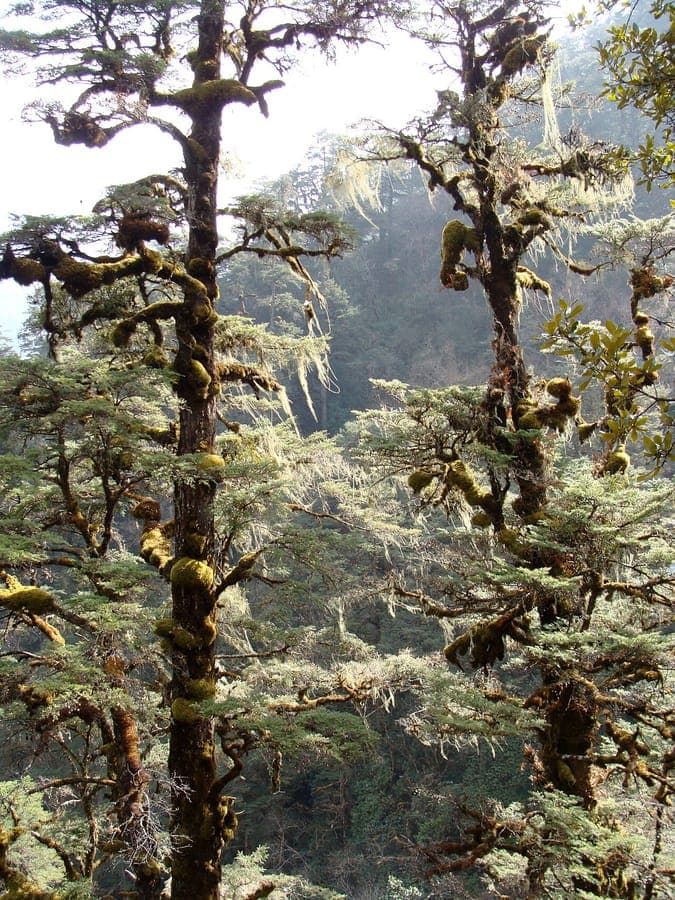
wonderlane on Flickr / CC BY 2.0, via Wikimedia Commons
Tsuga dumosa: complete guide
Tsuga dumosa
Want to see Tsuga dumosa: complete guide in your garden?
1 minute, no credit card
Overview
Tsuga dumosa, commonly called Himalayan hemlock or Yunnan hemlock, is an elegant, slow-growing conifer native to the Himalayan mountains and adjacent regions in China, Tibet, and Myanmar. This tree grows only 20-40 centimeters annually and eventually reaches 10-15 meters tall in garden conditions. With its delicate, drooping needles and relative winter hardiness, tsuga dumosa is ideal for sheltered garden corners, shaded zones, and subtle conifer accents.
In gardenworld.app designs, we employ tsuga dumosa for refined schemes where height and texture without aggression is desired. The tree offers year-round interest and tolerates shade better than many other conifers.
Appearance and Structure
Tsuga dumosa possesses very characteristic, fine, flattened needles with silvery-green undersides and dark green upper surface. Needles lie in two rows along branches, giving an elegant, feathery appearance. The branch form is initially dense and conical, later becoming more open with drooping twigs.
Branches initially grow upright but elegantly arch downward under their own weight. This creates an elegant, ornamental silhouette. Bark is grey-brown, smooth. Fruits (cones) are small, brown strobila approximately 1-2 centimeters long.
Height: eventually 10-15 meters (very slow-growing). Width: 6-8 meters. Growth rate: 20-40 centimeters annually.
Ideal Location
Tsuga dumosa thrives in dappled shade to light shade. Full sun is acceptable but can cause needle scorch in very hot summers. A sheltered spot with morning sun and afternoon shade is ideal.
Wind tolerance: moderate. This tree accepts sheltered sites better than very exposed locations. A position under existing trees or against a building's south side is ideal.
Soil moisture: tsuga dumosa accepts moist, sheltered habitats far better than dry, windy locations. A spot in the garden where gentle microclimates develop (near shrubs, under trees) promotes growth.
Soil Requirements
Tsuga dumosa thrives in deep, moisture-retentive soil with good drainage. pH 5.5 to 7.0 (acidic to neutral) is ideal. The tree accepts light clay better than heavy soils.
At planting, work in abundant organic matter (compost, leaf mold, conifer forest humus) to 40 centimeters depth. This significantly improves soil structure. Also add slow-release fertilizer (e.g., 8-8-8 NPK).
Known advantage: tsuga dumosa accepts acidic soils readily, making it suitable for locations beneath other conifers or where acidic humus mulch predominates.
Free design
Want to see Tsuga dumosa: complete guide in your garden? Make a free design now.
Watering
Tsuga dumosa requires regular water during the first two growing seasons. Water 1-2 times weekly, depending on rainfall. The tree thrives in soil that is consistently moist but not waterlogged.
Summer drought: in extremely dry summers, water more deeply and less frequently (once weekly) rather than shallow daily soakings. This promotes deep root development.
Once established (after 3 years), tsuga dumosa tolerates normal rainfall and requires supplemental water only during severe drought.
Pruning
Tsuga dumosa requires very minimal pruning. Remove only dead or damaged branches in early spring (March). This must be done carefully - this tree recovers slowly from major wounds.
Form pruning: if you want a more compact form, prune lightly in June (after growth sets). This promotes fullness. Avoid heavy pruning that damages tree form.
Inherent low-growing form: tsuga dumosa grows naturally narrow and elegant, requiring minimal shaping. Allow natural silhouette to unfold.
Maintenance Calendar
March: cut dead branches; check for winter damage. Apply slow-release fertilizer (8-8-8 NPK).
April-May: growth acceleration. Monitor for scale insects (very rare) and spider mites.
June-August: water regularly. Keep debris clear. Prune very lightly if shaping is needed.
September-October: reduce fertilization; prepare for winter dormancy.
November-February: dormancy. Check for trunk cracks from freezing.
Winter Hardiness
Tsuga dumosa is winter-hardy to approximately -15 degrees Celsius. In the Netherlands and Belgium, especially northern regions, winter protection may be needed for young trees.
Protection: in the first year, loosely wrap the trunk in burlap against snow damage and winter sun-scald. Also provide winter water (1-2 times in January/February) during dry periods.
In locations with very severe frost (below -20 degrees), young tsuga dumosa must be carefully protected or placed in sheltered locations.
Companion Plants
Pair tsuga dumosa with:
- Hydrangea quercifolia for large-leaf contrast
- Sarcococca for fragrant underplanting
- Ferns for textural layering
- Hosta for foliage-size contrast
- Helleborus for blooms beneath the tree
Closing Thoughts
Tsuga dumosa is an elegant, refined conifer for sheltered, shaded garden corners. Its fine needles, drooping twig structure, and slow growth make it ideal for subtle, natural designs. This tree deserves greater recognition in modern gardens. Order now from specialized tree nurseries.
Want to integrate tsuga dumosa into your shaded garden design? Use gardenworld.app and create an elegant Asian-inspired corner.
Want to see Tsuga dumosa: complete guide in your garden? Make a free design now.
Upload a photo, pick a style, and get a photorealistic design with plant list in under a minute.
No credit card required


Similar plants
Abies delavayi: complete guide
Abies delavayi
Delavayi fir is an elegant, medium-sized coniferous tree from the Pinaceae family with dark green needles. This Asian evergreen is perfect for alpine gardens and large landscapes.
Taiwan fir: complete guide
Abies kawakamii
Discover the magnificent Taiwan fir, a rare evergreen conifer from Taiwan's mountain regions. Learn growth requirements, care tips, and why this beautiful tree is perfect for collectors of unique garden specimens.
Farges fir: complete guide
Abies fargesii
Discover the majestic Farges fir, an impressive conifer from China's mountains with elegant foliage and columnar form. Ideal for large gardens.