Dinkum / CC BY-SA 3.0, via Wikimedia Commons
Wherry's foamflower (Tiarella wherryi): guide
Tiarella wherryi
Want to see Wherry's foamflower (Tiarella wherryi): guide in your garden?
Full design in HD: €7.99
Look after your Wherry's foamflower with the GardenWorld app
Identify plants with your camera and get a care calendar with reminders for this plant.


Overview
Tiarella wherryi is a foamflower from the woodlands of the southern Appalachians in the eastern United States. It takes its name from the American botanist Edgar Wherry, and its common name from the airy, frothy flower spires that hover above the leaves in late spring. Many botanists now treat it as a variety of the common foamflower, under the name Tiarella cordifolia var. collina, but Tiarella wherryi remains the name you will usually see in nurseries.
The key difference from Tiarella cordifolia lies in how it grows. The common foamflower produces surface runners and creeps quickly across the ground. Tiarella wherryi does not: it forms a neat, compact clump that widens slowly. That makes it ideal for small shade gardens, edges and containers, where a wandering ground cover would soon become too much.
Foamflowers belong to the saxifrage family (Saxifragaceae), alongside the closely related coral bells (Heuchera). Hybrids between the two genera are sold as Heucherella. On gardenworld.app you can have a garden design made in which foamflowers combine with ferns and hostas into a calm woodland border.
Appearance and bloom cycle
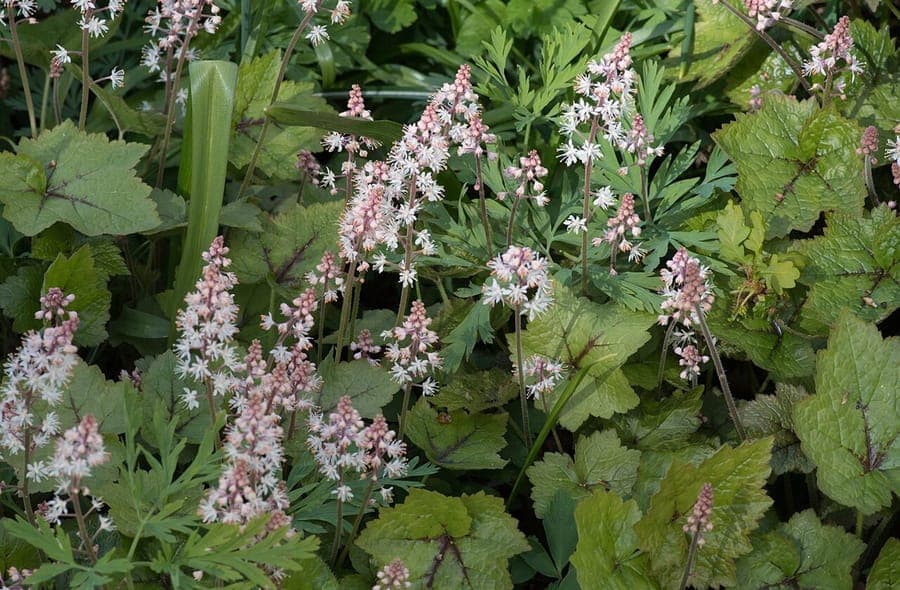
The plant forms a mound about 15 to 20 cm tall and 25 to 30 cm wide. The leaves are 5 to 10 cm across, three- to five-lobed and rather like small maple leaves. They are softly hairy and fresh green, with a striking dark purple to maroon pattern along the veins at the centre. In autumn the foliage turns bronze to wine red. In mild winters some leaves persist, so the plant is semi-evergreen.
From May into June, often with a smaller second flush into summer, flower spires 25 to 35 cm tall appear. The buds are pale pink, and the open flowers are small white stars with long stamens. Together they create the typical fluffy, foamy effect. The photo shows this beautifully: dozens of pink and white spires above lobed, dark-veined leaves, in a shade border among the finely cut foliage of other woodland plants.
The flowers are visited by early bees, hoverflies and bumblebees. No toxic compounds are known in foamflowers, though the plant is not edible either. As with any garden plant, it is sensible to keep pets from chewing it.
Ideal location
As a woodland plant, Tiarella wherryi is happiest in partial to light shade. A spot beneath deciduous trees or shrubs is ideal: early in spring light still reaches the clumps, while in summer the canopy shields them from strong sun. Morning sun is fine, but full afternoon sun scorches the leaf edges and dries the plant out.
It will grow in deep shade but flowers less freely there. Set plants 25 to 30 cm apart, allowing eight to ten per m² if you want a continuous carpet. Because it does not run, you can safely plant it right next to smaller spring flowers. In a 20 to 25 cm pot on a shady balcony it makes a rewarding feature.
Soil requirements
Foamflowers want a loose, humus-rich soil that stays moist without becoming waterlogged. Think of the ground in a broadleaved wood: a deep layer of rotted leaves over loam or sand. A slightly acidic to neutral pH of 5.5 to 7 is ideal. In heavy clay the crown soon rots in winter, so mix in plenty of leaf mould, compost and some coarse grit through the top 20 cm.
Plant the clump at the same depth as it sat in its pot. A mulch of 3 to 5 cm of leaf mould or fine bark keeps the soil cool and moist and closely imitates the natural leaf litter. Feeding is hardly needed: a thin layer of compost in spring is plenty.
Free preview
Want to see Wherry's foamflower (Tiarella wherryi): guide in your garden? Make a free preview of your design.
Watering
Tiarella wherryi needs evenly moist soil, especially while flowering and during its first year. Water young plants once or twice a week in dry spells, about 2 to 3 litres per clump. Established plants in well-mulched soil cope with short dry periods, but in longer droughts the leaf margins brown and flowering stops.
Water in the morning, at the base of the plant. Under trees, bear in mind that tree roots take up a great deal of moisture in summer. Check containers every other day in warm weeks. In winter the soil can be a little drier; wet feet in the cold months are more dangerous than a dry week in July.
Pruning
This foamflower needs very little pruning. Cut spent flower spires just above the foliage; this keeps the plant tidy and sometimes encourages a second flush. In early spring, around March, remove damaged or withered winter leaves so the new growth has room.
Every three or four years the centre of the clump becomes woody and bare. Divide it in April or September: lift the clump, gently tease it apart into pieces each with a few rosettes and good roots, and replant them in improved soil. In light soils frost can push the clumps up slightly over winter. Firm them back in spring and top up with leaf mould.
Pests and diseases are rare. As with heucheras, vine weevil grubs can eat the roots; limp plants that lift out of the ground without resistance are the telltale sign. Nematodes (Steinernema kraussei) applied in autumn or spring will deal with them.
Maintenance calendar
March: Remove damaged winter leaves, firm in any frost-lifted clumps and spread a thin layer of compost.
April: The best month for planting or dividing. Lay fresh mulch.
May-June: Full flower. Water in dry spells and remove faded spires.
July-August: The foliage is at its best. Keep the soil moist during heatwaves.
September: A second chance to divide or plant. Check for vine weevil and apply nematodes if needed.
October-November: Leaves turn bronze to red. Leave fallen tree leaves between the clumps as natural mulch.
December-February: Dormant period. Some foliage remains and adds a touch of colour to the winter garden.
For an overview of what you can do in your garden each month, the planting calendar on gardenworld.app is a handy guide.
Winter hardiness
Tiarella wherryi is reliably hardy, tolerating temperatures down to about -30 °C (USDA zone 4). In Britain and the Low Countries it needs no winter protection. In hard frost without snow cover the semi-evergreen leaves may brown, but the plant simply regrows in spring.
A bigger threat than cold is wet, cold soil. In poorly drained ground the crown rots in a wet winter. A well-prepared, humus-rich soil in a spot where rainwater does not linger matters more than any covering. Move containers against a wall and out of the rain for the winter.
Companion plants
The delicate spires and patterned leaves look lovely beside bold foliage. A blue-green hosta such as Hosta sieboldiana provides strong contrast, while the soft shield fern (Polystichum setiferum), with its finely divided evergreen fronds, reinforces the woodland feel. To cover a larger area, combine it with the common foamflower (Tiarella cordifolia), whose runners fill the gaps.
For early colour, Lenten roses (Helleborus orientalis) are ideal; once they fade, the foamflower takes over. Siberian bugloss (Brunnera macrophylla) flowers at the same time with sky-blue blooms, and together with the pink and white spires it makes a fresh spring pairing. Lily of the valley, corydalis and small bulbs such as snowdrops also suit this kind of woodland planting.
Final thoughts
Tiarella wherryi is a modest but thoroughly charming perennial for the shade garden. It forms tidy clumps, flowers generously with frothy pink and white spires and has handsomely marked leaves for most of the year. Give it a moist, humus-rich woodland soil and some protection from strong sun, and it will thrive for years with little effort. It is exactly the plant a dark corner or a strip beneath trees needs.
Frequently asked questions about Wherry's foamflower
Is Wherry's foamflower winter hardy?
Tiarella wherryi is reliably hardy, tolerating temperatures down to about -30 °C (USDA zone 4). In Britain and the Low Countries it needs no winter protection.
When and how do you prune Wherry's foamflower?
This foamflower needs very little pruning. Cut spent flower spires just above the foliage; this keeps the plant tidy and sometimes encourages a second flush.
How much water does Wherry's foamflower need?
Tiarella wherryi needs evenly moist soil, especially while flowering and during its first year. Water young plants once or twice a week in dry spells, about 2 to 3 litres per clump.
Where does Wherry's foamflower grow best?
As a woodland plant, Tiarella wherryi is happiest in partial to light shade. A spot beneath deciduous trees or shrubs is ideal: early in spring light still reaches the clumps, while in summer the canopy shields them from strong sun.
What soil does Wherry's foamflower need?
Foamflowers want a loose, humus-rich soil that stays moist without becoming waterlogged. Think of the ground in a broadleaved wood: a deep layer of rotted leaves over loam or sand.

See it in your garden
See Wherry's foamflower in your garden
One photo of your garden and a few questions. You see the result in about a minute.
Try it with a photoIdentify this plant in your own garden. Identify a plant
Similar plants
Tiarella cordifolia: complete guide
Tiarella cordifolia
Discover heart-leaf foamflower (Tiarella cordifolia), the elegant groundcover with distinctive heart-shaped leaves and frothy spring blooms. Care, placement, and growing tips.
Hosta sieboldiana: complete guide
Hosta sieboldiana
Hosta sieboldiana growing guide: large blue-green shade plant from Japan. Complete care tips, placement and maintenance for shady gardens and woodland areas.
Soft shield-fern: complete guide
Polystichum setiferum
How to grow and care for Polystichum setiferum in your garden. Ideal for shady borders, with soft, arching fronds and year-round interest.
