
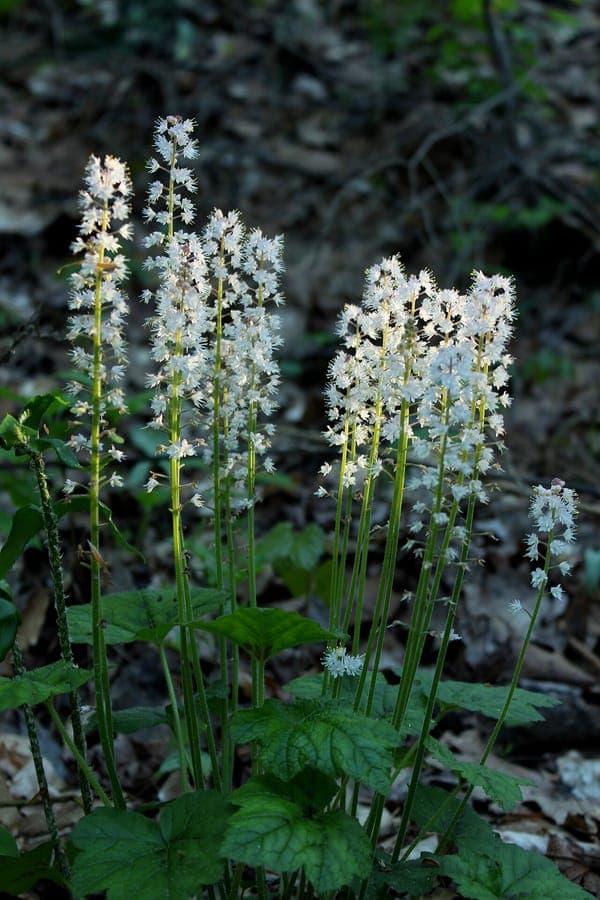
Wasrts / CC BY-SA 4.0, via Wikimedia Commons
Tiarella cordifolia: complete guide
Tiarella cordifolia
Want to see Tiarella cordifolia: complete guide in your garden?
1 minute, no credit card
Overview
Tiarella cordifolia, commonly called heart-leaf foamflower, is an elegant shade groundcover native to the eastern United States. This delicate plant earns its name from the frothy, foam-like flower clusters that emerge in spring. With distinctive heart-shaped leaves and excellent cold tolerance, tiarella cordifolia is an indispensable choice for shaded garden corners.
This species thrives exclusively in deciduous woodland understory, where it colonizes acidic, humus-rich soils. In gardenworld.app designs, we recommend tiarella cordifolia for naturalistic planting schemes because it adds organic texture and soft color accents without fuss.
Appearance and Bloom
The heart-shaped leaves of tiarella cordifolia form dense rosettes; many cultivars display burgundy or purple veining throughout the growing season. Mature plants reach 20 to 30 centimeters tall. Flowers emerge in April and May as slender spires with tiny white or pale pink florets that appear distinctly frothy and cloud-like.
The leaf texture is fine and triangular with serrated margins; they possess a slightly wrinkled character that creates dynamic shadow patterns. Mature plants can spread 40 to 60 centimeters across in ideal conditions.
Ideal Location
Tiarella cordifolia thrives in part shade to full shade. This is essential because full sun in temperate climates can cause leaf bleaching and desiccation. Placement beneath deciduous trees is ideal, where dappled light and moist microclimate converge.
In gardenworld.app designs, we position tiarella cordifolia beneath eaves, along north-facing walls, and under pergolas. The plant tolerates brief periods of direct sunlight (up to 2 hours daily), though flowering and leaf color diminish.
Regarding hardiness: tiarella cordifolia is winter-hardy to -20 degrees Celsius, making it suitable for northern regions throughout the Netherlands and Belgium.
Soil Requirements
Soil must be moisture-retentive yet well-draining. Acidic to neutral pH (5.5 to 7.0) is ideal. At planting, incorporate abundant organic matter (compost, leaf mold, or aged manure) throughout the planting hole. This improves soil structure and water-holding capacity.
This plant fails in compacted clay or permanently waterlogged ground. If your garden is heavy clay, raise the planting site 10 to 15 centimeters and amend thoroughly with humus-rich materials.
Key advantage: tiarella cordifolia succeeds in locations where traditional groundcovers struggle, such as beneath conifers where acidic humus layers predominate.
Free design
Want to see Tiarella cordifolia: complete guide in your garden? Make a free design now.
Watering
At planting time (March-May), water more frequently: at least twice weekly unless rainfall is adequate. Once established (after 3 to 4 months), the plant tolerates drier periods, though consistently moist soil remains preferred.
During summer, especially in prolonged drought, water deeply but infrequently (once or twice weekly) rather than shallow daily soakings. Drip irrigation is ideal because it keeps foliage dry and minimizes fungal disease.
In winter (December-February), water sparingly; only increase moisture if conditions are persistently dry.
Pruning
Tiarella cordifolia requires minimal pruning. Remove dead leaves in early spring (March) and cut back flower spikes after blooming finishes (June). This promotes compact growth and prevents unwanted self-seeding.
If plants become dense after several years, thin lightly in March/April by carefully removing older leaf-rosettes at the base. This improves air circulation and prevents powdery mildew.
For winter pest damage (slugs, insects): simply remove damaged leaves; tiarella cordifolia recovers quickly.
Maintenance Calendar
March: remove winter mulch, clear dead foliage, tidy edges. Apply balanced organic fertilizer (bloom-focus 2-8-4).
April-May: peak flowering. Water regularly if no rain. Monitor for aphids and spider mites.
June: cut back spent flower spikes after blooming ends. Decide whether to allow self-seeding or remove developing seedlings.
Summer (July-August): water deeply but less frequently during dry spells. Maintain 3-5 centimeters of mulch to retain moisture.
Autumn (September-October): reduce watering; plants become dormant.
Winter (November-February): no fertilization required. Ensure soil never completely dries during frost-free periods.
Winter Hardiness
Tiarella cordifolia is fully winter-hardy throughout the Netherlands and Belgium, withstanding temperatures to -20 degrees Celsius. No winter protection is necessary. Evergreen foliage remains ornamental year-round.
During extreme cold spells (below -25 degrees Celsius), apply a 5-centimeter mulch layer as a precaution.
Companion Planting
Pair tiarella cordifolia with:
- Heuchera (alumroot) for contrasting foliage color
- Helleborus (Christmas rose) for early season interest
- Carex oshimensis (Japanese sedge) for vertical accent
- Ferns for fine-textured layering
- Hosta for larger-leaf contrast
- Astilbe for feathery blooms and shade tolerance
Closing Thoughts
Tiarella cordifolia is a true classic for shade-filled gardens. Its heart-shaped leaves, frothy spring flowers, and minimal care requirements make it indispensable in contemporary front yard designs. Whether you have a woodland garden or shaded moist zone, tiarella cordifolia offers elegance without fuss. Order now from Intratuin or Gamma and enjoy this groundcover's beauty this season.
Want a complete planting design featuring tiarella cordifolia? Design your front yard free via gardenworld.app and receive personalized plant recommendations.
Want to see Tiarella cordifolia: complete guide in your garden? Make a free design now.
Upload a photo, pick a style, and get a photorealistic design with plant list in under a minute.
No credit card required


Similar plants
Korean astilbe: complete guide
Astilbe grandis
Discover Korean astilbe (Astilbe grandis): a tall shade plant with elegant flower plumes for pond edges and borders.
Heuchera pilosissima: complete guide to seaside alumroot
Heuchera pilosissima
Seaside alumroot (Heuchera pilosissima), an elegant North American dwarf perennial with hairy red-tinged foliage and red flower spikes.
Starry saxifrage: complete guide
Micranthes stellaris
Full guide to Micranthes stellaris, the starry saxifrage: location, soil, blooming and garden use. A tough alpine plant for moist, shady rock faces and pond margins.